


Key Takeaways
- Art therapy is a mental health discipline led by a master’s-level trained art therapist, in which image-making inside a therapeutic relationship helps clients express and integrate experience. Artistic skill is irrelevant.
- Image-making reaches material that talk therapy circles, including trauma stored in sensory memory without words, and it flanks the defenses of highly verbal adults who can narrate their story fluently and feel nothing.
- A session usually moves from a clinically chosen prompt and materials, to fifteen to twenty-five minutes of mostly quiet making, to a conversation where the client interprets and the therapist guides the looking.
- It tends to fit the over-verbal, trauma held below words, early recovery when feelings are hard to name, and grief or shame too heavy to say directly.
- The research base is real and growing but less standardized than first-line treatments, so it works as an adjunct alongside approaches like CPT and EMDR rather than a replacement.
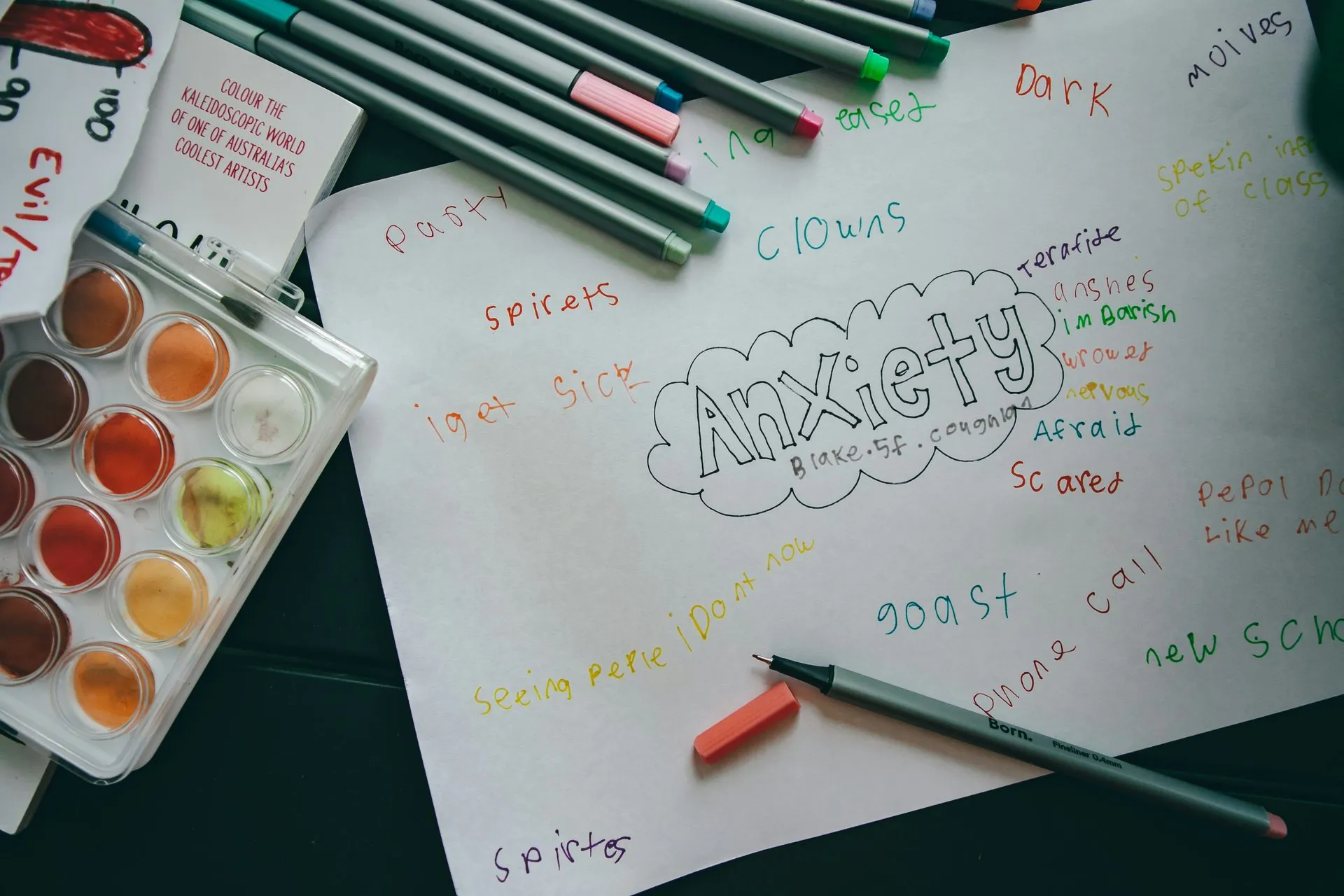
Somewhere in most adults’ heads is a construction-paper memory that makes art therapy sound unserious: glitter, glue, a nice hour of crafts between the real treatment. It is the most underestimated modality we offer, and the underestimation has a cost, because the clients who dismiss it fastest, the articulate, defended, verbally skilled ones, are frequently the clients it would reach deepest. Art therapy is not about making art. It is about accessing what talking cannot reach, through a channel that predates your defenses.
Here is the actual clinical case for it: what a credentialed art therapist really does, why the modality reaches material that talk therapy circles for months, what a session looks like when nobody is grading the drawing, and who it fits.
Art therapy: a mental health discipline in which a master’s-level trained art therapist uses the process of image-making, drawing, painting, collage, clay, inside a therapeutic relationship, to help clients express, examine, and integrate experience. The clinical material is the process and the conversation around it. Artistic skill is irrelevant, and no one is evaluating the product.
Why Making Beats Talking, for Certain Material
Verbal therapy runs through the brain’s language systems, which is precisely its limitation for certain kinds of material. Traumatic experience is encoded heavily in sensory and emotional memory, image, body state, fragment, and some of it simply does not have words attached, which is why trauma survivors so often say I can’t explain it. Meanwhile, highly verbal adults have a second problem: language is where their defenses live. A person who has narrated their story a hundred times can talk about their childhood fluently, at a perfect analytical distance, forever.
Image-making flanks both problems. Asked to draw the feeling instead of describe it, the fluent narrator has no rehearsed material; whatever comes out came from somewhere less defended. And the wordless material, the sensation, the fragment, the thing that happened before the age words worked, can arrive on paper without needing a sentence first. The art externalizes it: the fear is now over there, on the table, at a viewing distance, where the client and therapist can look at it together instead of the client drowning in it alone. That move, from inside me to in front of us, is the modality’s core mechanism, and it is the same externalization that makes parts work and body-based approaches effective for material that discussion alone cannot budge.
What a Session Actually Looks Like
A directive, usually: not draw whatever you want, but a clinically chosen prompt. Draw the craving. Make an image of where you are in your recovery and where the exits are. Build the safe place. Draw the wall between you and your father. The therapist chooses the prompt, and the materials, the way any clinician chooses an intervention: deliberately. Even the medium is clinical: pencil offers control for the client who needs it, watercolor refuses control for the client who needs to practice losing some, clay engages the hands and the body for the client who lives in their head.
Then the making, usually in quiet, usually fifteen to twenty-five minutes. Then the part people do not expect: the conversation, which is where the therapy concentrates. Not the therapist decoding your symbols like a fairground psychic; credentialed art therapists are trained specifically not to do that. Instead: what do you notice? What surprised you? Tell me about this corner you pressed so hard the paper dented. The client interprets; the therapist guides the looking. People routinely say more in ten minutes about their drawing than in three sessions about their life, because they are technically talking about a piece of paper, and the distance is exactly what makes the honesty affordable.
The session
How an art therapy hour typically moves
The shape varies with the client and the work; this is the common rhythm.
The prompt
A directive chosen for your treatment goals, with materials matched to what the work needs: control, release, or embodiment. No skill expected, and the therapist means that.
The making
Focused, mostly quiet creation. The state itself is clinical: absorbed, regulated, defenses idling. What shows up on the page shows up from underneath the rehearsed story.
The looking
Client and therapist examine the image together. You interpret; the therapist guides attention. The externalized material gets named, connected to the life, and folded into the treatment plan.
The images accumulate into something no verbal therapy produces: a visible record. Clients reviewing week one’s drawing beside week ten’s can see their own change, in their own hand.
Not Arts and Crafts: The Credential Behind the Easel
The distinction that sorts this field: art therapy is a regulated discipline with graduate-level training. A credentialed art therapist holds a master’s degree in art therapy, coursework in psychological development, clinical practice, and ethics included, plus supervised clinical hours, with board certification through the Art Therapy Credentials Board. That training is what separates a clinical session from a coloring hour: knowing which directive serves which treatment goal, how to work with what emerges without wild interpretation, and when the material surfacing on the page needs containing rather than exploring. Our art therapy is delivered by a clinician holding exactly that master’s-level art therapy training, alongside somatic credentials, which is a combination built for trauma work. Activity groups where clients paint while chatting have their place in treatment settings; they are not this, and a program should be able to tell you which one it is offering.
Trauma-Informed Care
Skeptical is a fine starting condition; most of our art therapy converts were.
Who It Tends to Fit
The over-verbal. The attorney, the executive, the therapist-as-client: people whose language skill has become a moat. The page does not negotiate, a dynamic familiar from our professional program.
Trauma held below words. Early trauma, preverbal material, and the fragments that never organized into a story can reach paper before they can reach a sentence, which is why art therapy sits naturally beside CPT and EMDR in a trauma plan rather than competing with them.
Early recovery’s unnameable weather. Newly sober clients often cannot yet name what they feel; decades of using meant decades of not practicing. Drawing the feeling builds the emotional vocabulary that the first months demand, and the finished images give group work in our IOP something concrete to gather around.
Grief, shame, and the things too heavy to say to a face. Some disclosures happen sideways or not at all. An image can carry them into the room at a survivable angle.
The caveats are modest: perfectionism about the product is common early and is itself workable material, and acute crisis calls for stabilization before exploratory work of any kind.
What the Evidence Shows, Honestly
Applying our usual standard: art therapy’s research base is real and growing, with studies showing reductions in trauma symptoms, anxiety, and depression across clinical populations, and it is younger and less protocol-standardized than front-line treatments, which makes large uniform trials harder to run and the meta-analytic picture more mixed. So it holds the same position here as our other experiential modalities: an adjunct that earns its place clinically, alongside first-line treatment, chosen by assessment. In practice, its most defensible claim is also its most observable one: it reliably gets unreachable material into the room, and what is in the room, the rest of the treatment plan can work with. The full modality description lives on our art therapy page.
Heights Behavioral Health is a private-pay practice. We are out of network with insurance and provide superbills you can submit for possible out-of-network reimbursement. How superbills work.
Crisis notice. Heights Behavioral Health provides scheduled outpatient care and is not an emergency or crisis service. This page is general information, not medical advice. If you are in crisis, call or text 988. If someone is in immediate danger, call 911.
Frequently Asked Questions
I genuinely cannot draw. Will this be humiliating?
Skill is truly irrelevant, and the therapist is not being polite when they say so. Stick figures carry clinical material as well as fine draftsmanship, sometimes better, because there is less performance in the way. Nobody grades, displays, or critiques anything, and many clients find that the low-stakes making is the first place in years they have done something without being evaluated.
Will the therapist analyze my drawings and tell me what they mean?
No. Wild symbol-decoding is specifically what graduate training teaches art therapists not to do. You are the authority on your image; the therapist’s craft is asking the questions that help you see what you put there. Interpretation imposed from outside is a red flag in this field, here or anywhere.
Is art therapy a replacement for regular therapy?
At Heights it runs as one modality inside a full plan: individual therapy, group work, family programming, and psychiatry where indicated. For some clients it becomes the channel where the deepest work happens; it still happens alongside, not instead of, the evidence-based core of treatment.
What happens to what I make?
Your images are treated as clinical material with the same confidentiality as anything you say, stored or kept by you as you and your therapist agree. Many clients keep them; reviewing early images months later is one of the more powerful progress reviews treatment offers.
Some things reach paper before they reach words. Confidential assessment with a licensed clinician. Call (877) 549-5102 or request a callback.
Sources
- American Art Therapy Association (AATA). About Art Therapy; Education Standards. arttherapy.org
- Art Therapy Credentials Board (ATCB). Credentials and Requirements. atcb.org
- Schouten, K. A., et al. The Effectiveness of Art Therapy in the Treatment of Traumatized Adults: A Systematic Review. Trauma, Violence, and Abuse.
- Malchiodi, C. A. Handbook of Art Therapy. Guilford Press.
Written and Reviewed by Licensed Clinicians
Joni Ogle is a Licensed Clinical Social Worker (LCSW) and Certified Sex Addiction Therapist (CSAT) with over 37 years of clinical experience in mental health and addiction recovery, dual diagnosis treatment, behavioral addictions, and family intervention. She is the founder of Heights Behavioral Health and Heights Mentoring in Houston, Texas, where she leads a team of licensed clinicians.
Texas LCSW #37376 · Verify license
Deborah Darnell-Drake, LCSW-S, ACSW, LMFT is the Chief Clinical Officer at Heights Behavioral Health and a clinical reviewer. With more than five decades of experience in mental health and substance use disorder treatment, Deborah specializes in addiction, co-occurring mental health conditions, family dynamics, and behavioral addictions including gambling and technology addiction.
Texas LCSW-S #14508 · LMFT #1125 · Verify license
Start a Confidential Conversation
One confidential message connects you with our admissions team and a clear next step. Prefer to talk now? Call (877) 549-5102.