




Key Takeaways
- A therapy intensive condenses more clinical hours into a shorter window, such as an extended session of several hours, instead of one hour a week.
- Weekly therapy suits most people. Intensives help when progress has stalled, when trauma work needs more time in one sitting, or when a schedule makes weekly attendance hard.
- At Heights, extended, intensive sessions are available within Individualized Intensive Programming when they fit a person’s needs. They are offered case by case, not as a separate retreat-style program.
- IIP itself is our individualized flagship: the clinical intensity of PHP or IOP, built around one person, with recovery mentoring woven into every phase.
- A clinical assessment decides the format. More hours are not always better, and pacing matters most in trauma work.
A therapy intensive packs more clinical work into a shorter window, such as an extended session of several hours, rather than spreading it across months of one-hour weekly appointments. Weekly therapy fits most people. Intensives can help when progress has stalled, when trauma work needs more time in one sitting, or when life makes weekly attendance hard. At Heights Behavioral Health, extended, intensive sessions are available within our Individualized Intensive Program (IIP) in Houston when they fit a person’s needs. This guide explains the difference, who benefits, and how IIP builds the right format around one person.
People reach this page two ways. Either someone recommended a more intensive program and you are trying to understand what that means, or you have watched standard outpatient care fall short and you are looking for the missing layer. Both paths end at the same question: what makes Individualized Intensive Programming different, and is it the right level of care?
After more than 37 years of clinical work, most of it here in Houston, here is my honest answer. The structure of a program often matters as much as the therapy inside it. When the plan is built around the person, treatment holds. When the person is forced into a plan that was set before anyone met them, the real problems get missed. This guide explains how IIP works, who it helps, what it costs, and when a different level of care is the better call.
What Is a Therapy Intensive?
A therapy intensive is a concentrated block of treatment. Instead of a 50-minute session once a week, you and your clinician work for an extended period, often several hours in one day or across consecutive days, on one focused goal. Intensives are most often used for trauma work, where getting into the material and all the way back out in the same sitting can be safer and more effective than stopping at the 50-minute mark, and for people whose travel or work schedules make weekly appointments unrealistic.
Intensive therapy is not the same as a higher level of care. A partial hospitalization program or an intensive outpatient program delivers many hours a week through groups and individual sessions on a schedule. An intensive is about the depth and length of the individual session itself.
Therapy Intensives vs Weekly Therapy: The Differences
| Feature | Weekly therapy | Therapy intensive |
|---|---|---|
| Session length | About 50 minutes | Several hours, sometimes across more than one day |
| Pace | Steady, with time to practice between sessions | Concentrated, with less time between sessions to apply new skills |
| Best for | Most people, ongoing support, skills that build over time | Focused goals such as a specific trauma memory, or a stalled course of therapy |
| Common therapies | CBT, DBT, ACT, EMDR, CPT, Somatic Experiencing | EMDR, CPT, and Somatic Experiencing, paced carefully |
| Risks | Slow progress if the fit is wrong | Moving faster than the nervous system can tolerate, which is why pacing and clinician judgment matter |
| At Heights | Individual therapy, available in person and virtually | Extended sessions within IIP, case by case, when clinically appropriate |
Who Benefits From a Therapy Intensive?
- People doing intensive trauma therapy. EMDR and CPT often go deeper when a session has room to finish what it starts.
- People whose weekly therapy has stalled. A concentrated block can break a pattern that months of weekly sessions have not shifted.
- Professionals and travelers. Someone who cannot attend every week may do better with longer, less frequent sessions.
- People stepping down from a higher level of care. Extended sessions can bridge the gap between full-day programming and weekly therapy.
Intensives are not right for everyone. When someone is in acute crisis, newly sober, or not yet stable enough to tolerate extended trauma work, slower is safer. That judgment is made in a clinical assessment, not by preference.
How Heights Offers Intensive Individual Therapy
We do not run a separate retreat-style intensive program. Instead, extended, intensive sessions are offered within Individualized Intensive Programming when they fit a person’s needs and the clinical team agrees they are appropriate. Because IIP is built around one person rather than a fixed schedule, the week can include a longer EMDR or Somatic Experiencing session when that is the right tool, surrounded by the structure, psychiatric coordination, and recovery mentoring that make the work hold. The rest of this guide explains how IIP is built.
What Is Individualized Intensive Programming?
IIP is outpatient treatment, which means you live at home or in sober living and come in for programming. What sets it apart is how the plan is assembled. After a thorough clinical assessment, your team designs the week from the elements that match your situation, and adjusts as you stabilize.
- Builds the week around the assessment. Individual therapy, group work, family sessions, and psychiatric coordination are combined in the amounts you actually need, not a template.
- Treats co-occurring conditions together. Heights Behavioral Health treats adults with substance use, mental health, and dual diagnosis, so anxiety and the drinking it drives are handled in one plan, by a team that communicates. Our guide to dual diagnosis treatment in Houston explains why that matters.
- Paces trauma work carefully. When trauma is part of the picture, it is addressed at a safe pace rather than rushed because the calendar said so.
- Adjusts as you go. If something works, we do more of it. If a group is not the right fit, we change it. That responsiveness is hard to get in a fixed program.
- Coordinates step-downs and referrals. IIP is not residential treatment and not medical detox. When detox is needed first, we help coordinate that referral before programming begins.
IIP vs PHP vs IOP: How Do They Differ?
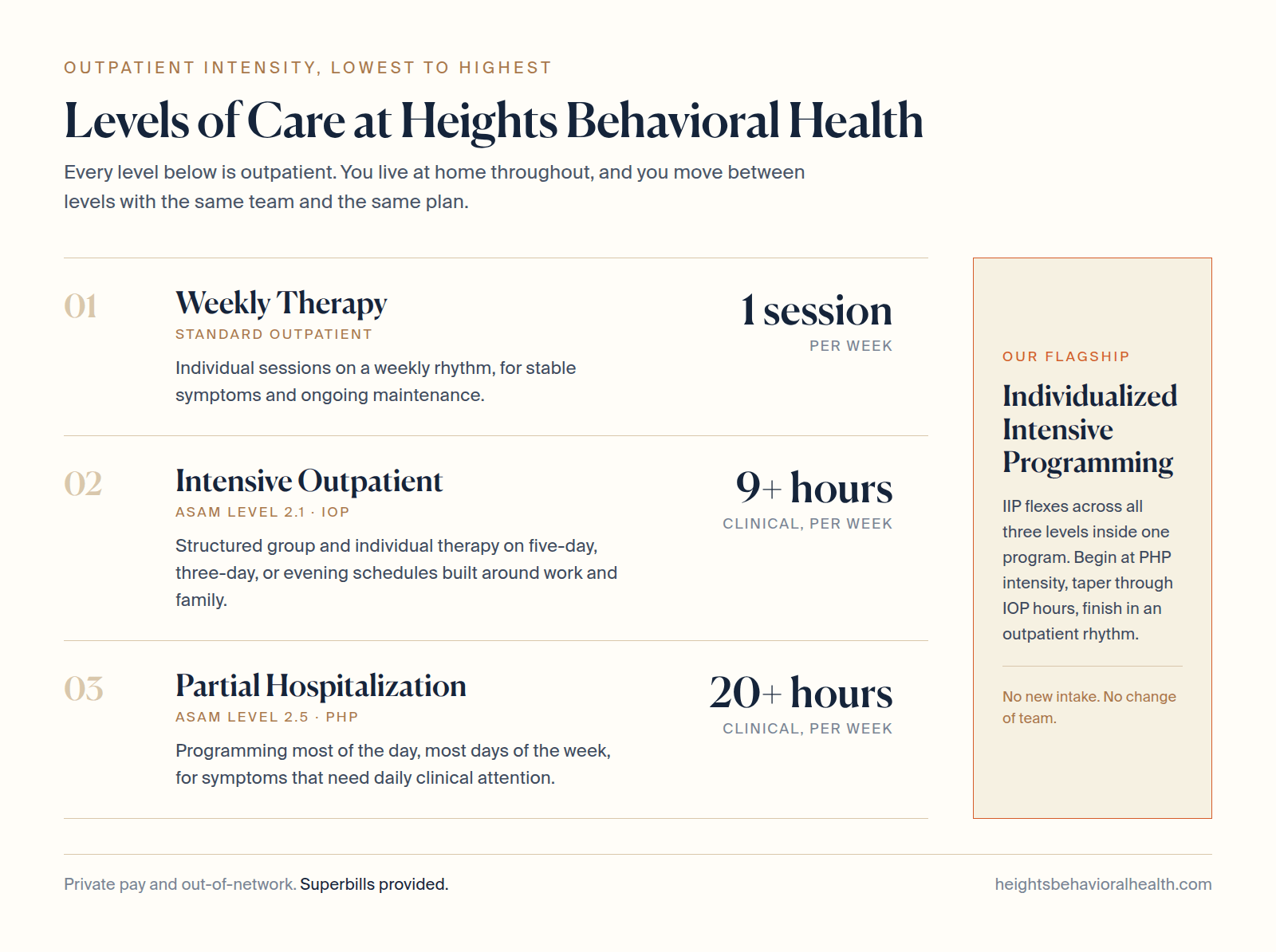
Partial hospitalization (PHP) and intensive outpatient (IOP) are defined mostly by hours per week. Individualized Intensive Programming is defined by personalization, and it can be delivered at PHP or IOP intensity depending on what you need. For a fuller breakdown of hours and structure, see our guide to choosing between PHP and IOP in Houston.
| Feature | Standard PHP / IOP | Individualized Intensive Programming |
|---|---|---|
| Schedule | Fixed group schedule set in advance | Weekly plan built around the individual |
| Focus | One shared curriculum for the whole group | Personal goals, history, and pace drive the plan |
| Co-occurring care | Often treated separately or referred out | Substance use and mental health treated together |
| Family involvement | Optional or limited | Built in when it helps the client |
| Best for | Adults who fit a standard structure | Adults who need care shaped around them |
Confidential Next Step
Not sure which level of care fits?
A short, confidential call is usually enough to point you in the right direction. Our Houston admissions team can talk through your situation and what IIP would look like for you.
Who Does Individualized Intensive Programming Help Most?
- Adults stepping down from residential or hospital care. IIP keeps the personalized attention people had in residential treatment while they reintegrate into daily life. This is the same logic behind continuing care after residential treatment.
- People with a substance use issue and a mental health condition. When anxiety, depression, or trauma sits underneath the substance use, treating only one rarely holds.
- Adults who found standard outpatient care too generic. If a one-size group program did not fit, a plan built around you often does.
- Professionals who need discretion and flexibility. Work, family, and privacy considerations can be built into the schedule rather than fought against.
- Families who need a clear next step. If a loved one needs non-clinical, lower-acuity support instead of treatment, our sister practice Heights Mentoring may be the better starting point, and we will help you decide.
What Does a Week of IIP Look Like?
No two plans are identical, which is the point. A typical week might combine individual therapy two or three times, a small number of focused groups, a family session, and coordination with a prescriber if medication is part of your care. As you stabilize, intensity tapers on a schedule that fits your progress rather than a fixed end date.
When Is IIP Not the Right Fit?
Honesty about limits is part of good care. Someone in an acute medical or psychiatric crisis needs a higher level of care first, and we will say so on the first call. Someone who is stable and doing well on weekly therapy may not need this intensity. A clinical assessment is the most reliable way to tell the difference, and we will point you to the right level of care even when it is not ours.
Heights Behavioral Health is a private-pay, out-of-network provider, and we are clear about pricing before you commit to anything. See how cost and out-of-network benefits work.
If this is an emergency or you are thinking about harming yourself, call 911, or call or text 988 to reach the Suicide and Crisis Lifeline. In Harris County, The Harris Center operates a 24-hour crisis line at 713-970-7000. Heights Behavioral Health is an outpatient program and is not a 24-hour crisis service.
Frequently Asked Questions
What is intensive therapy?
Intensive therapy means more clinical time in a shorter window, such as an extended session of several hours focused on one goal, often trauma work. It is different from an intensive outpatient program, which delivers many hours a week through groups and individual sessions.
Does Heights offer therapy intensives?
Extended, intensive sessions are available within Individualized Intensive Programming when they fit a person’s needs and are clinically appropriate. We do not run a separate multi-day retreat-style program.
Are therapy intensives better than weekly therapy?
Neither is better in general. Weekly therapy suits most people. Intensives help with focused goals, stalled progress, or schedules that make weekly attendance hard. Pacing matters, especially in trauma work, and a clinical assessment decides the format.
Is Individualized Intensive Programming the same as PHP or IOP?
Not exactly. PHP and IOP describe how many hours of programming you attend each week. IIP describes how the plan is built, fully around the individual, and it can be delivered at PHP or IOP intensity. The difference is personalization, not just hours.
Do I live at the facility during IIP?
No. IIP is an outpatient program, so you live at home or in sober living and come in for scheduled programming. It is not residential treatment, and it is not medical detox. If you need detox first, we help coordinate that referral.
Does Heights Behavioral Health take insurance for IIP?
We are private pay and out of network, and not in network with any plan. Because IIP flexes across PHP-level, IOP-level, and outpatient hours, we explain how the cost moves with the intensity before you begin. Superbills are available if your plan has out-of-network benefits.
Can IIP treat both addiction and a mental health condition?
Yes. Heights Behavioral Health treats adults with substance use, mental health, and co-occurring conditions. IIP is designed to address both in one coordinated plan rather than sending you to separate providers who do not communicate.
How do I know if IIP is right for me or my loved one?
A clinical assessment is the most reliable way to tell. Call us at (877) 549-5102 for a confidential conversation. If a different level of care fits better, we will say so and help you find it.
Care Built Around You, Not a Schedule
If you are weighing treatment for yourself or someone you love, one confidential call is enough to understand whether Individualized Intensive Programming is the right fit, and what the next step looks like.
Sources
Written and Reviewed by Licensed Clinicians
Joni Ogle is a Licensed Clinical Social Worker (LCSW) and Certified Sex Addiction Therapist (CSAT) with over 37 years of clinical experience in mental health and addiction recovery, dual diagnosis treatment, behavioral addictions, and family intervention. She is the founder of Heights Behavioral Health and Heights Mentoring in Houston, Texas, where she leads a team of licensed clinicians.
Texas LCSW #37376 · Verify license
Deborah Darnell-Drake, LCSW-S, ACSW, LMFT is the Chief Clinical Officer at Heights Behavioral Health and a clinical reviewer. With more than five decades of experience in mental health and substance use disorder treatment, Deborah specializes in addiction, co-occurring mental health conditions, family dynamics, and behavioral addictions including gambling and technology addiction.
Texas LCSW-S #14508 · LMFT #1125 · Verify license
Start a Confidential Conversation
One confidential message connects you with our admissions team and a clear next step. Prefer to talk now? Call (877) 549-5102.