


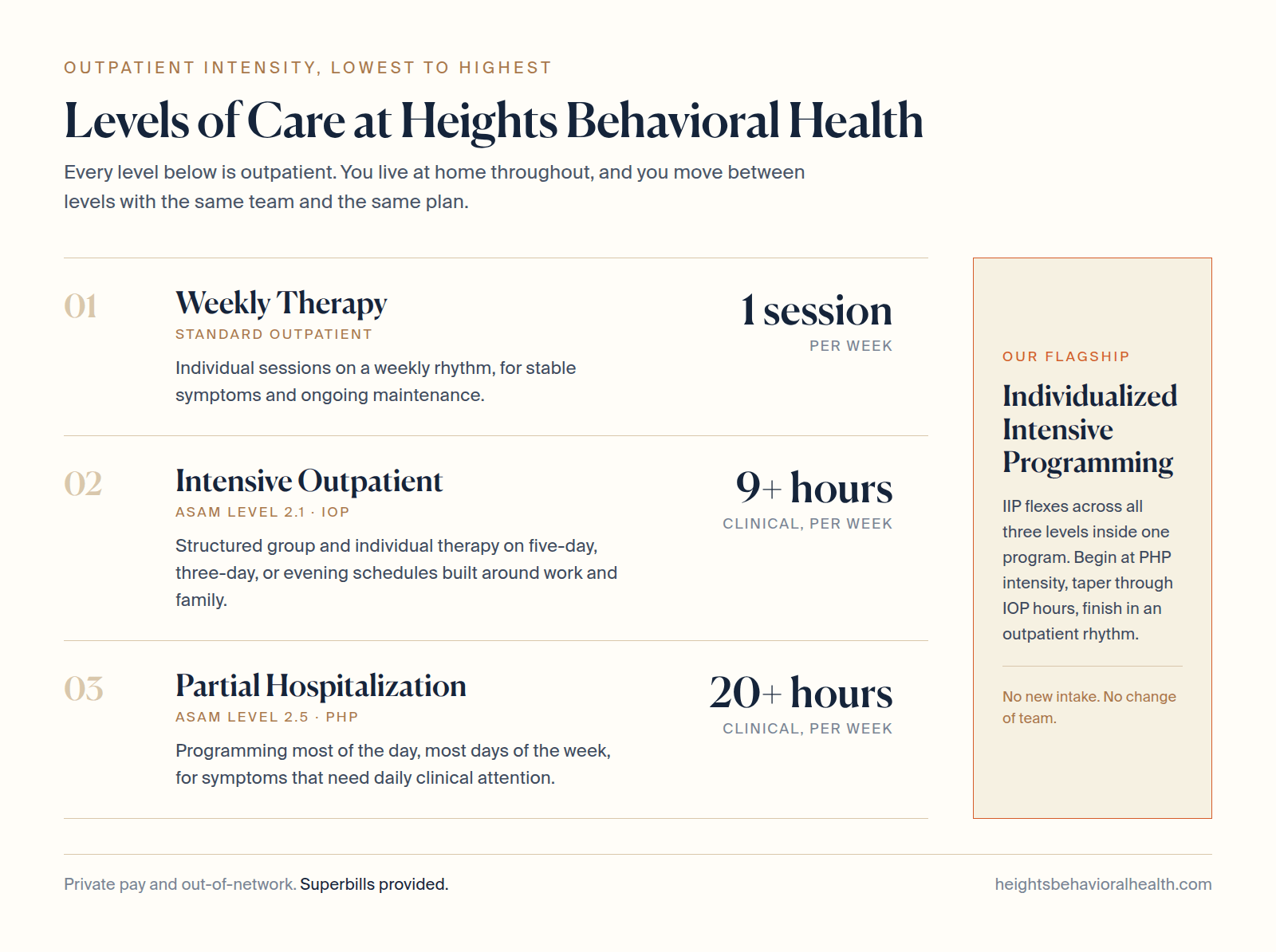
The difference between PHP and IOP is intensity. A partial hospitalization program (PHP) is the most structured outpatient level of care, usually five to six hours a day, five days a week. An intensive outpatient program (IOP) is a lighter commitment, often three hours a day, three to five days a week, designed to fit around work or family. In Houston, the right choice depends on how much structure you need to stay safe and make progress, not on a fixed rule. At Heights Behavioral Health, a clinical assessment matches you to the level that fits, and you step down as you stabilize.
People reach this page two ways. Either a provider mentioned PHP or IOP and you are trying to tell them apart, or you know you need more than weekly therapy and you are deciding how much more. Both paths come down to one question: how much structure does recovery actually require right now?
After 37 years of clinical work in Houston, here is my honest answer. Picking the right level of care is one of the highest-leverage decisions in treatment. Too little structure and early recovery does not hold. Too much and people disengage from work and family they need to keep. This guide explains both levels, how clinicians choose, and how our flagship Individualized Intensive Programming fits alongside them.
What Is a Partial Hospitalization Program (PHP)?
PHP is the most intensive level of care you can receive while still living at home or in sober living. It provides hospital-level structure during the day without an overnight stay.
- Time commitment. Typically about five to six hours a day, five days a week.
- What the day includes. A mix of individual therapy, group therapy, psychiatric and medication management, and skills work, with close clinical monitoring.
- Who it fits. Adults who need significant daily structure and support, including many people stepping down from residential or hospital care.
- What it is not. PHP is not residential treatment and not medical detox. When detox is needed first, we help coordinate that referral.
What Is an Intensive Outpatient Program (IOP)?
IOP delivers real clinical intensity in fewer hours, so you can keep working, parenting, or studying while you get treatment.
- Time commitment. Often about three hours a day, three to five days a week, with day and evening options at many programs.
- What the day includes. Group therapy is the backbone, supported by individual sessions, family work, and relapse-prevention planning.
- Who it fits. Adults who have enough stability to live their daily life but still need structured, frequent support, often as a step down from PHP.
- Flexibility. A 3-day IOP suits people balancing heavy work or caregiving; a 5-day IOP gives more support for those who need it.
PHP vs IOP: What Is the Difference?
| Feature | PHP | IOP |
|---|---|---|
| Hours | About 5 to 6 hours a day, 5 days a week | About 3 hours a day, 3 to 5 days a week |
| Structure | Highest outpatient structure | Structured but more flexible |
| Daily life | Limited room for work or school during programming | Built to fit around work, family, or school |
| Typical use | Acute need, or step-down from residential | Step-down from PHP, or a strong starting point for stable adults |
| Best for | More support, more monitoring | Maintaining momentum with real-world balance |
How Do Clinicians Decide Between PHP and IOP?
The decision is clinical, not a coin flip. In an assessment, we weigh several factors together:
- Safety and stability. Are symptoms or cravings manageable in a less structured setting, or is more monitoring needed to stay safe?
- Co-occurring conditions. When a mental health condition sits alongside substance use, more structure early on often helps. Our dual diagnosis guide explains why.
- Support at home. A stable, recovery-friendly home can make IOP appropriate sooner; an unstable one may call for PHP.
- Daily responsibilities. Work, caregiving, and school matter, and we build the plan to protect what supports your recovery.
- Trajectory. Most people step down over time, from PHP to IOP to ongoing care, as they stabilize.
Not sure which level fits your situation?
One confidential call with our Houston admissions team is usually enough to point you in the right direction, including whether PHP, IOP, or a personalized plan is the better starting point.
Where Does Individualized Intensive Programming Fit?
PHP and IOP describe how many hours you attend. They do not, by themselves, describe how personal the plan is. At Heights Behavioral Health, Individualized Intensive Programming can be delivered at PHP or IOP intensity, with the week built around your history, goals, and co-occurring needs rather than a fixed group curriculum. If you have tried standard outpatient care and found it too generic, this is often the difference that makes treatment hold.
When Is Outpatient Care Not Enough?
Outpatient care has limits, and naming them is part of good treatment. Someone with significant medical risk, active withdrawal, or an acute psychiatric crisis needs a higher level of care first, and we will say so on the first call and help you find it. If a loved one needs non-clinical, lower-acuity support instead of treatment, our sister practice Heights Mentoring may be the right starting point.
Heights Behavioral Health is a private-pay, out-of-network provider, and we are clear about pricing before you commit to anything. See how cost and out-of-network benefits work.
If this is an emergency or you are thinking about harming yourself, call 911, or call or text 988 to reach the Suicide and Crisis Lifeline. In Harris County, The Harris Center operates a 24-hour crisis line at 713-970-7000. Heights Behavioral Health is an outpatient program and is not a 24-hour crisis service.
Frequently Asked Questions
Is PHP or IOP more intensive?
PHP is more intensive. It usually runs about five to six hours a day, five days a week, while IOP is typically about three hours a day, three to five days a week. PHP offers more structure and monitoring; IOP offers more flexibility for work and family.
Can I work while in IOP?
Often, yes. IOP is designed to fit around daily responsibilities, and many programs offer day or evening tracks. PHP leaves less room for work during programming because the days are longer.
Do you take insurance for PHP or IOP?
We are private pay and out of network, and not contracted with insurance plans. PHP and IOP differ in weekly hours, so they differ in cost, and we go through both before you choose a level. If your plan has out-of-network benefits, we provide a superbill you can submit.
How long does PHP or IOP last?
Length varies by person. Many people step down over time, from PHP to IOP to ongoing care, as they stabilize. The plan is reviewed regularly rather than set to a fixed number of weeks for everyone.
How do I know which level of care I need?
A clinical assessment is the most reliable way to tell. Call us at (877) 549-5102 for a confidential conversation, and we will recommend the level that fits, even if it is somewhere other than here.
Which do I need, PHP or IOP?
That is decided by a clinical assessment, not by preference. In general, PHP suits people who need daily structure and closer monitoring, while IOP suits people stable enough to work or care for family while still in structured treatment. Many people start in PHP and step down to IOP as they stabilize. One call and an assessment will tell you which fits.
The Right Level of Care, Chosen With You
Whether you are weighing PHP, IOP, or a personalized plan, one confidential call will help you understand which fits and what the next step looks like.
Sources
Start a Confidential Conversation
One confidential message connects you with our admissions team and a clear next step. Prefer to talk now? Call (877) 549-5102.