



Key Takeaways
- An intensive outpatient program is structured group and individual treatment, usually about three hours a day, several days a week, that lets you live at home and keep working or caregiving.
- A typical IOP day blends group therapy, individual sessions, family involvement when helpful, relapse-prevention planning, and psychiatric coordination when medication is part of care.
- A 3-day IOP fits people balancing heavy work or caregiving, while a 5-day IOP offers more structure and support, and many people start at higher intensity and step down as they stabilize.
- To prepare for the first week, sort out transportation, work, and childcare early, tell a few supportive people, come honest, and expect relief, resistance, and hope to show up.
- IOP sits below partial hospitalization and above weekly therapy, and co-occurring anxiety, depression, or trauma can be treated alongside substance use within the same plan.
IOP stands for intensive outpatient program. It is structured treatment for mental health or substance use that meets several days a week, usually for nine or more hours in total, while you live at home and keep working or caring for family. At Heights Behavioral Health, our intensive outpatient program in Houston runs on five-day, three-day, or evening schedules, and a typical day blends group therapy, individual sessions, family work, and relapse-prevention planning, matched to what you actually need.
People reach this page two ways. Either you are about to start an IOP and want to know what the days are like, or you are choosing between a 3-day and a 5-day track. Both come down to one question: what will the experience actually involve, and how much do I need?
After more than 37 years of clinical work, most of it here in Houston, here is my honest answer. The unknown is what makes treatment scary. When people know what a week looks like, who they will see, and how it fits their life, they show up and stay. This guide walks through a typical IOP, the 3-day versus 5-day choice, and how it connects to other levels of care.
What Does IOP Mean?
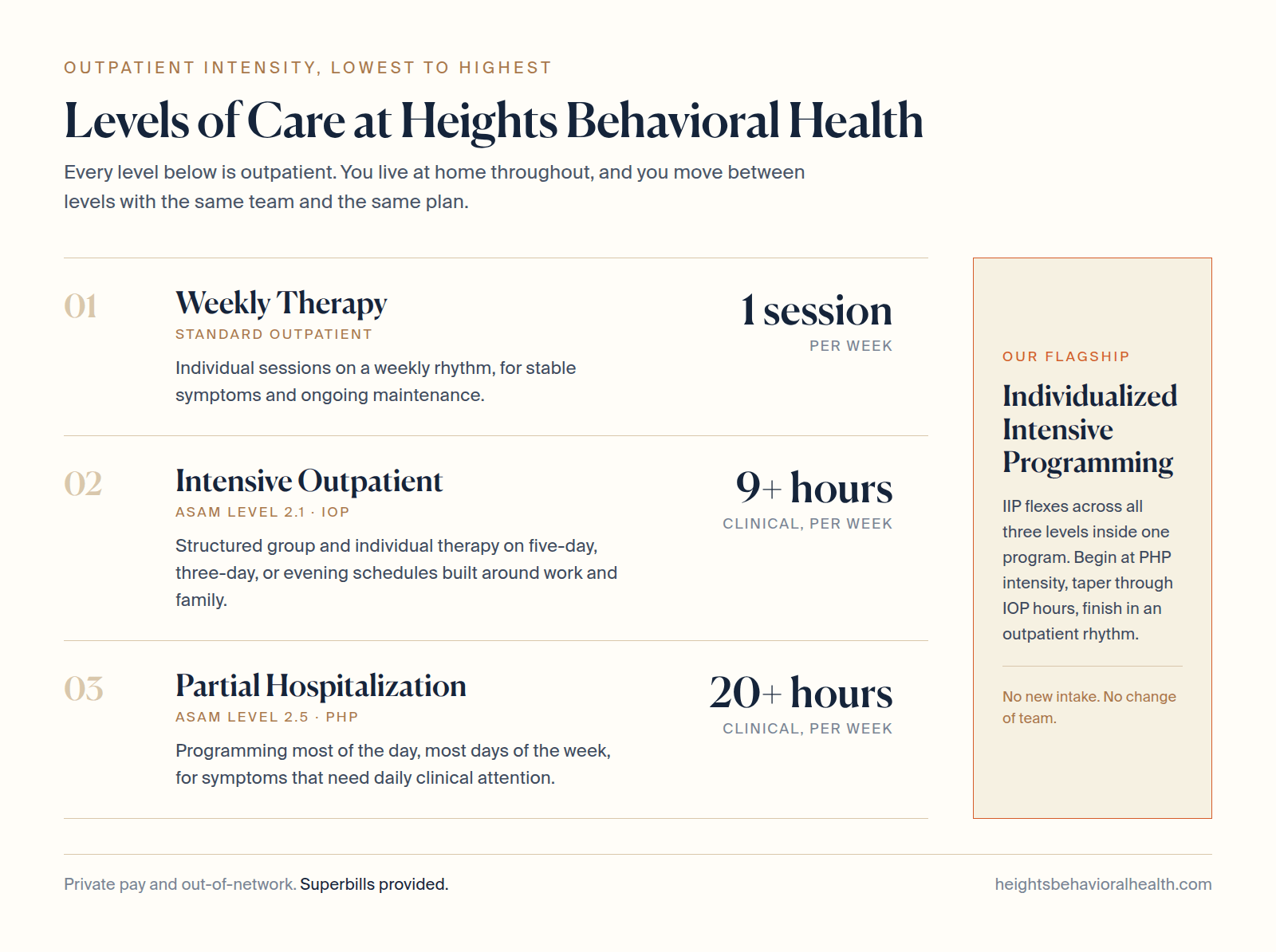
IOP means intensive outpatient program. It is a level of care between weekly therapy and partial hospitalization. In the ASAM Criteria that clinicians use to match people to treatment, IOP corresponds to Level 2.1. In mental health care, IOP is used for depression, anxiety, trauma, and mood disorders when weekly sessions are not enough. In addiction care, it is used for alcohol and drug use, often alongside co-occurring mental health conditions.
- Intensive means more structure and more clinical contact than weekly therapy.
- Outpatient means you live at home and attend scheduled sessions.
- Program means a coordinated plan with groups, individual therapy, and a team that works together.
How Many Hours Is IOP?
Most IOPs provide at least nine clinical hours per week. At Heights, that usually means about three hours a session on a five-day, three-day, or evening schedule. A five-day track adds more structure early on, a three-day track leaves more room for work and caregiving, and Evening IOP runs after work hours. Many groups and sessions are also available virtually, and hybrid schedules are common.
How Long Is IOP?
There is no fixed length. Many people spend several weeks to a few months in IOP, then step down to weekly therapy as they stabilize. Your team reviews progress regularly, and the schedule changes as you do. If symptoms become harder to manage, stepping up to a partial hospitalization program for a time is a normal part of good care, and our guide to PHP vs IOP explains how that decision is made.
What Does a Typical IOP Day Look Like?
No two programs are identical, but a Heights Behavioral Health IOP day usually includes a predictable mix:
- Group therapy. The backbone of IOP, where skills are taught and practiced and people learn they are not alone.
- Individual sessions. One-on-one time to work on what is specific to you, including any co-occurring condition.
- Family involvement. When it helps, family sessions repair communication and set healthy boundaries.
- Relapse-prevention planning. Concrete plans for high-risk moments, built before you need them.
- Psychiatric coordination. When medication is part of care, prescribers stay in the loop.
3-Day vs 5-Day IOP: Which One Fits?
| Consideration | 3-Day IOP | 5-Day IOP |
|---|---|---|
| Time per week | Lighter weekly commitment | More structure and contact |
| Best for | Balancing heavy work or caregiving | Needing more support to stay steady |
| Common use | Step-down as you stabilize | Early IOP or step-down from PHP |
| Flexibility | Maximum room for daily life | Still outpatient, with more guardrails |
Many people start at the higher intensity and step down as they stabilize. If you are deciding between IOP and a more structured option, our guide to PHP vs IOP in Houston explains how clinicians choose.
Confidential Next Step
Wondering which track fits your week?
A short, confidential call can match you to the right IOP intensity, or to a personalized plan if that fits better.
How Do I Prepare for My First Week?
- Sort out logistics early. Plan transportation, work hours, and childcare around your track so attendance is realistic.
- Tell the people who need to know. A few supportive people in your corner makes the first week easier.
- Come honest. The assessment and groups only help as much as you let them. Candor early saves time.
- Expect to feel a range of things. Relief, resistance, and hope can all show up in week one. That is normal.
Where Does IOP Fit Among Levels of Care?
IOP sits below partial hospitalization and above weekly therapy. At Heights Behavioral Health, IOP can be delivered as part of our flagship Individualized Intensive Programming, so the plan is built around you rather than a fixed curriculum. Co-occurring anxiety, depression, or trauma is treated alongside substance use rather than referred out.
Heights Behavioral Health is a private-pay, out-of-network provider, and we are clear about pricing before you commit to anything. See how cost and out-of-network benefits work.
If this is an emergency or you are thinking about harming yourself, call 911, or call or text 988 to reach the Suicide and Crisis Lifeline. In Harris County, The Harris Center operates a 24-hour crisis line at 713-970-7000. Heights Behavioral Health is an outpatient program and is not a 24-hour crisis service.
Curious how clinicians decide that IOP, rather than a higher or lower level of care, is the right fit? Our guide to the ASAM criteria explains the framework in plain English.
Frequently Asked Questions
What does IOP stand for?
IOP stands for intensive outpatient program, a structured level of care that meets several days a week while you live at home.
How long is IOP?
There is no fixed length. Many people spend several weeks to a few months in IOP before stepping down to weekly therapy, with progress reviewed regularly.
Is IOP the same for mental health and addiction?
The structure is similar, and the focus differs. At Heights, IOP tracks address mental health, substance use, and both together when they co-occur.
How many hours a week is IOP?
IOP is typically about three hours a day, three to five days a week. A 3-day track is a lighter commitment; a 5-day track gives more support. The exact schedule is matched to your needs.
Can I keep working during IOP?
Usually yes. IOP is designed to fit around work, school, and family, and many programs offer day or evening options. We help you plan a schedule that protects what supports your recovery.
Do you take insurance for IOP?
We are private pay and out of network, and not in network with any plan. Because a three-day and a five-day track differ in hours, we go through what each would cost before you choose. If your plan has out-of-network benefits, we provide a superbill to submit.
Is a 3-day or 5-day IOP better?
Neither is better in the abstract. A 5-day track suits people who need more structure; a 3-day track suits those balancing heavy responsibilities or stepping down. A clinical assessment matches you to the right one.
What happens after IOP ends?
Most people step down gradually into ongoing care, with a relapse-prevention plan in place. Continuing care helps protect the gains made in IOP.
Can I keep working while I am in IOP?
Usually yes, and it is one of the main reasons people choose IOP over a higher level of care. A 3-day schedule is often built around work or caregiving, and many programs offer day or evening tracks. We will look at your actual schedule during the assessment and recommend the track that protects both your recovery and your job.
Know What to Expect Before Day One
If you are starting or considering an IOP in Houston, one confidential call will walk you through the schedule, the track that fits, and the next step.
Sources
Written and Reviewed by Licensed Clinicians
Joni Ogle is a Licensed Clinical Social Worker (LCSW) and Certified Sex Addiction Therapist (CSAT) with over 37 years of clinical experience in mental health and addiction recovery, dual diagnosis treatment, behavioral addictions, and family intervention. She is the founder of Heights Behavioral Health and Heights Mentoring in Houston, Texas, where she leads a team of licensed clinicians.
Texas LCSW #37376 · Verify license
Deborah Darnell-Drake, LCSW-S, ACSW, LMFT is the Chief Clinical Officer at Heights Behavioral Health and a clinical reviewer. With more than five decades of experience in mental health and substance use disorder treatment, Deborah specializes in addiction, co-occurring mental health conditions, family dynamics, and behavioral addictions including gambling and technology addiction.
Texas LCSW-S #14508 · LMFT #1125 · Verify license
Start a Confidential Conversation
One confidential message connects you with our admissions team and a clear next step. Prefer to talk now? Call (877) 549-5102.