

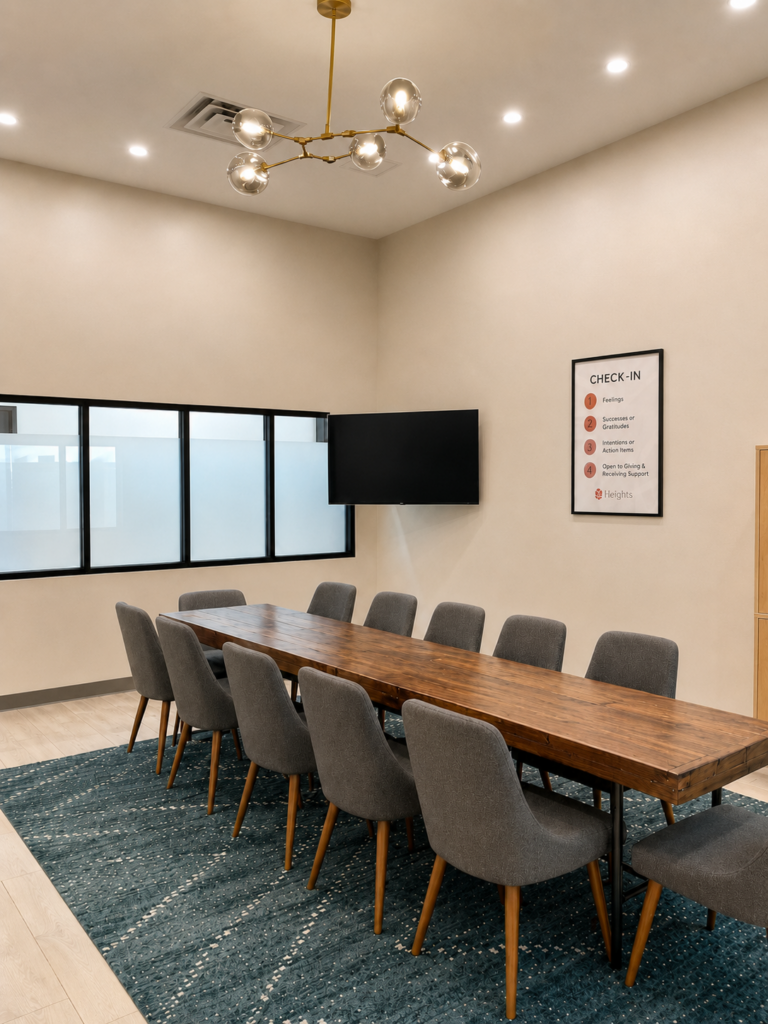
Why Environment Matters in Recovery: A Space Built to Heal
The room you get treated in affects whether you tell the truth in it. Why environment is clinical rather than cosmetic, and what we built at 1009 Yale St.

Partial Hospitalization Program · Houston & The Heights
Full-day clinical structure for mental health, substance use, and co-occurring disorders, while you sleep in your own bed. Our most structured level of outpatient care, delivered by master’s-level clinicians and customized around you. Private pay, with superbills for out-of-network reimbursement.
01ASAM Level 2.5
02Day Treatment · Home at Night
03Master’s-Level Clinicians
04Private Pay · Superbills
Real Structure, Without a Residential Stay
A partial hospitalization program, often called PHP or day treatment, is the most intensive level of outpatient care. You attend structured clinical programming most of the day, typically five days per week, then return home each evening. It is designed for people who need more than weekly therapy or an intensive outpatient program, but who do not need, or no longer need, twenty-four-hour residential care.
At Heights Behavioral Health, PHP corresponds to Level 2.5 of the ASAM Criteria: twenty or more clinical hours per week of group therapy, individual therapy, psychiatric coordination, and family involvement, all in one coordinated plan. We treat mental health conditions, substance use, and co-occurring disorders together rather than in separate silos, because for most people they arrived together.
PHP is often the first step after a hospital stay or residential treatment, and just as often the level that prevents one. Because you live at home during treatment, everything you work on in session is practiced in real life the same week: your routines, your relationships, your triggers, your sleep. When you are ready, you step down to intensive outpatient hours with the same team and the same plan, so momentum never resets.
Who PHP Is For
Acute but Stable
Symptoms of depression, anxiety, trauma, or substance use that keep breaking through outpatient therapy and need daily clinical attention to stabilize.
Step-Down Care
Leaving inpatient or residential care and needing a structured landing that protects progress through the highest-risk weeks of transition.
Step-Up Care
Clients in intensive outpatient or weekly care whose symptoms are escalating and who need more hours before considering residential options.
Dual Diagnosis
Mental health and substance use treated together in one plan: depression, anxiety, PTSD, bipolar and mood disorders, alongside alcohol or drug use.
Avoiding Disruption
People who need serious treatment but cannot, or should not, leave home, family, or responsibilities for weeks of residential care.
Whole-Family Healing
Loved ones who want education, communication coaching, and clear ways to help while the clinical team carries the treatment.
A Day in PHP
Programming runs most of the day, typically five days per week. Every schedule is confirmed at assessment and adjusted as you stabilize; evening and hybrid options are part of what we customize.
Morning
The day opens with a clinical check-in and a clinician-led process group: real work on what is driving the pattern, in a group small enough that you are known, not processed.
Midday
One-to-one therapy, psychiatric and medication appointments, and specialty work such as EMDR, CPT, or CSAT-led sessions, scheduled into your plan where they help most.
Afternoon
DBT and relapse prevention skills, experiential therapies like art or trauma-informed yoga, and daily planning, so what you learned goes home with you that evening.
PHP, IOP, or Residential?
The ASAM Criteria matches you to the right intensity across six dimensions: withdrawal potential, medical needs, emotional and behavioral health, readiness to change, relapse potential, and living environment. A licensed clinician completes that assessment before you begin, then reassesses throughout so you move between levels without changing teams or starting over.
ASAM Level 2.1
Nine or more hours per week on five-day, three-day, or evening schedules. The step after PHP, or a starting point when symptoms allow.
ASAM Level 2.5
You are here. Twenty or more clinical hours per week, most days of the week, while living at home. The most structure outpatient care offers.
Flagship
Our in-house flagship: a fully customized program that flexes across levels, with recovery mentoring woven into every phase.
ASAM Levels 3-4
When twenty-four-hour care is clinically indicated, we refer to trusted partners and coordinate your return to PHP for step-down.
What PHP Treats
Mental health is our foundation and substance use is treated as part of the same picture. Explore all conditions we treat, including mental health, substance use, and process addictions.
Inside the Program
Nothing here is an add-on. Every element is available to every client and sequenced into the plan where it helps most, chosen for what is actually driving the pattern. See the full toolkit on our clinical services page.
Clinician-led process, skills, and experiential groups, kept small enough that you are known by name.
One-to-one sessions that anchor your plan, scheduled multiple times per week at the PHP level.
Evidence-based trauma therapies sequenced into your plan when you are stabilized and ready.
Reframe the patterns driving behavior and build distress tolerance, regulation, and interpersonal skills.
On-staff psychiatry, evaluations, and medication management.
Education, family sessions, and communication coaching, included when it helps.
CSAT-led care, neurofeedback, somatic experiencing, art therapy, and trauma-informed yoga as your plan requires.
Daily structure, recovery planning, and continuing care preparation from the first week.

After PHP
Finishing PHP is not the end of care; it is a planned transition. Most clients step down to IOP, on a five-day, three-day, or evening schedule, then into weekly outpatient care, keeping the same clinical team and the same plan the whole way.
For clients who want support that reaches into daily life, recovery mentoring and companioning through our sister practice, Heights Mentoring, can be added at any point, so accountability and structure remain in place long after the clinical hours taper.
Our Approach
We keep groups thoughtful in size so you are known, not processed. Co-occurring mental health and substance use are treated in the same plan by master’s-level clinicians with advanced training. Family is involved when it helps, your privacy is protected throughout, and we are honest about cost and out-of-network benefits from the first conversation. Your program is customized around you, not a fixed track.
Guides and Resources
Plain-language articles from our clinical team on levels of care, what a typical day looks like, medication, assessments, and paying for treatment with superbills.
 Why Environment Matters in Recovery: A Space Built to Heal Stepping Down from PHP to IOP: How and When It Happens A Day in the Life of PHP: A Typical Houston Schedule
Ready When You Are
A confidential conversation and an ASAM-guided assessment tell us whether PHP is the right starting point. No pressure, no obligation.
Start Confidentially
Tell us a little about what is going on and the best way to reach you. A member of our admissions team will follow up personally and walk you through next steps. Please do not include sensitive medical details in the form.
Common Questions
If you do not see your question here, call our admissions team at (877) 549-5102 and we will walk you through it.
We are a private-pay practice. For clients with out-of-network benefits, we provide detailed superbills you can submit to your insurer for possible reimbursement, and we help you verify your specific benefits and understand costs before you commit to anything.
PHP, sometimes called day treatment, is the most intensive level of outpatient care. You attend structured clinical programming most of the day, typically five days per week, including group therapy, individual therapy, and psychiatric support, then return home each evening. It corresponds to Level 2.5 of the ASAM Criteria.
PHP is more intensive: twenty or more clinical hours per week, most days of the week. Intensive outpatient (IOP) runs nine or more hours per week on five-day, three-day, or evening schedules. Both include group and individual therapy while you live at home, and clients commonly step from PHP down to IOP with the same team.
No. In residential or inpatient care you live at the facility with twenty-four-hour supervision. In PHP you receive comparable daytime clinical intensity but sleep at home, which lets you practice recovery in real life while treatment is still highly structured. When residential care is clinically indicated, we refer to trusted partners and coordinate your return to PHP for step-down.
Our PHP provides twenty or more clinical hours per week, usually spread across five days with several hours of programming each day. Your exact schedule is confirmed at assessment and adjusted as you stabilize.
There is no fixed length. Many clients spend several weeks at the PHP level before stepping down to IOP and then weekly outpatient care, but your timeline follows your progress, reassessed by a licensed clinician throughout.
PHP is time-intensive by design, and many clients pause or reduce work during it. We help you plan around your obligations, and as you stabilize you can step down to IOP or Evening IOP schedules built specifically to protect work and school.
Both, together. Our PHP treats depression, anxiety, trauma and PTSD, bipolar and mood disorders, alcohol and drug use, and co-occurring combinations of these in one coordinated plan, delivered by master’s-level clinicians.
No. We are an outpatient practice and do not provide medical detox. If detox is needed first, we help coordinate a safe referral and continue your care with us afterward.
Group and individual therapy anchor the program, with CBT, DBT, EMDR, CPT, psychiatric and medication support, family involvement, and specialty work such as CSAT-led care, neurofeedback, somatic experiencing, art therapy, and trauma-informed yoga sequenced in as your plan requires.
When clinically appropriate and with your consent, yes. Family education, family sessions, and communication coaching are built into the program, because recovery is stronger when the people closest to you know how to help.
Step-down is planned from the start. Most clients move to IOP, then weekly outpatient care, keeping the same team and plan. Recovery mentoring and companioning through our sister practice, Heights Mentoring, can be added at any point for support that continues after clinical hours taper.
In mental health care, PHP stands for partial hospitalization program. It is a full-day, structured outpatient program, usually several hours a day on most weekdays, for people who need more support than IOP but do not need to stay overnight in a hospital or residential setting.
Many people take protected leave under FMLA or talk with their EAP before starting PHP, because the schedule fills most weekdays. Your HR team can explain what your employer offers, and our guide to using FMLA for treatment in Texas walks through the steps. Our admissions team can share the expected PHP schedule so you can plan your time away and your return.
Our admissions team answers seven days a week, from 8:00 am to 7:30 pm Central Time. Call (877) 549-5102 to talk with a real person about what is going on, your schedule, and whether our programs are the right fit. If you reach out after hours, leave a message or send the consultation form and we will return your call as soon as we open. If this is an emergency, call 911. If you or someone you love is in a mental health crisis, call or text 988.
Clinical Review
Written by Joni Ogle, LCSW, CSAT, CEO of Heights Behavioral Health, and clinically reviewed by Deborah Darnell-Drake, LCSW-S, ACSW, LMFT, Chief Clinical Officer. Heights Behavioral Health provides licensed outpatient behavioral health care for adults in Houston, Texas, delivered by master’s-level clinicians and licensed professionals. This page is intended to explain HBH services and does not replace an individualized clinical assessment. Last reviewed October 2026.
Explore Heights
Every program, condition, and specialty at Heights connects to one coordinated outpatient team in the Houston Heights. Start wherever fits your situation, or call admissions and we will point you to the right place.
Verified reviews from clients and families who have been through our programs. Read them in full on Google, or add your own.
“From my very first interaction, I felt welcomed, respected, and genuinely cared for. The staff took the time to listen, answer my questions, and create a treatment plan that fit my needs.”
“Heights offered treatment three evenings a week, which made it possible for them to work during the day and still get consistent support.”
“Our family was scared and unsure where to turn. From the first conversation with Jeff and Beckie to walking through the doors, we felt genuinely cared for.”
Contact Admissions
One confidential call connects you with admissions, an ASAM-guided assessment, and a clear next step.
Crisis Notice
Heights Behavioral Health provides scheduled outpatient care and is not an emergency or crisis service. This page is general information, not medical advice. If you are in crisis, call or text 988, or call 911 if someone is in immediate danger.

© 2026 Heights Behavioral Health. All rights reserved. Notice of Privacy PracticesPrivacy PolicyCookie PolicyEditorial Standards
