




Key Takeaways
- Stepping down from PHP to IOP is a clinical judgment that you need less structure, based on what has changed in you rather than on a set number of weeks.
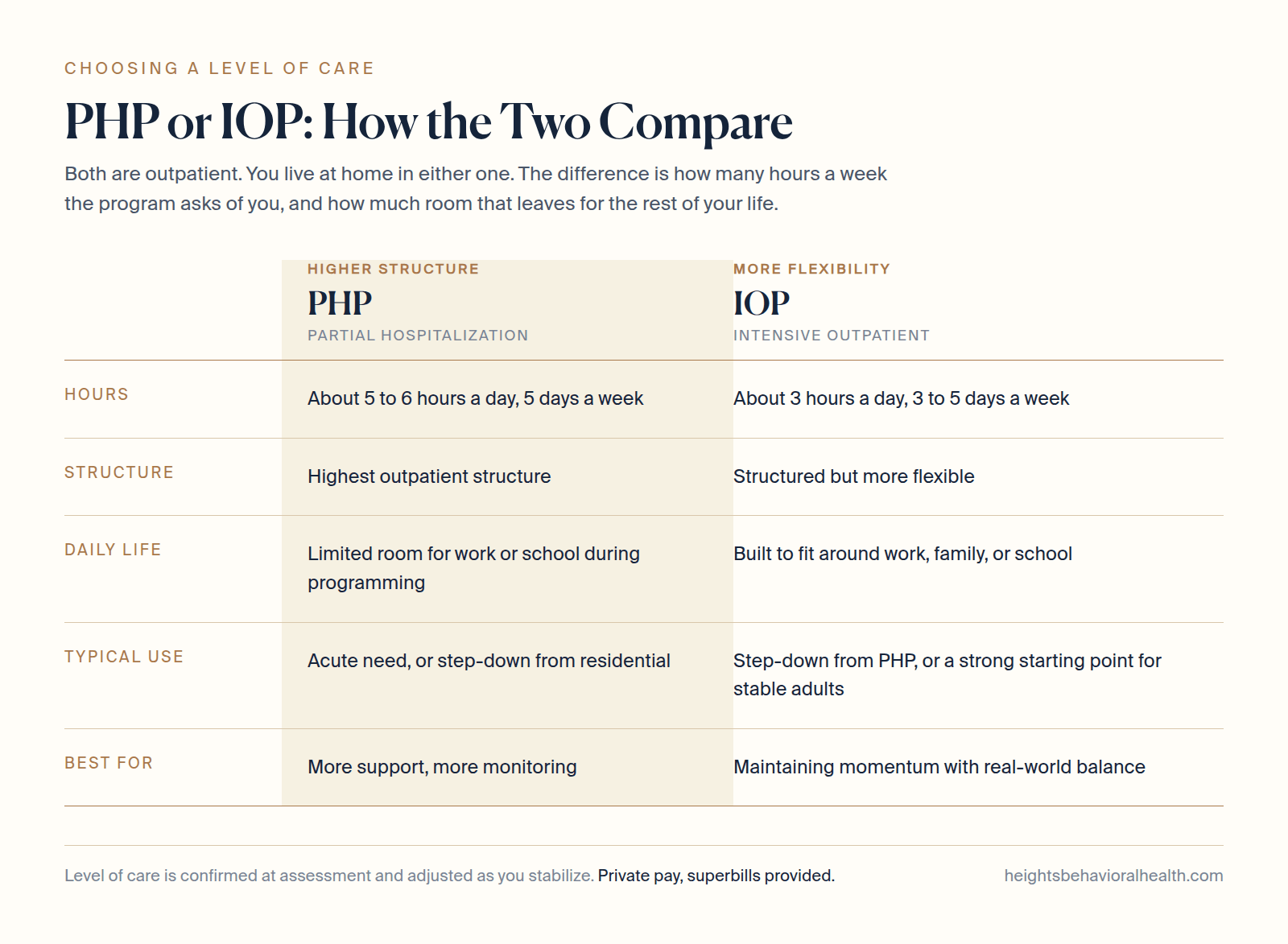
- PHP runs most of the day, five days a week, while IOP runs roughly three hours a session, three to five days a week, with heavily overlapping clinical content.
- Readiness includes manageable cravings, steadier sleep and mood, no recent crisis, a supportive living situation, some outside structure, and being able to name your own warning signs without prompting.
- Readiness is not running out of days, feeling better for a week, or boredom, and a step-down plan written in advance names your schedule, warning signs, and who you call.
- The most common failures are treating step-down as an ending and changing everything else at once, so keep attending, change one thing at a time, and plan continuing care after IOP.
Stepping down is not graduating. It is a clinical judgment that you need less structure than you did, made because of what has changed in you rather than because a set number of weeks elapsed. Done well it is barely noticeable. Done badly it is the moment treatment quietly falls apart.
This article is about the second half of the journey: what readiness looks like, how the handoff works here, and what tends to go wrong.
What PHP and IOP Actually Differ On
PHP runs most of the day, five days a week. IOP runs roughly three hours a session, three to five days a week. The clinical content overlaps heavily; what changes is how much structure surrounds you and how much of the day you are responsible for on your own. Our PHP versus IOP comparison covers the choice between them at intake.
What Readiness Looks Like
- Cravings are present but manageable, and you have used a skill instead of using
- Sleep, appetite, and mood have steadied enough to be assessed accurately
- No recent crisis, and no active safety concerns
- A living situation that supports recovery rather than working against it
- Some structure outside the program: work, school, family responsibility, or a plan for one
- You can name your own warning signs without a clinician prompting you
None of that requires you to feel finished. Most people step down while still very much in the middle of the work.
What Readiness Is Not
It is not running out of days. It is not feeling better for a week. And it is not boredom, which shows up reliably around the point where the acute crisis has passed and the harder relational work begins. Wanting less treatment is sometimes a sign of progress and sometimes a symptom. Naming which one it is out loud is part of the work.
Confidential Next Step
Not sure whether you are ready to step down?
It is a clinical question. We will give you a straight answer.
How the Transition Works Here
The step-down plan is written before it is needed, not on the last day. It names your schedule, your individual therapy cadence, the specific warning signs that would mean stepping back up, and who you call. Where possible you keep your individual therapist and stay in groups you already trust, because losing every familiar face in the same week is its own destabilizer.
What Goes Wrong
The most common failure is treating the step-down as an ending. Attendance drifts, individual sessions get rescheduled, and the structure that was doing quiet work disappears before anything replaces it. The second most common is stepping down and changing everything else at once: new job, new relationship, moving out. One change at a time. Our relapse prevention and first 90 days articles cover this window.
And After IOP
IOP is not the end of the line either. Most people step down again to a lighter schedule and continuing care, planned the same way. See continuing care, and if evenings fit your work better, our evening IOP runs after the workday.
If this is an emergency or you are thinking about harming yourself, call 911, or call or text 988 to reach the Suicide and Crisis Lifeline. In Harris County, The Harris Center operates a 24-hour crisis line at 713-970-7000. Heights Behavioral Health is an outpatient program and is not a 24-hour crisis service.
Step-down timing is a criteria question, not a calendar question; our guide to the ASAM criteria explains the dimensions clinicians weigh.
Frequently Asked Questions
How long does PHP last before stepping down to IOP?
It depends on clinical progress rather than a fixed number of weeks. Readiness is judged on stability, safety, and skills use, not on time served.
Does stepping down mean I am finished with treatment?
No. It means you need less structure than you did. Most people step down while still actively working, and then step down again to continuing care.
Do you take insurance?
We are private pay and out of network, and not in network with any plan. Because a step down changes your weekly hours, it changes your cost, and we walk through that with you before the change rather than after. Superbills are available if your plan has out-of-network benefits.
Can I step back up to PHP if IOP is not enough?
Yes, and it is not a failure. Needing more support again is information, not a verdict. The step-down plan should name in advance what would trigger that decision.
Will I keep the same therapist and groups?
Where possible, yes. Continuity matters during a transition, so we try to avoid changing every familiar element at once.
What is the most common mistake at this stage?
Treating the step-down as an ending. Attendance drifts and individual sessions slip before anything has replaced the structure that was helping.
Plan the Step-Down Before You Need It
A confidential conversation about where you are, what comes next, and what would tell us to slow down.
Sources
Written and Reviewed by Licensed Clinicians
Joni Ogle is a Licensed Clinical Social Worker (LCSW) and Certified Sex Addiction Therapist (CSAT) with over 37 years of clinical experience in mental health and addiction recovery, dual diagnosis treatment, behavioral addictions, and family intervention. She is the founder of Heights Behavioral Health and Heights Mentoring in Houston, Texas, where she leads a team of licensed clinicians.
Texas LCSW #37376 · Verify license
Deborah Darnell-Drake, LCSW-S, ACSW, LMFT is the Chief Clinical Officer at Heights Behavioral Health and a clinical reviewer. With more than five decades of experience in mental health and substance use disorder treatment, Deborah specializes in addiction, co-occurring mental health conditions, family dynamics, and behavioral addictions including gambling and technology addiction.
Texas LCSW-S #14508 · LMFT #1125 · Verify license
Start a Confidential Conversation
One confidential message connects you with our admissions team and a clear next step. Prefer to talk now? Call (877) 549-5102.