




Key Takeaways
- Evening intensive outpatient lets someone work a full day and still receive clinical care at night several nights a week, and it is a real level of care rather than a lighter substitute.
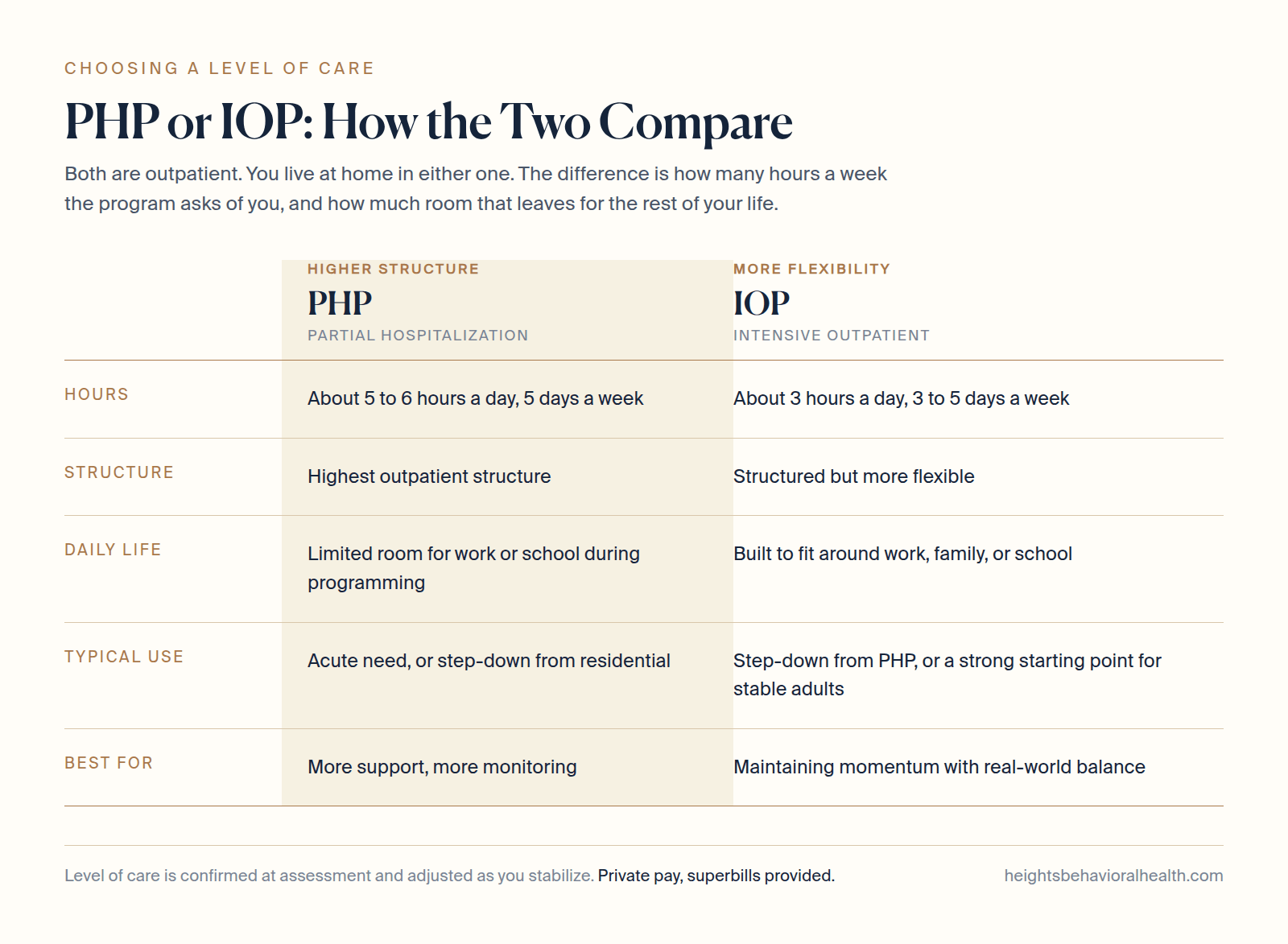
- IOP generally runs three hours a session, three to five days a week, with group process, CBT or DBT skills work, psychoeducation, and separately scheduled individual therapy.
- Evening IOP fits working adults with stable, safe housing, people stepping down from PHP or residential care, professionals who cannot take leave, and parents balancing childcare and school.
- Active withdrawal risk, an unsafe or actively using home, a crisis, or daytime hours being the hardest part of the day all point toward PHP or a residential referral instead.
- You are not required to tell your employer about treatment, your care is protected health information, and options like FMLA and employer EAP programs exist if accommodations are needed.
The most common reason people delay treatment is not denial. It is a job. Evening intensive outpatient exists so that someone can work a full day and still get clinical care that night, several nights a week, without explaining an absence to anyone.
It is a real level of care, not a lighter substitute, and it is not right for everyone. Both of those things matter.
What an Evening Schedule Looks Like
Intensive outpatient generally runs three hours a session, three to five days a week. In an evening format, that lands after the workday: group process, skills work such as CBT or DBT, and psychoeducation, plus individual therapy scheduled separately. Our what to expect in IOP article walks through a session in detail.
Who Evening IOP Fits Well
- Working adults with stable housing and a safe environment to return to each night
- People stepping down from PHP or residential care who are re-entering work
- Professionals who cannot take a leave of absence without significant consequence
- Anyone who has completed detox and needs structure rather than supervision
- Parents coordinating treatment around childcare and school schedules
Who Needs More Than an Evening Program
Evening IOP is not the right starting point when there is active withdrawal risk, when the home environment is unsafe or actively using, when someone is in crisis, or when daytime hours are the hardest part of the day. In those cases PHP or a residential referral is the honest recommendation, and we will say so. Our outpatient versus residential comparison lays out the decision.
Confidential Next Step
Wondering whether an evening schedule is enough?
A confidential assessment will tell you which level of care actually fits.
Confidentiality and Your Employer
You are not required to tell your employer that you are in treatment. Your care is protected health information. If you do need accommodations, FMLA and employer EAP programs exist for exactly this, and some clients use them while others never need to. We do not contact employers without your written authorization.
Cost, Without the Runaround
We are a private-pay, out-of-network provider. We quote the weekly cost before you commit, and we provide the documentation needed to submit for out-of-network reimbursement. See our guide to cost and superbills and our private-pay explainer.
Where We Are
We are at 1009 Yale St in the Houston Heights, inside the 610 Loop with access from I-10, I-45, and 290, which keeps an after-work commute realistic from most of the Inner Loop. More on why that matters in our Heights location article.
If this is an emergency or you are thinking about harming yourself, call 911, or call or text 988 to reach the Suicide and Crisis Lifeline. In Harris County, The Harris Center operates a 24-hour crisis line at 713-970-7000. Heights Behavioral Health is an outpatient program and is not a 24-hour crisis service.
Frequently Asked Questions
How many nights a week is evening IOP?
Intensive outpatient typically runs three to five days a week, about three hours per session. The exact schedule depends on your assessment and your obligations.
Can I keep working full time?
Most people in evening IOP do. That is the point of the format. If your assessment indicates you need daytime structure, we will recommend PHP instead rather than fitting you into a program that will not hold.
Do you take insurance for evening IOP?
We are private-pay and out of network. We quote weekly cost upfront and provide documentation for out-of-network reimbursement claims.
Does my employer have to know?
No. Your treatment is protected health information and we do not contact employers without your written authorization. Some clients choose to use FMLA or an EAP; many do not need to.
Is evening IOP as effective as a daytime program?
The clinical content is the same. What changes is the schedule. The bigger question is whether IOP is the right level of care for you at all, which is what an assessment determines.
Treatment That Fits Around Work
One confidential call to talk through schedule, level of care, and cost.
Sources
Written and Reviewed by Licensed Clinicians
Joni Ogle is a Licensed Clinical Social Worker (LCSW) and Certified Sex Addiction Therapist (CSAT) with over 37 years of clinical experience in mental health and addiction recovery, dual diagnosis treatment, behavioral addictions, and family intervention. She is the founder of Heights Behavioral Health and Heights Mentoring in Houston, Texas, where she leads a team of licensed clinicians.
Texas LCSW #37376 · Verify license
Deborah Darnell-Drake, LCSW-S, ACSW, LMFT is the Chief Clinical Officer at Heights Behavioral Health and a clinical reviewer. With more than five decades of experience in mental health and substance use disorder treatment, Deborah specializes in addiction, co-occurring mental health conditions, family dynamics, and behavioral addictions including gambling and technology addiction.
Texas LCSW-S #14508 · LMFT #1125 · Verify license
Start a Confidential Conversation
One confidential message connects you with our admissions team and a clear next step. Prefer to talk now? Call (877) 549-5102.