



Key Takeaways
- The difference between outpatient and residential treatment is where you sleep and how much structure you need to stay safe. Neither is better in the abstract; the right one depends on medical risk and home stability.
- Residential treatment means living on site, typically for 30 to 90 days, in a controlled environment. That containment helps most when home is unsafe, use is life-threatening, or a person cannot stop long enough to begin.
- Outpatient treatment delivers real clinical intensity while you sleep at home and keep working or parenting. It often fits best for people who are medically stable, have a supportive home, and want to practice recovery in real life.
- Residential or a higher level of care generally comes first for active withdrawal needing medical supervision, significant medical or psychiatric instability, an unsafe home, or repeated inability to stay safe between outpatient sessions.
- Treatment is usually a sequence rather than a single choice, moving from detox if needed through residential, PHP, IOP, and ongoing care. The highest-risk window is the transition between levels, when support drops sharply.
The difference between outpatient and residential treatment is where you sleep and how much structure you need to stay safe. Residential means living at the facility around the clock. Outpatient means receiving structured clinical treatment during the day and going home at night. Neither is a better level of care in the abstract. The right one depends on medical risk, home stability, and how much support recovery actually requires right now. We are an outpatient program in Houston, and we will tell you plainly when residential is the safer starting point.
Almost everyone researching treatment starts with the same fear: that they will be told to disappear for a month. It is worth knowing that for a large share of people, that is not clinically necessary, and for a smaller share, it absolutely is.
What Is Residential Treatment?
Residential treatment, sometimes called inpatient or rehab, means living on site for a defined period, typically 30 to 90 days. Care is continuous, the environment is controlled, and you step out of daily life entirely. That containment is the point. For someone whose home environment is unsafe, whose use is life-threatening, or who cannot stop long enough to begin, that containment is what makes recovery possible.
What Is Outpatient Treatment?
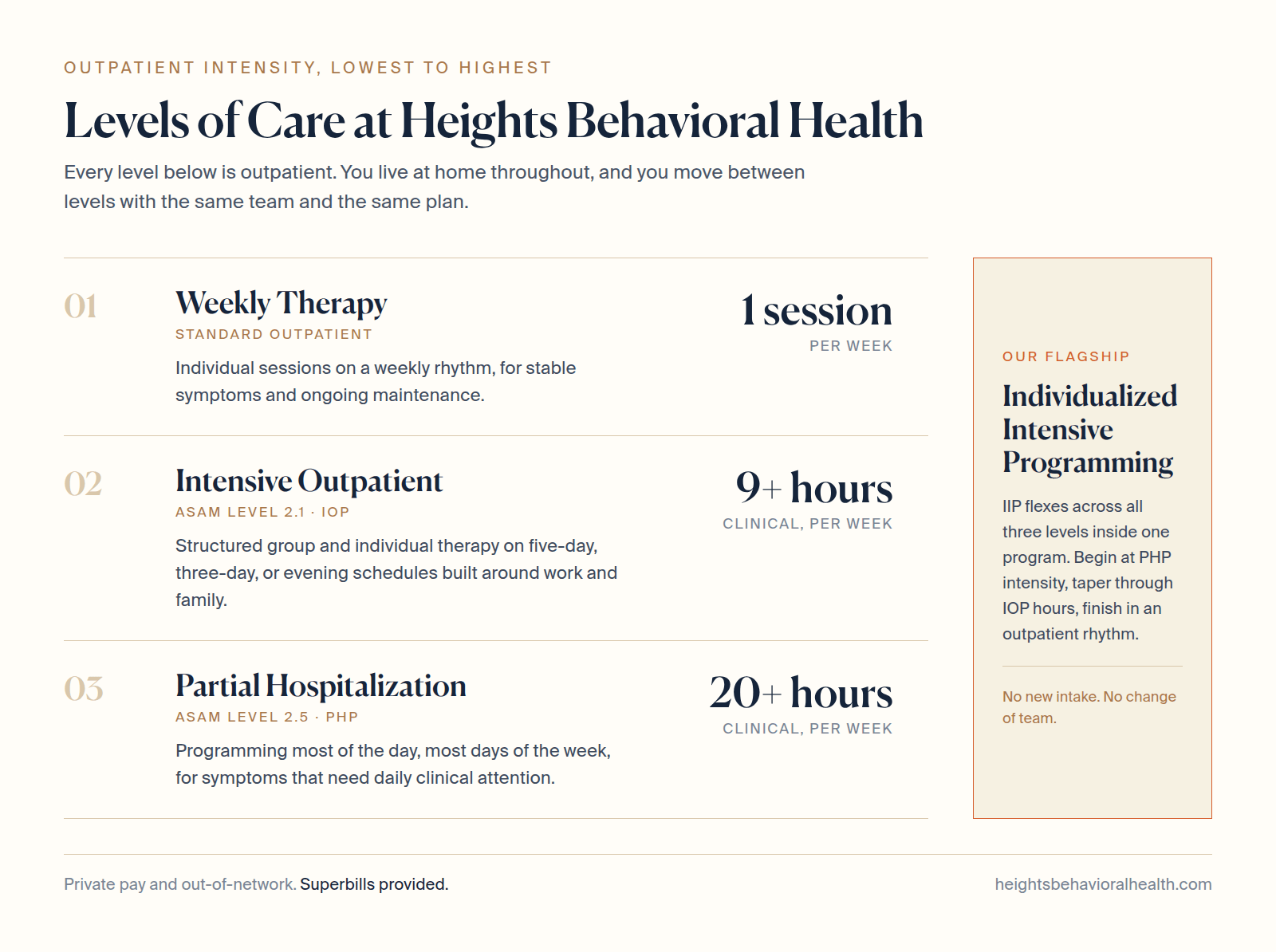
Outpatient treatment delivers real clinical intensity while you keep living your life. At the higher end, a partial hospitalization or intensive outpatient program can mean most of a day, several days a week, with individual therapy, group work, and psychiatric care. You sleep in your own bed, keep working or parenting, and practice recovery in the environment where you actually have to sustain it.
How Do They Actually Compare?
| Residential | Outpatient | |
|---|---|---|
| Where you live | On site, 24 hours a day | At home |
| Typical length | About 30 to 90 days | Weeks to months, stepping down over time |
| Work, school, family | Paused | Maintained, and often built into the plan |
| Best when | Medical risk, unsafe home, or repeated failed attempts to stop | Medically stable, a workable home, and real motivation |
| Main strength | Containment and constant support | Practicing recovery in real life, with support around it |
| Main limitation | Life is interrupted; re-entry can be its own risk | Requires enough stability to go home each night |
| Cost | Higher, reflecting 24-hour care | Lower per week than residential |
Confidential Next Step
Not sure which level you actually need?
One confidential call and a clinical assessment will tell you, even if the answer is a program other than ours.
When Residential Is the Right Answer
We would rather send you to the right place than keep you in the wrong one. Residential or a higher level of care generally comes first when there is active withdrawal that needs medical supervision, significant medical or psychiatric instability, a home environment where using is unavoidable, no reliable place to sleep, or a pattern of trying outpatient and being unable to stay safe between sessions.
If any of that is true, we will say so on the first call and help you find an appropriate placement.
When Outpatient Works Better
Outpatient is often the stronger choice when you are medically stable, when you have a home that supports recovery, when work or caregiving cannot simply be paused, and when you want to build recovery skills in the same environment where you will have to use them. It is also the natural step down after residential, which is why continuing care matters so much.
It Is Usually a Sequence, Not a Choice
Framing this as either-or is misleading. Many people move through levels: detox if needed, then residential, then PHP, then IOP, then ongoing care. The highest-risk window is the transition between them, when support drops sharply. Our Individualized Intensive Programming is built to hold that step down, and our admissions team can help you plan it.
How Payment Works at Heights Behavioral Health
Heights Behavioral Health is a private-pay, out-of-network provider and is not in network with insurance plans. Some clients have out-of-network benefits that offset part of the cost, and we are upfront about pricing before you commit. See our guide to cost and superbills.
If this is an emergency or you are thinking about harming yourself, call 911, or call or text 988 to reach the Suicide and Crisis Lifeline. In Harris County, The Harris Center operates a 24-hour crisis line at 713-970-7000. Heights Behavioral Health is an outpatient program and is not a 24-hour crisis service.
The outpatient-versus-residential question is exactly what the national placement framework was built to answer; see our plain-English guide to the ASAM criteria.
Frequently Asked Questions
Is residential treatment more effective than outpatient?
Not inherently. Research supports matching the level of care to clinical need rather than defaulting to the most intensive option. For medically stable people with a workable home, outpatient outcomes are comparable, and the skills are practiced in real life.
Can I start with outpatient instead of residential?
Often, yes, if you are medically stable and safe at home. An assessment determines that. If withdrawal or safety risk is present, detox or residential comes first.
Do you take insurance?
We are private pay and out of network, and not in network with any plan. Cost is one of the real differences between outpatient and residential care, so we quote ours before you compare. If your plan has out-of-network benefits, we provide a superbill you can submit.
What if I try outpatient and it is not enough?
That is useful information, not failure. Levels of care are meant to flex. If you need more structure, we help you step up; if you stabilize, you step down.
Do I have to stop working to get treatment?
Usually not in outpatient. Programs commonly offer day, evening, or three-day schedules built around work and caregiving.
The Right Level of Care, Decided Clinically
One confidential call and an assessment will tell you which level fits, and we will point you elsewhere if that serves you better.
Sources
Written and Reviewed by Licensed Clinicians
Joni Ogle is a Licensed Clinical Social Worker (LCSW) and Certified Sex Addiction Therapist (CSAT) with over 37 years of clinical experience in mental health and addiction recovery, dual diagnosis treatment, behavioral addictions, and family intervention. She is the founder of Heights Behavioral Health and Heights Mentoring in Houston, Texas, where she leads a team of licensed clinicians.
Texas LCSW #37376 · Verify license
Deborah Darnell-Drake, LCSW-S, ACSW, LMFT is the Chief Clinical Officer at Heights Behavioral Health and a clinical reviewer. With more than five decades of experience in mental health and substance use disorder treatment, Deborah specializes in addiction, co-occurring mental health conditions, family dynamics, and behavioral addictions including gambling and technology addiction.
Texas LCSW-S #14508 · LMFT #1125 · Verify license
Start a Confidential Conversation
One confidential message connects you with our admissions team and a clear next step. Prefer to talk now? Call (877) 549-5102.