




Key Takeaways
- Private pay treatment means paying the program directly rather than billing an insurance network, and at Heights in Houston it is a deliberate model with pricing shared upfront before you commit.
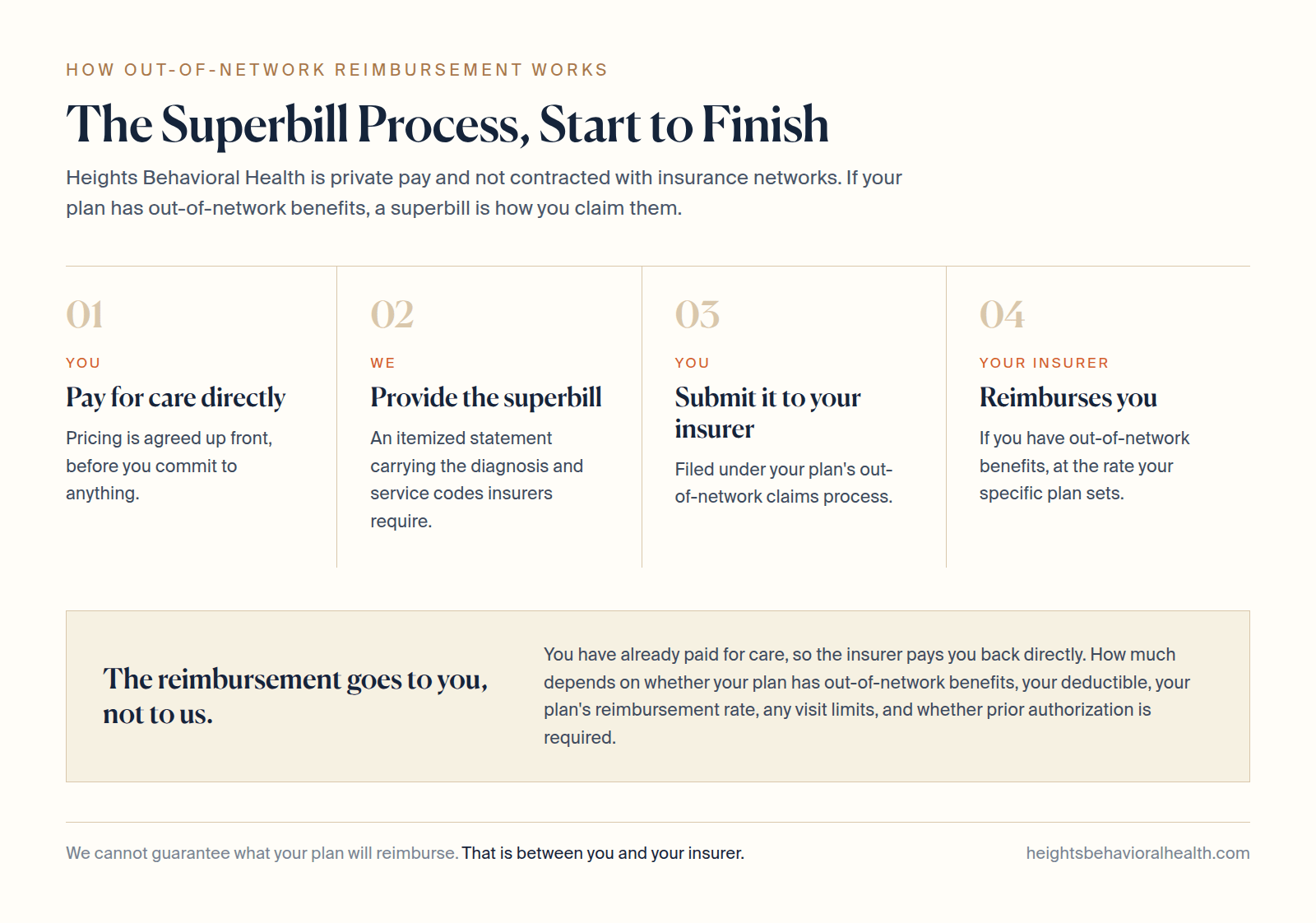
- With out-of-network benefits, you can submit a superbill and be reimbursed for part of what you paid, and that reimbursement goes to you because you have already paid for care.
- The model lets length and intensity of care be clinical decisions rather than authorization decisions, and because nothing is filed as an insurance claim, privacy is structurally different.
- When comparing programs, ask for the total weekly cost, what is billed separately, whether a superbill is provided, what happens if you need more time, and who your therapist would be.
- Private pay is not right for everyone, and if cost is genuinely out of reach or a higher level of care is needed first, an honest program will point you toward other options.
Private pay treatment means you pay the program directly instead of billing an insurance network. At Heights Behavioral Health in Houston, that is a deliberate model, not a workaround. It lets the clinical team build care around the person rather than around what a plan will authorize, and it gives you privacy that in-network billing cannot. You still may recover part of the cost through out-of-network benefits, and we are upfront about pricing before you commit to anything.
Most people meet the phrase “private pay” at the worst possible moment: they are frightened, they need help quickly, and the word sounds like a closed door. It is worth understanding what the model actually is before deciding it is out of reach.
What Does Private Pay Actually Mean?
Private pay, sometimes called cash-pay or self-pay, means the program is not contracted with insurance networks. You pay the provider directly at an agreed price. It does not mean insurance is irrelevant. If your plan includes out-of-network benefits, you can submit a superbill and be reimbursed for part of what you paid, and our guide to out-of-network coverage explains how those benefits work.
Why Would a Program Choose to Be Private Pay?
This is the question worth asking of any program, and the honest answer is that the model changes who controls the treatment plan.
- The clinical plan is not authorization-driven. In-network care often runs on approved days and documented “medical necessity” reviews. When a plan stops authorizing, care ends, whether or not the person is ready.
- Length and intensity are clinical decisions. Stepping someone down from PHP to IOP happens when they stabilize, not when a benefit runs out.
- Privacy is structurally different. Nothing is filed through an insurance claim, so there is no claims record of your diagnosis or treatment sitting with a plan or an employer-sponsored insurer.
- Smaller programs stay small. Network reimbursement rates push volume; private pay lets a program keep groups small and clinicians specialized.
What Cash-Pay Care Actually Buys You
Cost is only meaningful next to what it includes. At Heights, a week of care is a full clinical program, not a series of billed appointments.
| What is included | Why it matters |
|---|---|
| A clinical assessment that sets the plan | Level of care is matched to you rather than to a default track |
| Individual therapy with a licensed, master’s-level clinician | Continuity with one clinician who knows your history |
| Specialized group programming | Process, skills, and experiential groups rather than one generic curriculum |
| Specialty modalities where they fit | CSAT, EMDR, Somatic Experiencing, CPT, and neurofeedback |
| Medication management and coordination | Including MAT with buprenorphine or naltrexone where clinically appropriate |
| Family involvement | Because outcomes improve when the people around you are included |
Confidential Next Step
Want to know what your care would actually cost?
One confidential call gives you real pricing and a clinical recommendation, with no obligation.
Who Private Pay Fits, and Who It Does Not
It fits people who want a specific level of clinical specialization, who value privacy highly, who have out-of-network benefits worth using, or who have been through in-network care that ended before it worked.
It is not the right answer for everyone, and we would rather say so on the first call than after you commit. If cost is genuinely out of reach, there are in-network and public options in Houston, and we will point you toward them. A program that will not tell you its price, or that pressures you before an assessment, is a program to walk away from.
How to Compare Programs on Cost Honestly
- Ask for the total weekly cost, not a per-session rate.
- Ask what is included and what is billed separately, such as psychiatry or testing.
- Ask whether they provide a superbill and how often.
- Ask what happens clinically if you need more time than expected.
- Ask who your therapist would be and what their credentials are.
When You Need More Than Outpatient Care
If there is active withdrawal, significant medical risk, or an acute psychiatric crisis, a higher level of care comes first and we will say so and help you find it. For non-clinical support, our sister practice Heights Mentoring may be a fit. When you are ready to start here, our admissions team will walk you through it.
If this is an emergency or you are thinking about harming yourself, call 911, or call or text 988 to reach the Suicide and Crisis Lifeline. In Harris County, The Harris Center operates a 24-hour crisis line at 713-970-7000. Heights Behavioral Health is an outpatient program and is not a 24-hour crisis service.
Frequently Asked Questions
Is private pay the same as being uninsured?
No. Many private-pay clients have insurance. Private pay means the program does not bill your insurance network directly. If your plan has out-of-network benefits, you can still submit a superbill for possible reimbursement.
Will I get any money back?
That depends entirely on your plan, your out-of-network deductible, and the insurer’s allowed amount. Some clients are reimbursed for a meaningful share, others for none. We provide the superbill and explain the process, but we will not promise a figure.
Why does private pay cost more up front?
Because you are paying the full cost of care directly rather than a negotiated network rate with the balance billed to an insurer. In exchange, the treatment plan is set clinically and your care is not filed through an insurance claim.
Do you tell me the price before I commit?
Yes. You get clear pricing for the recommended level of care before you agree to anything. If a program will not do that, treat it as a warning sign.
Can I use an HSA or FSA?
Many clients use HSA or FSA funds for outpatient behavioral health care. Check with your plan administrator, since eligibility rules are set by the account, not by us.
Get Real Numbers, Not a Runaround
One confidential call gives you honest pricing, a clinical recommendation, and a clear next step, whether or not you start here.
Sources
Written and Reviewed by Licensed Clinicians
Joni Ogle is a Licensed Clinical Social Worker (LCSW) and Certified Sex Addiction Therapist (CSAT) with over 37 years of clinical experience in mental health and addiction recovery, dual diagnosis treatment, behavioral addictions, and family intervention. She is the founder of Heights Behavioral Health and Heights Mentoring in Houston, Texas, where she leads a team of licensed clinicians.
Texas LCSW #37376 · Verify license
Deborah Darnell-Drake, LCSW-S, ACSW, LMFT is the Chief Clinical Officer at Heights Behavioral Health and a clinical reviewer. With more than five decades of experience in mental health and substance use disorder treatment, Deborah specializes in addiction, co-occurring mental health conditions, family dynamics, and behavioral addictions including gambling and technology addiction.
Texas LCSW-S #14508 · LMFT #1125 · Verify license
Start a Confidential Conversation
One confidential message connects you with our admissions team and a clear next step. Prefer to talk now? Call (877) 549-5102.