




Key Takeaways
- In Texas, titles like counselor, coach, and therapist are not equally protected. Verifying a license takes about two minutes and is the single most useful step before trusting someone with your mental health.
- The Texas Behavioral Health Executive Council offers a public license lookup at bhec.texas.gov for counselors, family therapists, clinical social workers, and psychologists. Physicians and psychiatrists are verified through the Texas Medical Board.
- When checking, confirm the license is active, note its type and any disciplinary history, make sure the name matches your clinician, and see whether they are a supervisee, which is legitimate but worth knowing.
- Certifications such as CSAT or EMDR training describe added training on top of a license, not a substitute for one. Recovery, life, and sober coach are unregulated terms in Texas, and coaches cannot diagnose or treat disorders.
- Ask directly who you will work with, what their license is, and who supervises them. A program that cannot name your clinician before you pay is telling you something.
In Texas, titles like counselor, coach, and therapist are not all equally protected, and the difference matters most when you are least equipped to investigate it. Verifying a license takes about two minutes. It is the single most useful thing you can do before handing someone your mental health, and almost nobody does it.
Verify the License First
The Texas Behavioral Health Executive Council maintains a public license lookup covering Licensed Professional Counselors, Licensed Marriage and Family Therapists, Licensed Clinical Social Workers, and psychologists. Search by name or license number at bhec.texas.gov. Physicians and psychiatrists are separate and are verified through the Texas Medical Board.
Note that some profile details are self-reported by the license holder. The license status itself is the authoritative part.
What to Check While You Are There
- That the license is active rather than expired, inactive, or surrendered
- The license type, which tells you the scope of practice
- Whether there is any disciplinary history on record
- That the name matches the person you are actually going to see
- Whether they are a supervisee, which is not disqualifying but is worth knowing
What the Letters Actually Mean
- LPC licensed professional counselor. LPC-S is approved to supervise others
- LCSW licensed clinical social worker. LCSW-S is a supervisor
- LMFT licensed marriage and family therapist
- PsyD or PhD psychologist, doctoral level, licensed separately
- MD or DO physician, including psychiatrists, who can prescribe
- LPC-Associate or LMSW practicing under supervision, which is legitimate and should be disclosed
Credentials That Are Not Licenses
Certifications sit on top of a license and describe additional training. CSAT indicates certified sex addiction therapist training. EMDR trained or EMDR certified indicates trauma training through EMDRIA. Those are meaningful, and they are not substitutes for a license. If someone holds a certification and no state license, they are not a licensed clinician, whatever the website says.
The Word Coach
Recovery coach, life coach, and sober coach are unregulated terms in Texas. No license is required, no board oversees them, and there is no complaint process if something goes wrong. Some coaches are excellent and provide real value. What they cannot do is diagnose or treat a mental health or substance use disorder, and a program that staffs coaches where clinicians should be is worth asking hard questions about.
Confidential Next Step
Vetting programs, not just individuals?
Our guide to choosing a program covers the ten questions worth asking.
Questions Worth Asking Directly
Who specifically will I be working with, and what is their license? Are they supervised, and by whom? What training do they have in the thing I am coming for? A program that cannot name your clinician before you pay is telling you something. Our choosing an outpatient program article has the full list.
Apply This to Us
Our clinicians are master’s level and licensed, and every article on this site names its author and its clinical reviewer with their credentials, which you are welcome to verify. We are also clear about what we are not: we do not provide medical detox or residential care, and our author and reviewer are licensed clinicians rather than physicians. If you want a physician-led program, that is a legitimate preference and worth naming on your first call.
If this is an emergency or you are thinking about harming yourself, call 911, or call or text 988 to reach the Suicide and Crisis Lifeline. In Harris County, The Harris Center operates a 24-hour crisis line at 713-970-7000. Heights Behavioral Health is an outpatient program and is not a 24-hour crisis service.
Frequently Asked Questions
How do I verify a therapist license in Texas?
Use the Texas Behavioral Health Executive Council license lookup at bhec.texas.gov, which covers LPCs, LMFTs, LCSWs, and psychologists. Physicians are verified separately through the Texas Medical Board.
Is a recovery coach the same as a therapist?
No. Coach titles are unregulated in Texas, require no license, and carry no board oversight or complaint process. Coaches cannot diagnose or treat mental health or substance use disorders.
Do you take insurance?
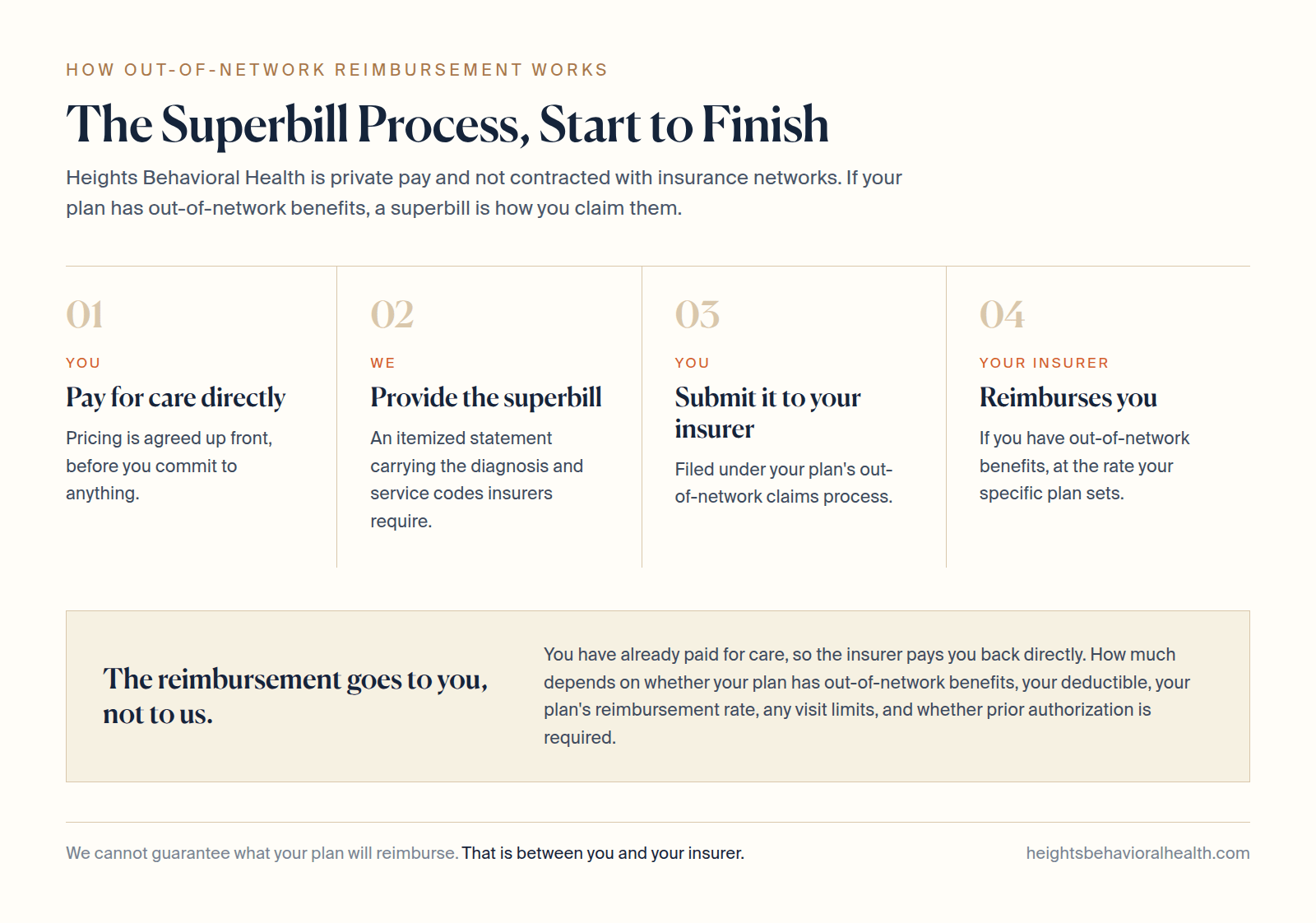
We are private pay and out of network, and not in network with any plan. Asking a provider directly about cost and network status is part of vetting them, and our answer is that we are not contracted with insurers and pricing is explained upfront. If your plan has out-of-network benefits, we provide a superbill you can submit.
What does the -S mean after a license?
It indicates the clinician is board-approved to supervise other clinicians, as in LPC-S or LCSW-S. It generally reflects additional experience.
Is it a problem if my therapist is an associate?
Not inherently. Associates practice under supervision and it is a normal stage of licensure. It should be disclosed to you, and you can ask who provides the supervision.
Are certifications like CSAT or EMDR the same as a license?
No. They are additional training layered on top of a license. Someone holding a certification with no state license is not a licensed clinician.
Ask Us the Same Questions
We will name your clinician and their credentials before you commit to anything.
Sources
Written and Reviewed by Licensed Clinicians
Joni Ogle is a Licensed Clinical Social Worker (LCSW) and Certified Sex Addiction Therapist (CSAT) with over 37 years of clinical experience in mental health and addiction recovery, dual diagnosis treatment, behavioral addictions, and family intervention. She is the founder of Heights Behavioral Health and Heights Mentoring in Houston, Texas, where she leads a team of licensed clinicians.
Texas LCSW #37376 · Verify license
Deborah Darnell-Drake, LCSW-S, ACSW, LMFT is the Chief Clinical Officer at Heights Behavioral Health and a clinical reviewer. With more than five decades of experience in mental health and substance use disorder treatment, Deborah specializes in addiction, co-occurring mental health conditions, family dynamics, and behavioral addictions including gambling and technology addiction.
Texas LCSW-S #14508 · LMFT #1125 · Verify license
Start a Confidential Conversation
One confidential message connects you with our admissions team and a clear next step. Prefer to talk now? Call (877) 549-5102.