




Key Takeaways
- Asking every outpatient program the same ten questions is the fastest way to compare them. Good programs answer plainly, while those that deflect, pressure you, or avoid discussing cost are telling you something important.
- Ask who your therapist would be and what license they hold, what level of care is recommended and why, and what a typical week actually includes in hours, groups, and individual sessions.
- Ask for the total weekly cost and what is billed separately, whether the program is in-network or provides superbills, and how co-occurring conditions like anxiety, depression, ADHD, or trauma are treated together.
- Ask what the program does not do, how detox or a higher level of care is handled, what family involvement looks like, and what step-down support exists when the program ends.
- Be skeptical of advertised success rates, since there is no standardized definition of success. Walk away from pressure to admit today, guaranteed cures, patient-broker offers, or no named licensed clinician.
Choosing a treatment program is a high-stakes decision made under pressure, usually by someone exhausted or frightened. The fastest way to tell programs apart is to ask the same ten questions of each one and compare the answers. Good programs answer plainly. Programs that deflect, pressure you, or will not discuss cost before an assessment are telling you something important.
What follows is the list we would want our own family to use, including the answers that should make you cautious about us.
1. Who Would Actually Be My Therapist, and What Are Their Credentials?
You want a named, licensed clinician and a real credential: LCSW, LPC, LMFT, PsyD, or PhD, plus any specialty certification relevant to your situation such as CSAT for compulsive sexual behavior or EMDR training for trauma. Be cautious if the answer is vague about licensure or if you will not know who you are working with until after you pay.
2. What Level of Care Do You Think I Need, and Why?
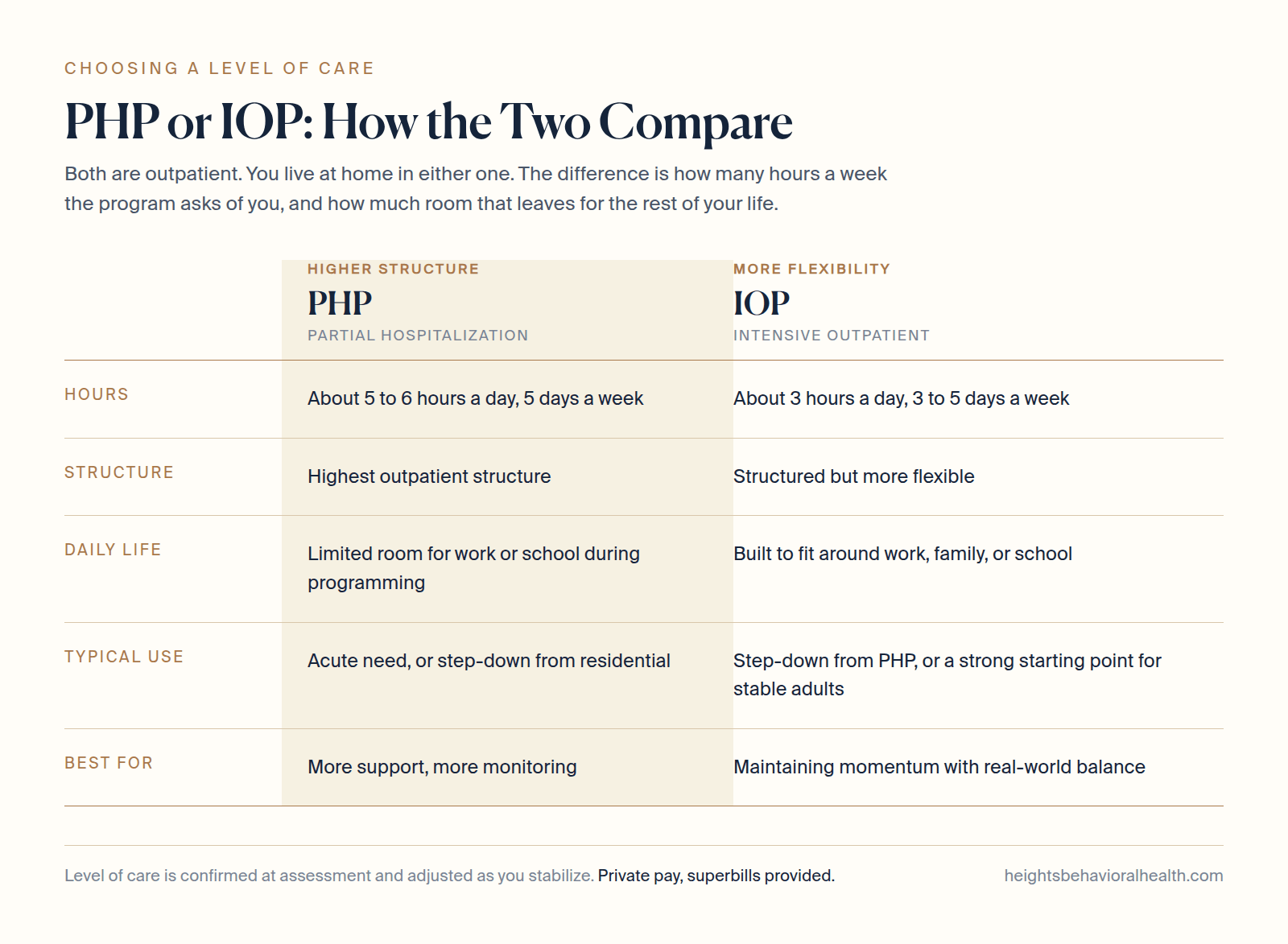
A good program recommends a level of care after an assessment and explains the reasoning. Be cautious if every caller is recommended the most intensive option, or if the recommendation arrives before anyone has asked about your history.
3. What Does a Typical Week Actually Look Like?
Ask for the real schedule: how many hours, which groups, how much individual therapy, and who leads what. “Individual therapy” that turns out to be once a month is a very different program from one with weekly sessions.
4. How Much Does It Cost, in Total, Per Week?
Ask for the weekly total, not a per-session rate, and ask what is billed separately. Any program that will not give you a number before you commit is one to avoid. Ours is a private-pay, out-of-network model and we quote it upfront; our guide to cost and superbills explains how reimbursement can work.
5. Do You Take My Insurance, or Provide a Superbill?
If in-network, ask how many sessions are authorized and what happens when authorization ends. If out-of-network, ask whether they provide superbills and how often. Both models are legitimate; what matters is that you understand which one you are in.
Confidential Next Step
Want honest answers to all ten, about us?
One confidential call, no pressure, and we will tell you if another program is the better fit.
6. How Do You Handle Co-occurring Mental Health Conditions?
Most people seeking addiction treatment also have anxiety, depression, ADHD, or trauma. Ask whether both are treated together and by whom. Sequential treatment, where you address one and then the other, is a common reason people relapse. Our dual diagnosis care treats them at once.
7. What Happens if I Need Detox or a Higher Level of Care?
Ask directly what the program does not do. A trustworthy answer names the limits and describes the referral relationships. We do not provide medical detox or methadone on site, we do offer MAT with buprenorphine and naltrexone, and we coordinate detox referrals when they are needed first.
8. What Does Family Involvement Look Like?
Outcomes improve when the people around you are included. Ask whether there is family programming, how often, and whether it is available virtually for relatives who cannot attend in person.
9. What Happens When the Program Ends?
The transition out is the highest-risk window in treatment. Ask what step-down and alumni support exist, and whether the plan is written before discharge rather than after. This is what our relapse prevention and continuing care approach is built around.
10. What Are Your Outcomes, and How Do You Measure Them?
Be skeptical of a program advertising a specific success rate. There is no standardized definition of success in this field, and impressive percentages are usually marketing rather than data. A more honest answer describes how progress is tracked and reviewed, and admits the limits of the measurement.
Red Flags Worth Walking Away From
- Pressure to admit today, or a “bed available now” urgency script
- Refusal to discuss cost before an assessment
- Guaranteed success rates or promises of a cure
- Paid patient-broker arrangements or offers to cover your travel
- No named, licensed clinician you can identify before starting
- Vague answers about what the program does not treat
If this is an emergency or you are thinking about harming yourself, call 911, or call or text 988 to reach the Suicide and Crisis Lifeline. In Harris County, The Harris Center operates a 24-hour crisis line at 713-970-7000. Heights Behavioral Health is an outpatient program and is not a 24-hour crisis service.
One more tool for the shortlist: our plain-English guide to the ASAM criteria, the framework any good program should be using to recommend your level of care.
Frequently Asked Questions
What is the single most important question to ask?
What level of care do you recommend for me, and why. It reveals whether the program assesses clinical need or defaults every caller to the same answer.
Should I trust programs that advertise a success rate?
Be skeptical. There is no standard definition of success in addiction treatment, so published rates are rarely comparable and are often marketing. Ask instead how progress is measured and reviewed.
Do you take insurance?
We are private pay and out of network, so we are not contracted with insurance plans. Ask every program on your list this early, and ask what happens to the number if you need more or fewer hours. Our pricing is explained before you commit, and we provide a superbill if your plan has out-of-network benefits.
Is out-of-network care worse than in-network?
No, it is a different model. In-network care can be constrained by authorization; out-of-network care is set clinically but costs more upfront. What matters is understanding which you are in and what it includes.
How do I compare two programs fairly?
Ask all of them the same ten questions and write down the answers. Differences in specificity, especially about credentials, weekly hours, and cost, tell you more than the brochure does.
Ask Us the Same Ten Questions
One confidential call gets you straight answers about credentials, schedule, cost, and fit, including whether another program would serve you better.
Sources
Written and Reviewed by Licensed Clinicians
Joni Ogle is a Licensed Clinical Social Worker (LCSW) and Certified Sex Addiction Therapist (CSAT) with over 37 years of clinical experience in mental health and addiction recovery, dual diagnosis treatment, behavioral addictions, and family intervention. She is the founder of Heights Behavioral Health and Heights Mentoring in Houston, Texas, where she leads a team of licensed clinicians.
Texas LCSW #37376 · Verify license
Deborah Darnell-Drake, LCSW-S, ACSW, LMFT is the Chief Clinical Officer at Heights Behavioral Health and a clinical reviewer. With more than five decades of experience in mental health and substance use disorder treatment, Deborah specializes in addiction, co-occurring mental health conditions, family dynamics, and behavioral addictions including gambling and technology addiction.
Texas LCSW-S #14508 · LMFT #1125 · Verify license
Start a Confidential Conversation
One confidential message connects you with our admissions team and a clear next step. Prefer to talk now? Call (877) 549-5102.