



Key Takeaways
- Dual diagnosis means having a substance use issue and a mental health condition such as anxiety, depression, PTSD, or bipolar disorder at the same time, and the two feed each other.
- Common pairings include drinking to quiet anxiety that rebounds harder, using while depression deepens, self-medicating trauma symptoms, and use patterns that track with bipolar mood episodes.
- Treating only one side rarely works because the untreated condition keeps driving use, withdrawal and intoxication can mask or mimic symptoms, and separate providers can give conflicting guidance.
- Integrated care means one team and one plan for both conditions, starting with a coordinated assessment, with psychiatric coordination and family involvement when they help.
- If treatment for one problem has not held, or both conditions are clearly at work, a clinical assessment is the most reliable way to confirm a dual diagnosis and match the right level of care.
Dual diagnosis, also called co-occurring disorders, means a person has both a substance use issue and a mental health condition such as anxiety, depression, PTSD, or bipolar disorder at the same time. In Houston, treating one while ignoring the other is one of the most common reasons recovery does not hold. At Heights Behavioral Health, dual diagnosis treatment addresses both together, in one coordinated plan, by a team that communicates, because the two problems feed each other and rarely heal in isolation.
People reach this page two ways. Either a diagnosis named both a mental health condition and a substance use issue, or you have watched treatment that targeted only one of them fail to last. Both paths end at the same question: why does addressing both at once matter so much?
After 37 years of clinical work in Houston, here is my honest answer. When anxiety, depression, or trauma sits underneath substance use, treating the substance alone is like bailing a boat without patching the hole. The relief lasts until the underlying condition pushes back. Integrated care patches the hole and bails at the same time. This guide explains what dual diagnosis is, why it is so common, how integrated treatment works, and how to start.
What Does Dual Diagnosis Actually Mean?
Dual diagnosis is not a single condition. It is any combination of a mental health disorder and a substance use disorder occurring together. Common pairings we see include:
- Anxiety and alcohol. Drinking to quiet anxiety that then rebounds harder the next day. Our guide to anxiety and alcohol looks at this cycle in detail.
- Depression and substance use. Using to feel something, or to feel less, while the depression deepens underneath.
- Trauma or PTSD and substances. Self-medicating symptoms of trauma that talk therapy alone has not resolved.
- Bipolar disorder and substance use. Patterns of use that track with mood episodes and complicate both.
Why Does Treating Only One Side Rarely Work?
For decades, people were sent to addiction treatment in one place and mental health treatment in another, with neither team talking to the other. The results were predictable.
- The untreated condition keeps driving use. If anxiety is the engine, sobriety without anxiety care leaves the engine running.
- Symptoms get misread. Withdrawal can look like anxiety; intoxication can mask depression. One team seeing the whole picture reads it correctly.
- Care plans contradict each other. Separate providers can give conflicting guidance. Integrated care keeps the plan coherent.
Confidential Next Step
Think both pieces are in play?
If a mental health condition and substance use seem tangled together, a confidential assessment can sort out what is driving what, and what level of care fits.
How Does Integrated Dual Diagnosis Treatment Work?
Integrated means one team, one plan, both conditions. At Heights Behavioral Health, dual diagnosis care is built into our outpatient levels of care rather than bolted on.
- One coordinated assessment. We look at the substance use and the mental health condition together, including how they interact.
- A plan that treats both. Therapy for the mental health condition, structured support for the substance use, and psychiatric coordination when medication is part of care.
- The right level of care. Dual diagnosis can be treated in PHP or IOP, or in our flagship Individualized Intensive Programming when a personalized plan fits best.
- Family involvement. When it helps, families are brought in, because co-occurring conditions affect the whole household.
When Should You Reach Out?
If treatment for one problem has not held, or if you can see both a mental health condition and substance use at work, that is exactly the situation integrated care is built for. A clinical assessment is the most reliable way to confirm a dual diagnosis and match it to the right level of care. If a loved one needs non-clinical, lower-acuity support instead of treatment, our sister practice Heights Mentoring may be the right starting point.
Heights Behavioral Health is a private-pay, out-of-network provider, and we are clear about pricing before you commit to anything. See how cost and out-of-network benefits work.
If this is an emergency or you are thinking about harming yourself, call 911, or call or text 988 to reach the Suicide and Crisis Lifeline. In Harris County, The Harris Center operates a 24-hour crisis line at 713-970-7000. Heights Behavioral Health is an outpatient program and is not a 24-hour crisis service.
For the two most common pairings we treat, read our in-depth guides to bipolar disorder and alcohol and PTSD and alcohol.
Frequently Asked Questions
What is the difference between dual diagnosis and co-occurring disorders?
They mean the same thing: a mental health condition and a substance use disorder present at the same time. Clinicians use the terms interchangeably.
Which should be treated first, the addiction or the mental health condition?
Neither, in isolation. Current best practice is integrated treatment that addresses both at once, because each condition affects the other. Treating them separately is a common reason recovery does not last.
Do you take insurance for dual diagnosis treatment?
We are private pay and out of network, so we are not contracted with insurance plans. Treating both conditions is one plan and one quote rather than two, explained before you commit to anything. Superbills are available if your plan has out-of-network benefits.
Can dual diagnosis be treated in an outpatient program?
Often, yes. Many adults are treated successfully in PHP, IOP, or a personalized plan while living at home. People in an acute crisis or active withdrawal may need a higher level of care first, and we will say so.
Does Heights Behavioral Health treat both conditions in one place?
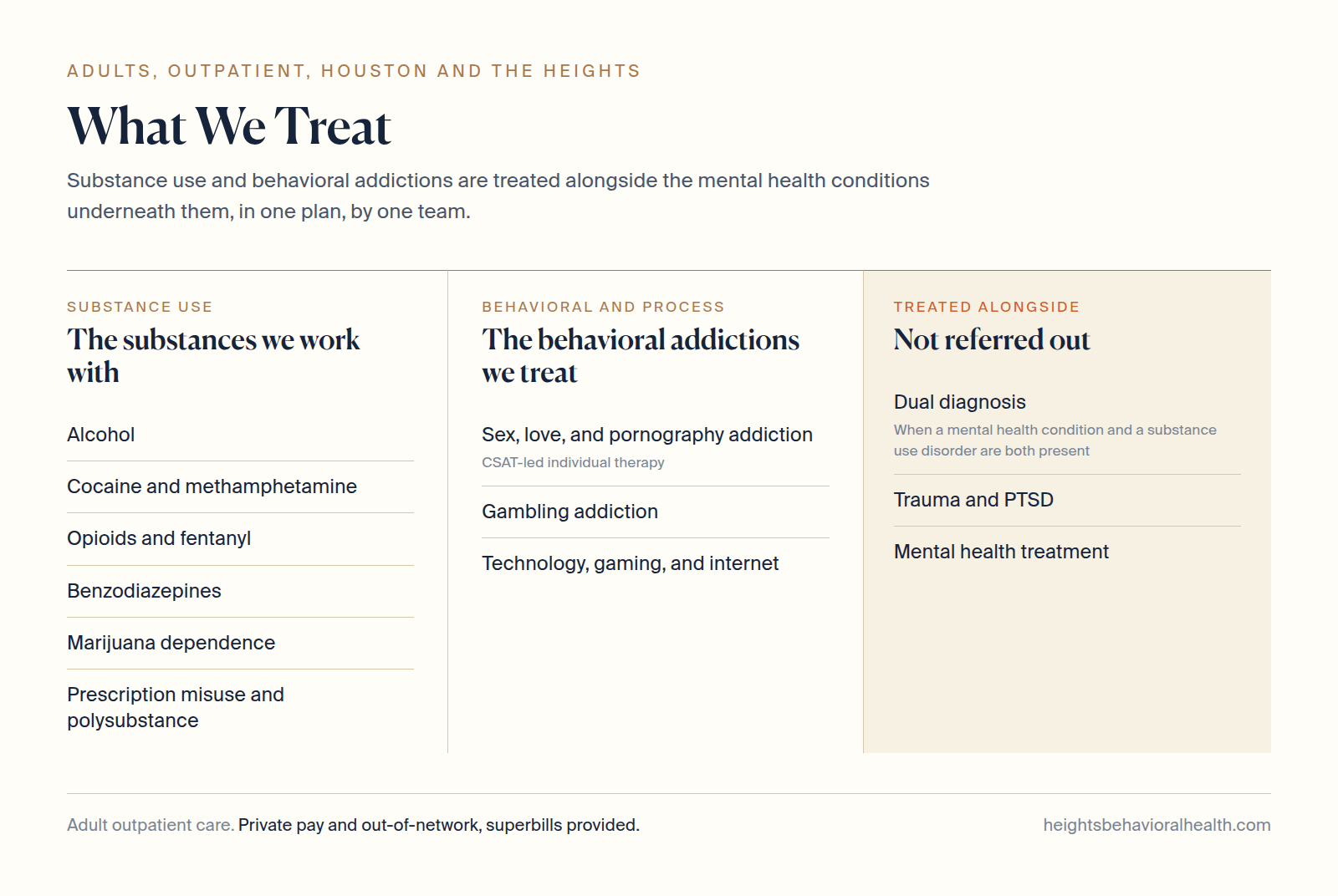
Yes. We treat adults with substance use, mental health, and co-occurring conditions together, with one team and one coordinated plan, rather than referring the two problems to separate providers.
Treat the Whole Picture, Not Half of It
If a mental health condition and substance use are tangled together, one confidential call will help you understand how integrated treatment works and what the next step looks like.
Sources
- Substance Abuse and Mental Health Services Administration (SAMHSA). Co-Occurring Disorders and Integrated Treatment. samhsa.gov
- National Institute on Drug Abuse (NIDA). Common Comorbidities with Substance Use Disorders. nida.nih.gov
- National Institute of Mental Health (NIMH). Substance Use and Co-Occurring Mental Disorders. nimh.nih.gov
Written and Reviewed by Licensed Clinicians
Joni Ogle is a Licensed Clinical Social Worker (LCSW) and Certified Sex Addiction Therapist (CSAT) with over 37 years of clinical experience in mental health and addiction recovery, dual diagnosis treatment, behavioral addictions, and family intervention. She is the founder of Heights Behavioral Health and Heights Mentoring in Houston, Texas, where she leads a team of licensed clinicians.
Texas LCSW #37376 · Verify license
Deborah Darnell-Drake, LCSW-S, ACSW, LMFT is the Chief Clinical Officer at Heights Behavioral Health and a clinical reviewer. With more than five decades of experience in mental health and substance use disorder treatment, Deborah specializes in addiction, co-occurring mental health conditions, family dynamics, and behavioral addictions including gambling and technology addiction.
Texas LCSW-S #14508 · LMFT #1125 · Verify license
Start a Confidential Conversation
One confidential message connects you with our admissions team and a clear next step. Prefer to talk now? Call (877) 549-5102.