



Key Takeaways
- PHP is the most structured outpatient level of care, generally five days a week for most of the day, and you sleep at home each night.
- Mornings begin with a check-in that sets the clinical agenda and a process group, followed by skills work in approaches like CBT, DBT, ACT, and relapse prevention that you can use that night.
- Midday shifts to experiential and body-oriented work, and afternoons carry specialty groups and individual sessions such as CPT, EMDR, Somatic Experiencing, and neurofeedback as indicated.
- Going home in the evening is part of the design, because evenings are where the day’s skills get tested in the same kitchen, with the same phone and the same people.
- Length of stay depends on clinical need, and most people step down to IOP; active withdrawal risk, an unsafe household, or acute crisis calls for detox or residential referral first.
People ask what partial hospitalization involves and get a brochure answer. Here is the concrete version: what a day looks like, what happens in each block, and what you do with the hours that are not programming. PHP is the most structured outpatient level of care, generally five days a week for most of the day, and you sleep at home.
Morning: Check-In and Process Group
Days start with a check-in, which is less small talk than it sounds. It sets the clinical agenda: who slept, who had cravings, who had a hard conversation last night. Process group follows, where the actual work happens between people rather than in a lecture.
Mid-Morning: Skills
This block is structured and teachable: CBT, DBT, ACT, motivational interviewing, addiction education, relapse prevention. It is where you get tools you can use that night, which matters more in outpatient care than in residential, because you go home to the same environment every evening.
Midday: Break, and Then Something Different
After a break, programming shifts to work that is not talk-based: experiential and body-oriented groups, guided meditation or body scan, art therapy, equine work, nutrition, or yoga depending on the day. This is not filler. For people whose nervous systems are the actual problem, these sessions often do more than another hour of discussion. Our experiential therapy article covers why.
Afternoon: Specialty Groups and Individual Work
Afternoons carry the targeted groups: Process Addictions, Healthy Relationships, Shame Resilience, Anger Awareness, Spirituality, Goals and Intentions. Individual sessions are scheduled through the week, including CSAT, CPT, EMDR, Somatic Experiencing, and neurofeedback as indicated. Our group programming article lists the full slate.
Confidential Next Step
Want to see the actual current schedule?
Call and we will walk you through this week, group by group.
Evenings and Weekends
You go home. That is the design, not a shortcut. Evenings are where the day gets tested: the same kitchen, the same phone, the same people. Homework is usually practical rather than academic, and family programming, including a virtual group for loved ones, happens outside the treatment day.
How Long People Stay in PHP
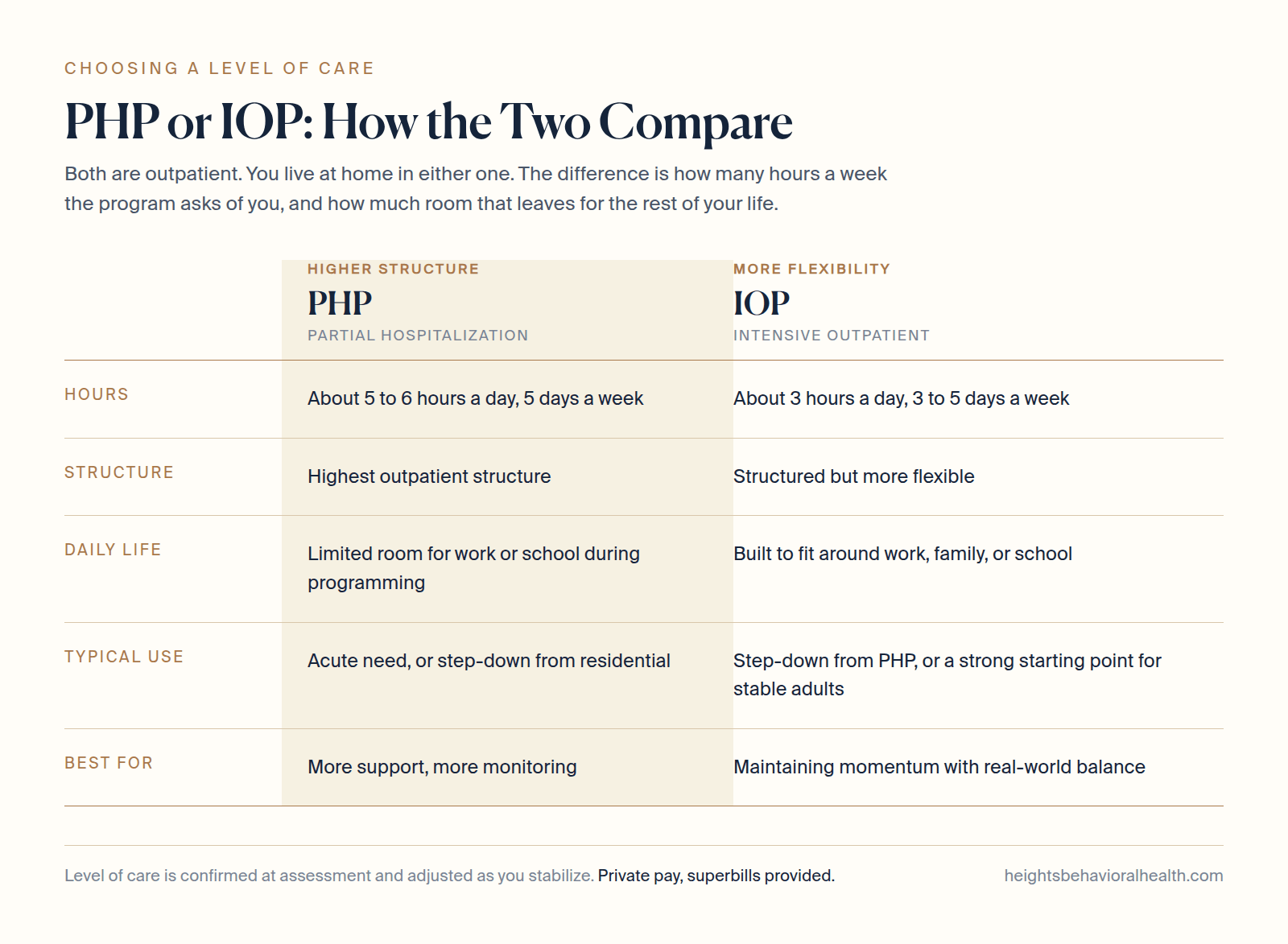
It varies with clinical need rather than a fixed number, and most people step down to IOP rather than stopping abruptly. The step-down plan is written before it is needed. See PHP versus IOP for how the levels differ, and continuing care for what comes after.
Who PHP Is Not Right For
PHP assumes you are medically stable and have a safe place to sleep. If there is active withdrawal risk, an unsafe or actively using household, or an acute crisis, detox or a residential referral comes first. We do not provide detox on site, we do offer MAT with buprenorphine and naltrexone, and we will tell you plainly if we are not the right starting point.
If this is an emergency or you are thinking about harming yourself, call 911, or call or text 988 to reach the Suicide and Crisis Lifeline. In Harris County, The Harris Center operates a 24-hour crisis line at 713-970-7000. Heights Behavioral Health is an outpatient program and is not a 24-hour crisis service.
Frequently Asked Questions
How many hours a day is PHP?
Partial hospitalization is the most time-intensive outpatient level, typically most of the day, five days a week. The exact hours depend on your assessment and current schedule.
Do I sleep at the facility?
No. PHP is outpatient. You attend during the day and go home at night, which is what distinguishes it from residential treatment.
Do you take insurance?
We are private pay and out of network, and not contracted with insurance plans. Because PHP is twenty or more clinical hours a week, we go through exactly what that costs before you start rather than after. If your plan has out-of-network benefits, we provide the superbill to submit.
Can I work while in PHP?
Rarely full time. PHP occupies most of the workday, so people often use leave or reduced hours. If you cannot step back from work, IOP or our Individualized Intensive Program may fit better.
What is the difference between PHP and IOP?
PHP runs most of the day, five days a week. IOP runs about three hours a session, three to five days a week. PHP offers more structure and support for people who need it.
How long does PHP last?
It depends on clinical progress rather than a set number of weeks. Most people step down to IOP rather than ending treatment abruptly, with the step-down planned in advance.
See What a Week Here Actually Looks Like
One confidential call to walk through the schedule, the level of care, and the cost.
Sources
Written and Reviewed by Licensed Clinicians
Joni Ogle is a Licensed Clinical Social Worker (LCSW) and Certified Sex Addiction Therapist (CSAT) with over 37 years of clinical experience in mental health and addiction recovery, dual diagnosis treatment, behavioral addictions, and family intervention. She is the founder of Heights Behavioral Health and Heights Mentoring in Houston, Texas, where she leads a team of licensed clinicians.
Texas LCSW #37376 · Verify license
Deborah Darnell-Drake, LCSW-S, ACSW, LMFT is the Chief Clinical Officer at Heights Behavioral Health and a clinical reviewer. With more than five decades of experience in mental health and substance use disorder treatment, Deborah specializes in addiction, co-occurring mental health conditions, family dynamics, and behavioral addictions including gambling and technology addiction.
Texas LCSW-S #14508 · LMFT #1125 · Verify license
Start a Confidential Conversation
One confidential message connects you with our admissions team and a clear next step. Prefer to talk now? Call (877) 549-5102.