




Key Takeaways
- Trauma lives in the nervous system, not just in memory, which is why talk therapy alone sometimes leaves people still startling, sleepless, or on edge despite understanding what happened.
- EMDR uses guided bilateral stimulation, such as eye movements, to help the brain reprocess distressing memories so they lose their charge, often without retelling every detail.
- Somatic Experiencing works gently with the tension, freeze, and survival energy held in the body, and is especially useful for people who feel chronically anxious, numb, or disconnected.
- Neurofeedback gives the brain real-time feedback about its own activity to support sleep, focus, and emotional regulation, and it is a supportive tool within a broader plan rather than a standalone cure.
- After a careful assessment, these one-on-one therapies are matched to you, paired with group work, and paced around your nervous system, since trauma recovery cannot be rushed or standardized.
Trauma lives in the nervous system, not just in memory, which is why talk therapy alone is sometimes not enough. EMDR, Somatic Experiencing, and neurofeedback are body-aware, evidence-informed approaches that help the brain and body process and settle after trauma. At Heights Behavioral Health in Houston, these are delivered one-on-one and woven into our Individualized Intensive Programming for adults with trauma, PTSD, and co-occurring conditions.
Many people come to us after years of therapy that helped them understand their trauma but not feel better in their body. They still startle, still cannot sleep, still feel on edge. These approaches target exactly that gap, working with the nervous system rather than only the story.
This article is an educational overview of how these approaches work. If you are looking for the treatment itself, start with our EMDR therapy in Houston service page.
What Is EMDR and How Does It Work?
Eye Movement Desensitization and Reprocessing (EMDR) is a structured, well-researched therapy for trauma. Using guided bilateral stimulation, such as eye movements, it helps the brain reprocess distressing memories so they lose their charge and stop intruding on the present. It is recognized by major bodies as an effective treatment for PTSD, and many people experience relief without having to retell every detail of what happened.
What Is Somatic Experiencing?
Somatic Experiencing focuses on the physical residue of trauma, the tension, freeze, and survival energy that stays trapped in the body. Working gently and gradually, it helps the nervous system complete its stress response and return to a regulated state. It is especially useful for people who feel chronically anxious, numb, or disconnected from their bodies.
What Is Neurofeedback?
Neurofeedback is a non-invasive approach that gives the brain real-time feedback about its own activity, helping it learn to regulate more effectively over time. People often use it to support better sleep, calmer focus, and steadier emotional regulation, alongside their core therapy. We are honest that it is a supportive tool, used as part of a broader plan rather than a standalone cure.
How Do We Combine These Therapies?
No single approach fits everyone, which is the whole point of our model. After a careful assessment, we match you to the right combination, and pair these one-on-one therapies with group work such as Shame Resilience, Mindfulness, and skills groups in DBT and CBT. This is the heart of trauma-informed care, and it connects directly to our broader trauma and PTSD treatment.
Confidential Next Step
Still carrying trauma in your body after years of talking about it?
One confidential call with our Houston team can help you find an approach that actually reaches it.
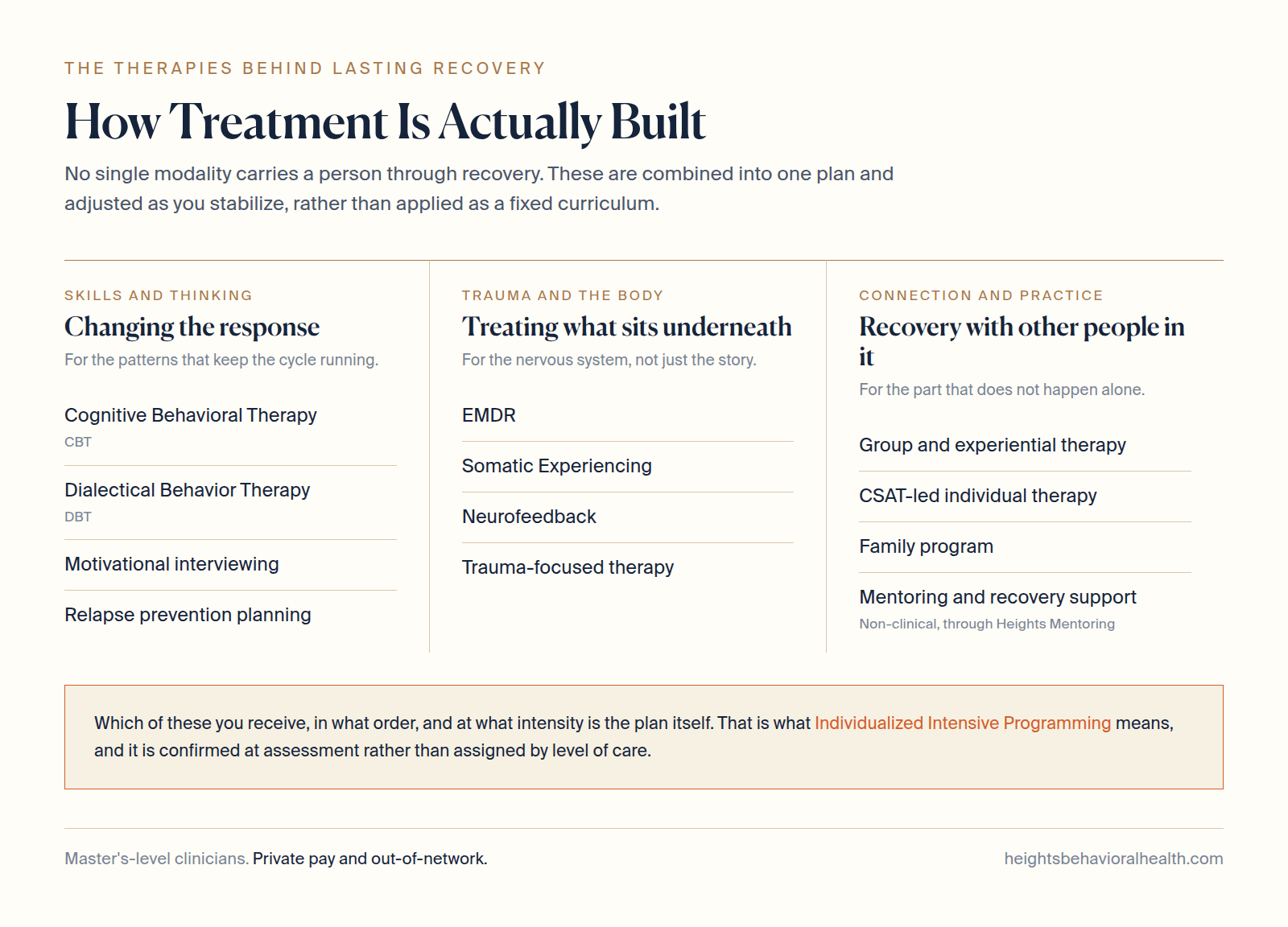 EMDR, Somatic Experiencing, neurofeedback, and trauma-focused therapy; connection and practice covering group and experiential therapy, CSAT-led individual therapy, family program, and mentoring and recovery support” width=”1600″ height=”1152″ style=”width:100%;height:auto;display:block;” loading=”lazy” decoding=”async” />
How Are Trauma, Addiction, and Mental Health Connected?
Unresolved trauma sits underneath a great deal of addiction, depression, and anxiety, and the behaviors are often attempts to cope with it. Treating the trauma is frequently what finally allows the rest to heal, which is why our dual diagnosis care and our behavioral addiction treatment rely on these tools.
How Does Individualized Programming Sequence Trauma Work?
Trauma recovery cannot be rushed or standardized. Our flagship Individualized Intensive Programming builds the pace and combination of therapies around your nervous system and your goals, at PHP or IOP intensity.
When Is Trauma Processing Too Much for Outpatient Care?
If you are in crisis or at significant risk, a higher level of care comes first, and we will help you find it. For non-clinical support, our sister practice Heights Mentoring may be a fit.
Heights Behavioral Health is a private-pay, out-of-network provider, and we are clear about pricing before you commit to anything. See how cost and out-of-network benefits work.
If this is an emergency or you are thinking about harming yourself, call 911, or call or text 988 to reach the Suicide and Crisis Lifeline. In Harris County, The Harris Center operates a 24-hour crisis line at 713-970-7000. Heights Behavioral Health is an outpatient program and is not a 24-hour crisis service.
EMDR is one of two front-line trauma protocols we deliver; for the other, see our session-by-session guide to cognitive processing therapy.
Frequently Asked Questions
Is EMDR evidence-based?
Yes. EMDR is a well-researched therapy recognized by major health bodies as effective for PTSD. Many people experience meaningful relief, often without retelling every detail of the trauma.
What is the difference between EMDR and Somatic Experiencing?
EMDR focuses on reprocessing specific distressing memories, while Somatic Experiencing focuses on releasing the physical, nervous-system residue of trauma. They complement each other, and we often use both.
Do you take insurance?
We are private pay and out of network, and not contracted with insurance plans. Trauma work is paced rather than rushed, so we explain the cost of a course of care upfront rather than leaving it open ended. Superbills are available if your plan has out-of-network benefits.
Does neurofeedback really work?
Neurofeedback is a supportive tool that helps the brain learn to regulate, and many people find it helps sleep, focus, and calm. We use it as part of a broader plan, not as a standalone cure, and we are honest about that.
Do I have to talk about my trauma in detail?
Not necessarily. These approaches are designed to reduce the need to relive every detail. We go at a pace that feels safe for your nervous system.
Healing That Reaches the Body, Not Just the Story
EMDR, Somatic Experiencing, and neurofeedback can reach trauma that talk therapy alone has not. One confidential call is the first step.
Sources
Written and Reviewed by Licensed Clinicians
Joni Ogle is a Licensed Clinical Social Worker (LCSW) and Certified Sex Addiction Therapist (CSAT) with over 37 years of clinical experience in mental health and addiction recovery, dual diagnosis treatment, behavioral addictions, and family intervention. She is the founder of Heights Behavioral Health and Heights Mentoring in Houston, Texas, where she leads a team of licensed clinicians.
Texas LCSW #37376 · Verify license
Deborah Darnell-Drake, LCSW-S, ACSW, LMFT is the Chief Clinical Officer at Heights Behavioral Health and a clinical reviewer. With more than five decades of experience in mental health and substance use disorder treatment, Deborah specializes in addiction, co-occurring mental health conditions, family dynamics, and behavioral addictions including gambling and technology addiction.
Texas LCSW-S #14508 · LMFT #1125 · Verify license
Start a Confidential Conversation
One confidential message connects you with our admissions team and a clear next step. Prefer to talk now? Call (877) 549-5102.