



Key Takeaways
- Anxiety disorders are among the most common and most treatable mental health conditions, going beyond ordinary stress with persistent worry, fear, or physical symptoms that interfere with daily life.
- Common types include generalized anxiety, panic attacks and panic disorder, social anxiety, health anxiety and specific phobias, and anxiety that travels with depression, trauma, or substance use.
- Treatment starts with a thorough assessment and combines individual therapy with skills groups in CBT, DBT, ACT, and mindfulness. CBT has strong evidence for anxiety, and medication is coordinated when appropriate.
- Anxiety and substance use feed each other, and treating one without the other rarely holds. When anxiety is rooted in trauma, it is treated directly with approaches like EMDR and Somatic Experiencing.
- If you are in crisis or at risk of harming yourself, you need immediate help, and a higher level of care comes before outpatient anxiety treatment.
Anxiety disorders are among the most common and most treatable mental health conditions. They go beyond ordinary stress, with persistent worry, fear, or physical symptoms that interfere with daily life. They respond well to evidence-based therapy, skills work, and medication when appropriate. At Heights Behavioral Health in Houston, adults receive outpatient anxiety treatment built around the person through our flagship Individualized Intensive Programming. For program details, schedules, and admissions, see anxiety treatment in Houston.
Anxiety can be invisible to everyone but the person living with it. On the outside, life looks fine. On the inside, there is a constant hum of worry, a racing mind, or a body braced for danger that never comes. The good news is that few conditions respond as well to treatment as anxiety does.
What Are the Common Types of Anxiety?
- Generalized anxiety, persistent worry across many areas of life
- Panic attacks and panic disorder, sudden waves of intense fear and physical symptoms
- Social anxiety, intense fear of judgment or social situations
- Health anxiety and specific phobias
- Anxiety that travels with depression, trauma, or substance use
How Do We Treat Anxiety?
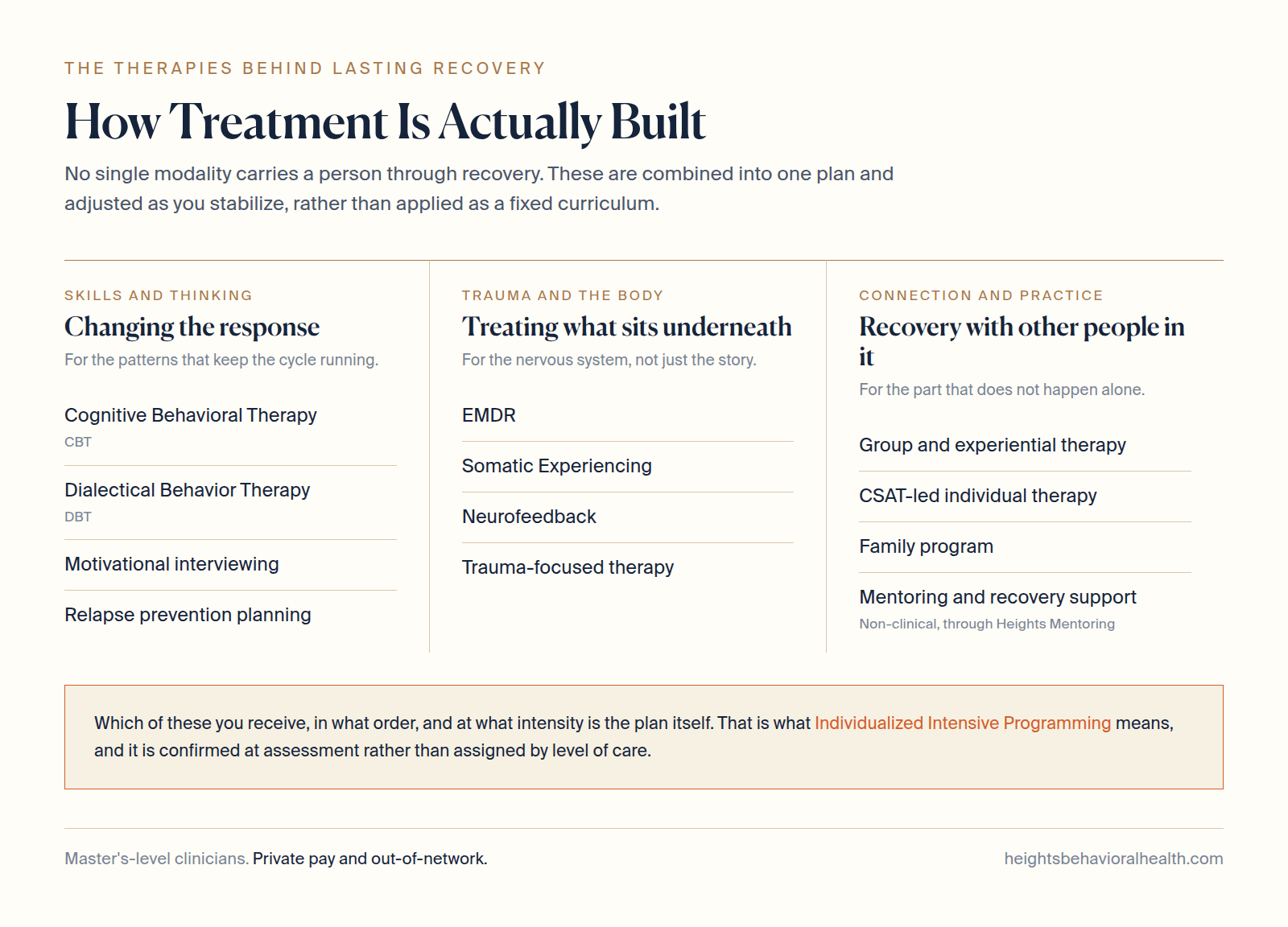
Treatment starts with a thorough assessment, then combines individual therapy with group work. Our Houston groups include skills groups in CBT, DBT, and ACT, plus Mindfulness, Guided Meditation, and Body Scan and Experiential Awareness that calm an overactive nervous system. CBT has strong evidence for anxiety, and we coordinate medication management when it is appropriate.
When anxiety is rooted in trauma, we treat that directly with EMDR, Somatic Experiencing, and neurofeedback, described in our trauma therapy guide. And because so many people try to quiet anxiety with alcohol or other substances, we treat that connection openly in our anxiety and alcohol guide.
Confidential Mental Health Care
Tired of living braced for the next wave of worry?
One confidential call with our Houston team can help you understand your options and find a starting point.
What If Anxiety and Addiction Travel Together?
Anxiety and substance use feed each other, and treating one without the other rarely holds. Our dual diagnosis care treats both at once, which makes recovery far more durable.
How Does a Personalized Plan Change Anxiety Treatment?
Anxiety is personal, and what calms one person can overwhelm another. Our flagship Individualized Intensive Programming builds the plan around your symptoms and triggers, at PHP or IOP intensity depending on how much support you need.
When Is Outpatient Anxiety Care Not the Right Starting Point?
If you are in crisis or at risk of harming yourself, you need immediate help, and a higher level of care comes first. Use the resources below, and we can help you find the right next step. For non-clinical support, our sister practice Heights Mentoring may be a fit.
Heights Behavioral Health is a private-pay, out-of-network provider, and we are clear about pricing before you commit to anything. See how cost and out-of-network benefits work.
If this is an emergency or you are thinking about harming yourself, call 911, or call or text 988 to reach the Suicide and Crisis Lifeline. In Harris County, The Harris Center operates a 24-hour crisis line at 713-970-7000. Heights Behavioral Health is an outpatient program and is not a 24-hour crisis service.
When the anxiety is social specifically, and alcohol has become the coping tool, our guide to social anxiety and drinking maps the loop and the way out.
Frequently Asked Questions
What is the most effective treatment for anxiety?
Cognitive behavioral therapy has the strongest evidence for anxiety, often combined with skills work, mindfulness, and medication when appropriate. Trauma-focused therapies help when trauma is the root.
How long until anxiety treatment works?
Many people notice meaningful improvement within several weeks of consistent treatment, though it varies by person and type of anxiety. The plan is reviewed regularly to make sure it is working.
Do you take insurance?
We are private pay and out of network, and not in network with any plan. Not knowing the cost is its own source of anxiety, so we give you the number before you commit to anything. Some clients use out-of-network benefits to offset part of it, and we provide the superbill.
Do I have to take medication?
Not necessarily. Many people improve with therapy and skills alone. Medication is one option we coordinate when it is appropriate, and the choice is always made with you.
Can you treat anxiety and substance use together?
Yes, and we strongly recommend it. Treating co-occurring anxiety and substance use at the same time is one of the most important factors in lasting recovery.
Anxiety Is Highly Treatable
With the right care, the constant hum of worry can quiet. One confidential call is the first step.
Sources
Written and Reviewed by Licensed Clinicians
Joni Ogle is a Licensed Clinical Social Worker (LCSW) and Certified Sex Addiction Therapist (CSAT) with over 37 years of clinical experience in mental health and addiction recovery, dual diagnosis treatment, behavioral addictions, and family intervention. She is the founder of Heights Behavioral Health and Heights Mentoring in Houston, Texas, where she leads a team of licensed clinicians.
Texas LCSW #37376 · Verify license
Deborah Darnell-Drake, LCSW-S, ACSW, LMFT is the Chief Clinical Officer at Heights Behavioral Health and a clinical reviewer. With more than five decades of experience in mental health and substance use disorder treatment, Deborah specializes in addiction, co-occurring mental health conditions, family dynamics, and behavioral addictions including gambling and technology addiction.
Texas LCSW-S #14508 · LMFT #1125 · Verify license
Start a Confidential Conversation
One confidential message connects you with our admissions team and a clear next step. Prefer to talk now? Call (877) 549-5102.