



Key Takeaways
- Process addiction is a pattern of compulsive behavior, such as gambling, sex, gaming, or spending, that continues despite real harm. It is a clinical issue, not a lack of willpower, and it is treatable.
- Behavioral addictions follow the same loop as substance addictions: a behavior briefly relieves distress, then consequences and shame follow, creating a stronger urge to repeat it.
- Gambling disorder is the one behavioral addiction formally recognized in the DSM-5, and internet gaming disorder is listed for further study. Withdrawal is usually emotional rather than physical, and no medical detox is involved.
- Treatment starts with a clinical assessment and combines individual therapy with focused groups. Because these patterns are often rooted in trauma and shame, care addresses what sits underneath the behavior.
- Anxiety, depression, ADHD, and trauma frequently accompany behavioral addiction, and treating only the behavior is why people relapse. Someone in acute crisis needs a higher level of care first.
Process addiction, also called behavioral addiction, is a pattern of compulsive behavior, such as gambling, sex, gaming, or spending, that continues despite real harm. It is treated much like substance addiction, with assessment, individual and group therapy, and relapse prevention, but the focus stays on the behavior and the emotions driving it rather than a substance. At Heights Behavioral Health in Houston, behavioral addictions are a core specialty, and our Individualized Intensive Programming builds the plan around the specific behavior, any co-occurring conditions, and the person’s real life.
People often arrive unsure whether what they are struggling with even counts as an addiction. There is no drug involved, so they wonder if it is a real clinical issue or just a lack of willpower. It is a clinical issue, and it is treatable.
After many years of clinical work in Houston, here is the honest version. Behavioral addictions follow the same loop as substance addictions: a behavior that briefly relieves distress, followed by consequences, shame, and a stronger urge to do it again. Treating them well means treating that loop, not just the surface behavior.
What Counts as a Process or Behavioral Addiction?
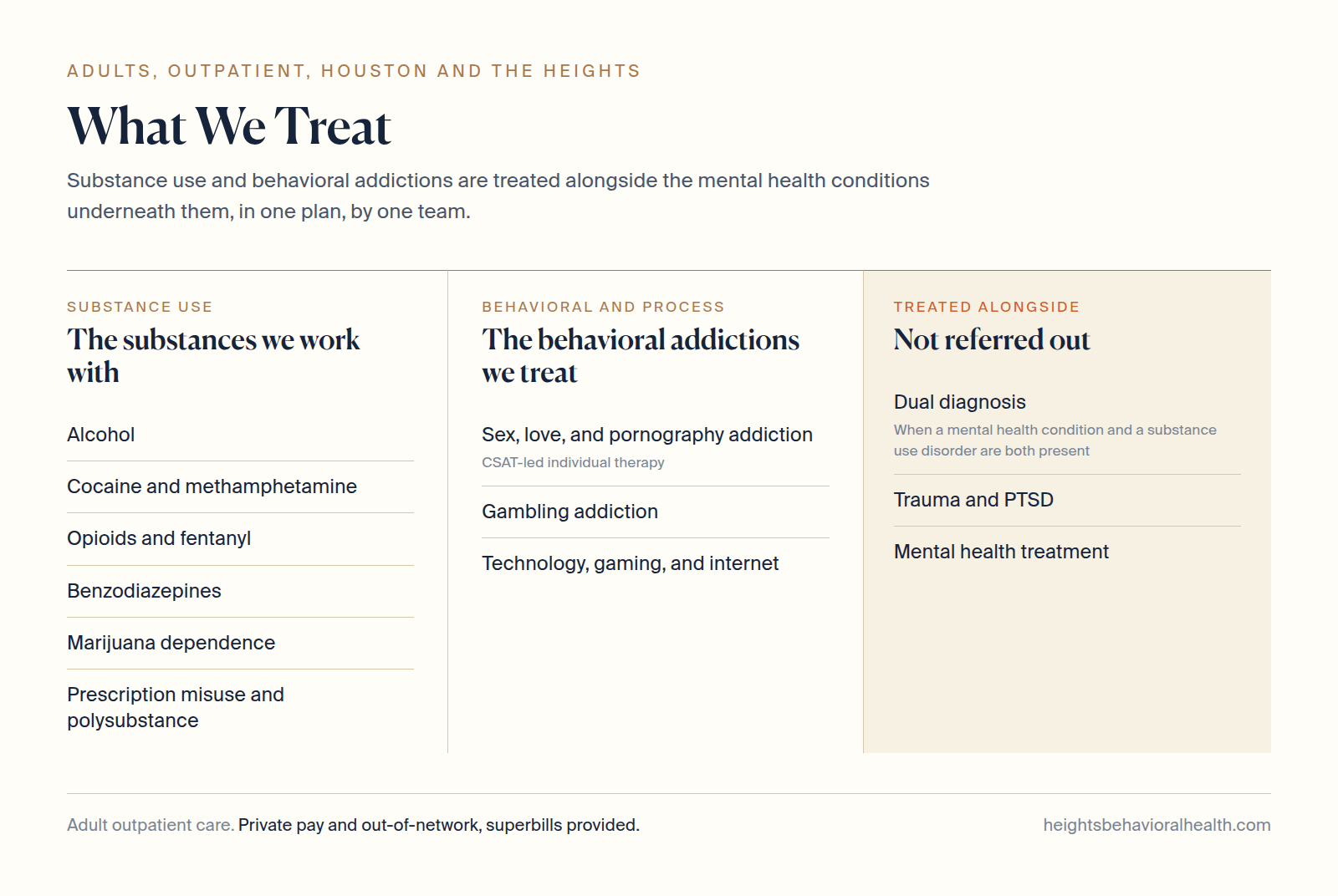
A process addiction is compulsive engagement in a behavior for its mood-altering effect, continued despite mounting harm to health, relationships, finances, or work. The behaviors we most often treat include: To see how this works in practice, read about our process addiction treatment in Houston.
- Gambling, including sports betting and online casinos
- Sex, love, and relationship patterns, often called compulsive sexual behavior
- Internet, gaming, and screen use
- Pornography use that feels out of control
- Compulsive spending, shopping, or work and achievement patterns
Honesty matters here. Gambling disorder is the one behavioral addiction formally recognized in the DSM-5, and internet gaming disorder is listed as a condition for further study. The others are clinically well described and treatable even where the formal label is still debated. The science is still developing, but the suffering is real and the clinical tools work.
How Does Behavioral Addiction Compare to Substance Addiction?
The two share the same reward-and-relief loop, which is why the structure of treatment looks familiar. The main differences are in how the body reacts and whether a medical detox is involved.
| Feature | Substance addiction | Process or behavioral addiction |
|---|---|---|
| The relief | A chemical changes the brain’s reward circuits | A behavior triggers the same reward and relief response |
| Tolerance | Needing more of the substance over time | Needing more of the behavior, or more intensity, for the same effect |
| Withdrawal | Often physical, and sometimes medically dangerous | Usually emotional: irritability, restlessness, low mood, and craving |
| Medical detox | May be required before treatment can begin | Not a medical detox, though early urges can be intense |
| Treatment focus | The substance, plus the thinking and emotions around it | The behavior, the triggers, and the emotions it is used to manage |
How Do We Treat Process Addictions?
Treatment starts with a clinical assessment, because the same behavior can mean very different things in different people. From there, care combines individual therapy with focused group work. Our adult groups in Houston include a dedicated Process Addictions group, Healthy Relationships, Shame Resilience, Relapse Prevention, and skills groups in CBT, DBT, ACT, and Motivational Interviewing, alongside experiential work such as art and equine therapy.
Because behavioral addictions are so often rooted in trauma and shame, we treat what sits underneath the behavior, not just the behavior itself. That can include EMDR, Somatic Experiencing, and neurofeedback delivered one-on-one, and care led by clinicians with specialized training, including a Certified Sex Addiction Therapist for compulsive sexual behavior.
How Does a Personalized Plan Change Process Addiction Treatment?
Behavioral addictions rarely fit a fixed curriculum. Gambling, compulsive sexual behavior, and screen use each have different triggers, different consequences, and different recovery skills. Our flagship Individualized Intensive Programming builds the week around your specific behavior and any co-occurring conditions, which is exactly what these patterns require. It can be delivered at PHP or IOP intensity depending on how much structure you need.
Confidential Next Step
Wondering if a behavior has crossed into addiction?
One confidential call with our Houston team can help you tell the difference and find the right starting point.
Are Co-occurring Conditions Common With Process Addiction?
Anxiety, depression, ADHD, and trauma frequently sit alongside behavioral addiction, and the behavior is often a way to manage them. Treating only the behavior, without the condition underneath, is why people relapse. Our dual diagnosis approach treats both together.
When Does a Process Addiction Need a Higher Level of Care?
Outpatient care has limits, and naming them is part of good treatment. Someone in acute crisis, or with significant medical or psychiatric risk, needs a higher level of care first, and we will say so and help you find it. If a loved one needs non-clinical support rather than treatment, our sister practice Heights Mentoring may be the right starting point.
Heights Behavioral Health is a private-pay, out-of-network provider, and we are clear about pricing before you commit to anything. See how cost and out-of-network benefits work.
If this is an emergency or you are thinking about harming yourself, call 911, or call or text 988 to reach the Suicide and Crisis Lifeline. In Harris County, The Harris Center operates a 24-hour crisis line at 713-970-7000. Heights Behavioral Health is an outpatient program and is not a 24-hour crisis service.
Frequently Asked Questions
Is behavioral addiction a real diagnosis?
Gambling disorder is formally recognized in the DSM-5, and internet gaming disorder is listed for further study. Others, such as compulsive sexual behavior, are clinically well described and treatable even where the formal label is still debated. We treat the behavior and its consequences, not a label.
Can you have a behavioral addiction and a substance addiction at once?
Yes, and it is common. People often swap one compulsive behavior for another. Good treatment looks at the whole pattern, which is part of why a personalized plan works better than a single fixed program.
Do you take insurance?
We are private pay and out of network, and not in network with any plan. Behavioral addictions are treated in the same plan as anything co-occurring, with one price explained before you commit. If your plan has out-of-network benefits, we provide the superbill to submit.
Is treatment the same as drug or alcohol rehab?
The structure is similar, with assessment, individual and group therapy, and relapse prevention, but the focus is on the behavior and the emotions driving it rather than a substance. There is no medical detox.
How long does treatment take?
It varies by person and by how much structure you need. Many people start at a higher intensity and step down as they stabilize. Plans are reviewed regularly rather than set to a fixed number of weeks for everyone.
Change Is Possible, and It Is Specific to You
Behavioral addiction responds to treatment that fits the person and the behavior. One confidential call is the first step toward a plan built around you.
Sources
Written and Reviewed by Licensed Clinicians
Joni Ogle is a Licensed Clinical Social Worker (LCSW) and Certified Sex Addiction Therapist (CSAT) with over 37 years of clinical experience in mental health and addiction recovery, dual diagnosis treatment, behavioral addictions, and family intervention. She is the founder of Heights Behavioral Health and Heights Mentoring in Houston, Texas, where she leads a team of licensed clinicians.
Texas LCSW #37376 · Verify license
Deborah Darnell-Drake, LCSW-S, ACSW, LMFT is the Chief Clinical Officer at Heights Behavioral Health and a clinical reviewer. With more than five decades of experience in mental health and substance use disorder treatment, Deborah specializes in addiction, co-occurring mental health conditions, family dynamics, and behavioral addictions including gambling and technology addiction.
Texas LCSW-S #14508 · LMFT #1125 · Verify license
Start a Confidential Conversation
One confidential message connects you with our admissions team and a clear next step. Prefer to talk now? Call (877) 549-5102.