



Key Takeaways
- When a spouse enters treatment, feeling relief, anger, exhaustion, and doubt all at once is the normal experience for partners, not a sign that something is wrong with you.
- Many partners experience a crash in the first weeks as adrenaline drains, and anger that surfaces after sobriety reflects what was unavailable to you while you were coping.
- Early treatment is a poor time for permanent decisions, and you do not have to decide right away about forgiveness, the marriage, or whether this time is different.
- Trust rebuilds on evidence over time, boundaries around finances, honesty, and a return to use still apply in recovery, and deciding your response to a relapse in advance helps.
- Partners often go years without care of their own, so seek support through family programming or individual work, whether or not your spouse is a client.
Nobody prepares partners for how complicated relief feels. Your spouse is finally getting help, which is what you wanted, and you are also furious, exhausted, suspicious of the relief, and quietly wondering whether you want to be in this marriage. All of that at once is the normal experience, not a sign that something is wrong with you.
What the First Weeks Often Look Like
Partners frequently describe a crash rather than a lift. While the crisis was active, you were operating on adrenaline and logistics. When someone else takes over the management, the adrenaline drains and everything you postponed arrives at once. Anger that surfaces after they get sober is not ingratitude; it is what was unavailable while you were coping.
Things You Do Not Have to Decide Right Now
- Whether you forgive them
- Whether the marriage continues
- Whether you believe this time is different
- Whether you are angry or relieved, since it is usually both
- How much you will tell family and friends
Early treatment is a poor moment for permanent decisions, in both directions. Not the decision to leave, and not the decision to commit to a version of them that is only weeks old.
The Trust Question
You will be asked, directly or otherwise, to trust someone whose word has been unreliable. You are not obligated to produce that on demand. Trust rebuilds on evidence over time, and a partner in genuine recovery can tolerate that timeline. Pressure to trust faster is worth noticing.
Your Life Reorganized Around Their Illness
Most partners have spent years monitoring, compensating, covering, and anticipating. Those habits do not stop because treatment started, and they do not have an obvious off switch. Handing back responsibilities you have been carrying alone is disorienting rather than purely welcome. Our codependency and family roles article covers this directly.
For Families and Loved Ones
Getting nothing for yourself while they get treatment?
That is the most common pattern we see in partners, and it is fixable.
Boundaries Still Apply in Recovery
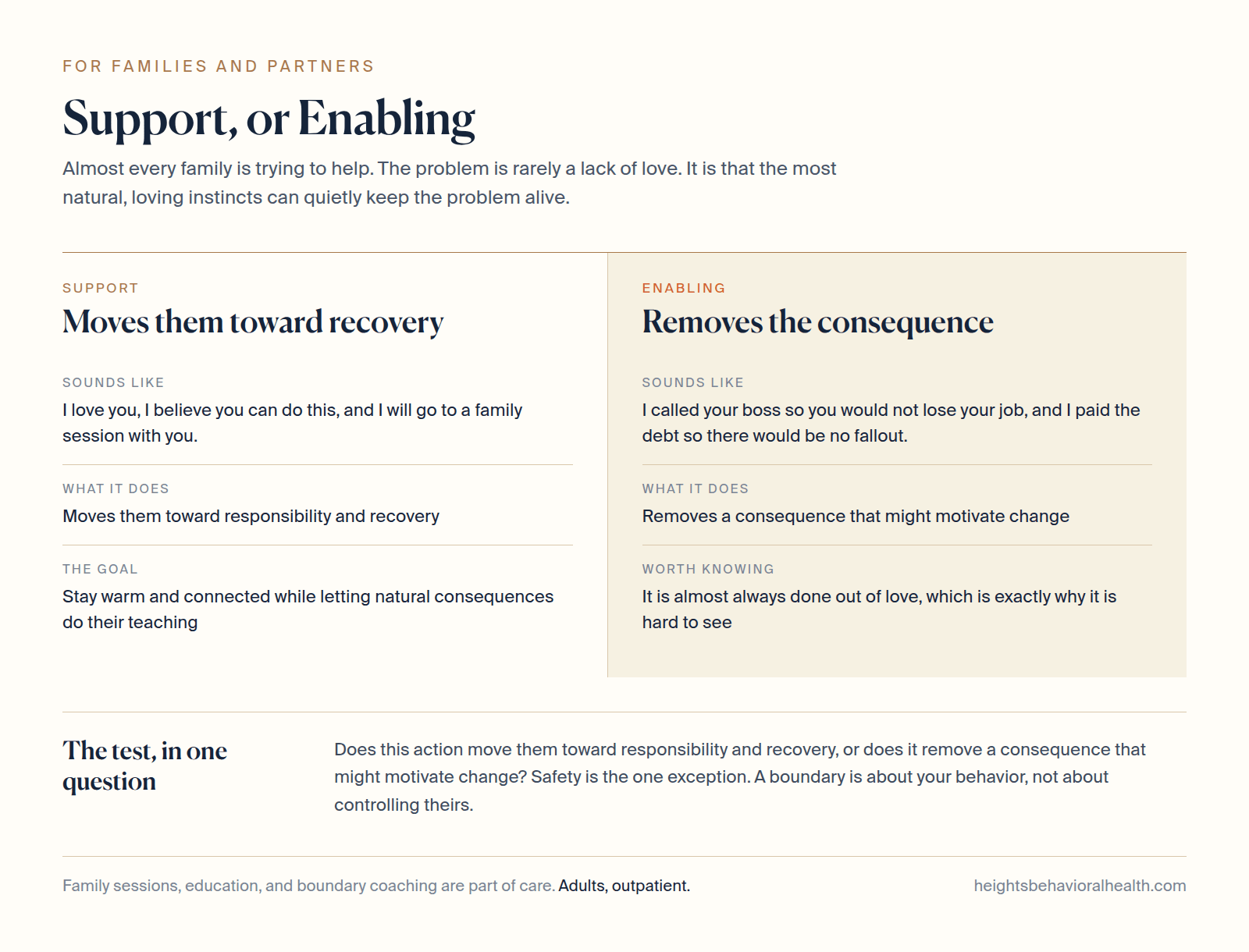
Boundaries are not only for active use. Financial limits, honesty expectations, and what happens if there is a return to use are all reasonable to keep in place, and having them does not signal a lack of faith. Our boundaries article covers how to set ones you can hold.
If They Return to Use
It happens, and it is not proof that treatment failed or that you were foolish to hope. What matters is what happens next: whether it is disclosed or hidden, and whether they re-engage with care quickly. Decide in advance what your response will be, while you are calm rather than in the moment. See relapse prevention.
Get Your Own Support
Partners often go years without any care of their own, on the logic that the person with the diagnosis is the one who needs it. That logic is how partners end up depleted, resentful, or unwell themselves. Our family programming includes a virtual group for loved ones, and individual work is available whether or not your spouse is our client. See supporting a loved one.
If this is an emergency or you are thinking about harming yourself, call 911, or call or text 988 to reach the Suicide and Crisis Lifeline. In Harris County, The Harris Center operates a 24-hour crisis line at 713-970-7000. Heights Behavioral Health is an outpatient program and is not a 24-hour crisis service.
Frequently Asked Questions
Why am I angry now that they are finally getting help?
Because anger was not available while you were managing the crisis. It surfaces when the adrenaline drops and someone else takes over the day-to-day. It is extremely common and not ingratitude.
Should I decide about the marriage now?
Early treatment is a poor time for permanent decisions in either direction. You are entitled to wait and see actual evidence over time.
Do you take insurance?
We are private pay and out of network, and not contracted with insurance plans. Partners often ask this early, because the money question sits underneath a lot of the anxiety at home. We are direct about pricing before anything starts, and we provide a superbill you can submit if your plan has out-of-network benefits.
Do I have to trust them again right away?
No. Trust rebuilds on evidence, not on request. A partner genuinely in recovery can tolerate that timeline, and pressure to trust faster is worth paying attention to.
Should I keep boundaries in place now that they are in treatment?
Yes. Boundaries are not a statement about faith in them. Financial limits, honesty expectations, and a plan for a return to use are all reasonable to maintain.
Can I get support if my spouse is not your client?
Yes. Partners can access family programming and individual support regardless of where their spouse is receiving treatment.
You Deserve Support of Your Own
A confidential conversation about what you are carrying, not only about them.
Sources
Written and Reviewed by Licensed Clinicians
Joni Ogle is a Licensed Clinical Social Worker (LCSW) and Certified Sex Addiction Therapist (CSAT) with over 37 years of clinical experience in mental health and addiction recovery, dual diagnosis treatment, behavioral addictions, and family intervention. She is the founder of Heights Behavioral Health and Heights Mentoring in Houston, Texas, where she leads a team of licensed clinicians.
Texas LCSW #37376 · Verify license
Deborah Darnell-Drake, LCSW-S, ACSW, LMFT is the Chief Clinical Officer at Heights Behavioral Health and a clinical reviewer. With more than five decades of experience in mental health and substance use disorder treatment, Deborah specializes in addiction, co-occurring mental health conditions, family dynamics, and behavioral addictions including gambling and technology addiction.
Texas LCSW-S #14508 · LMFT #1125 · Verify license
Start a Confidential Conversation
One confidential message connects you with our admissions team and a clear next step. Prefer to talk now? Call (877) 549-5102.