




Key Takeaways
- A clinician-led intervention is a planned, respectful conversation with a treatment plan already in place, not a surprise confrontation. The goal is to remove every obstacle between your loved one and saying yes.
- Consult a clinician before anything else. They can tell you whether an intervention is appropriate, what level of care fits, and whether withdrawal risk or suicidality must be addressed first.
- Keep the group small, with three to five calm people who have real influence, and line up treatment beforehand. An intervention that ends in yes and then a two-week wait usually ends in no.
- Write what you will say and keep it specific, naming observed events and how they affected you. Choose boundaries you will actually follow through on rather than ultimatums that get walked back.
- A first conversation often ends without agreement, and that is not failure. Decide in advance what each person will do differently if the answer is no, and stay in relationship rather than cutting off contact.
Most people picture an intervention as a surprise confrontation, a circle of relatives reading letters to someone who had no idea it was coming. That version makes for television. It also produces defensiveness, and it can damage relationships that recovery will later depend on. A clinician-led intervention is a planned, respectful conversation with a treatment plan already in place before anyone speaks.
The goal is not to corner someone. It is to remove every obstacle between them and saying yes.
Step 1: Consult a Clinician Before Anything Else
Families usually plan the conversation first and think about treatment second. Reverse that. A clinician can tell you whether an intervention is appropriate at all, what level of care fits, and whether safety concerns such as withdrawal risk or suicidality need to be addressed before any conversation happens.
Step 2: Decide Who Should Be in the Room
Small is better. Three to five people who genuinely have influence and can stay calm. Leave out anyone actively in conflict with the person, anyone who cannot hold their own emotions, and anyone whose presence would humiliate rather than persuade.
Step 3: Line Up Treatment Before the Conversation
An intervention that ends in yes and then a two-week wait usually ends in no. Have the assessment scheduled, the cost understood, and the logistics like time off work, childcare, and transportation solved in advance. Our admissions process is built to move quickly for exactly this reason.
For Families and Loved Ones
Planning a conversation with someone you love?
Talk to a clinician first. We will tell you honestly whether an intervention is the right move.
Step 4: Write What You Will Say, and Keep It Specific
Skip the character assessment. Name specific things you have observed and how they affected you: the missed pickup, the night in the ER, the conversation you cannot forget. Specific and factual is harder to argue with than a general accusation. Our guide to talking to a loved one goes deeper on wording.
Step 5: Decide on Boundaries, Not Ultimatums
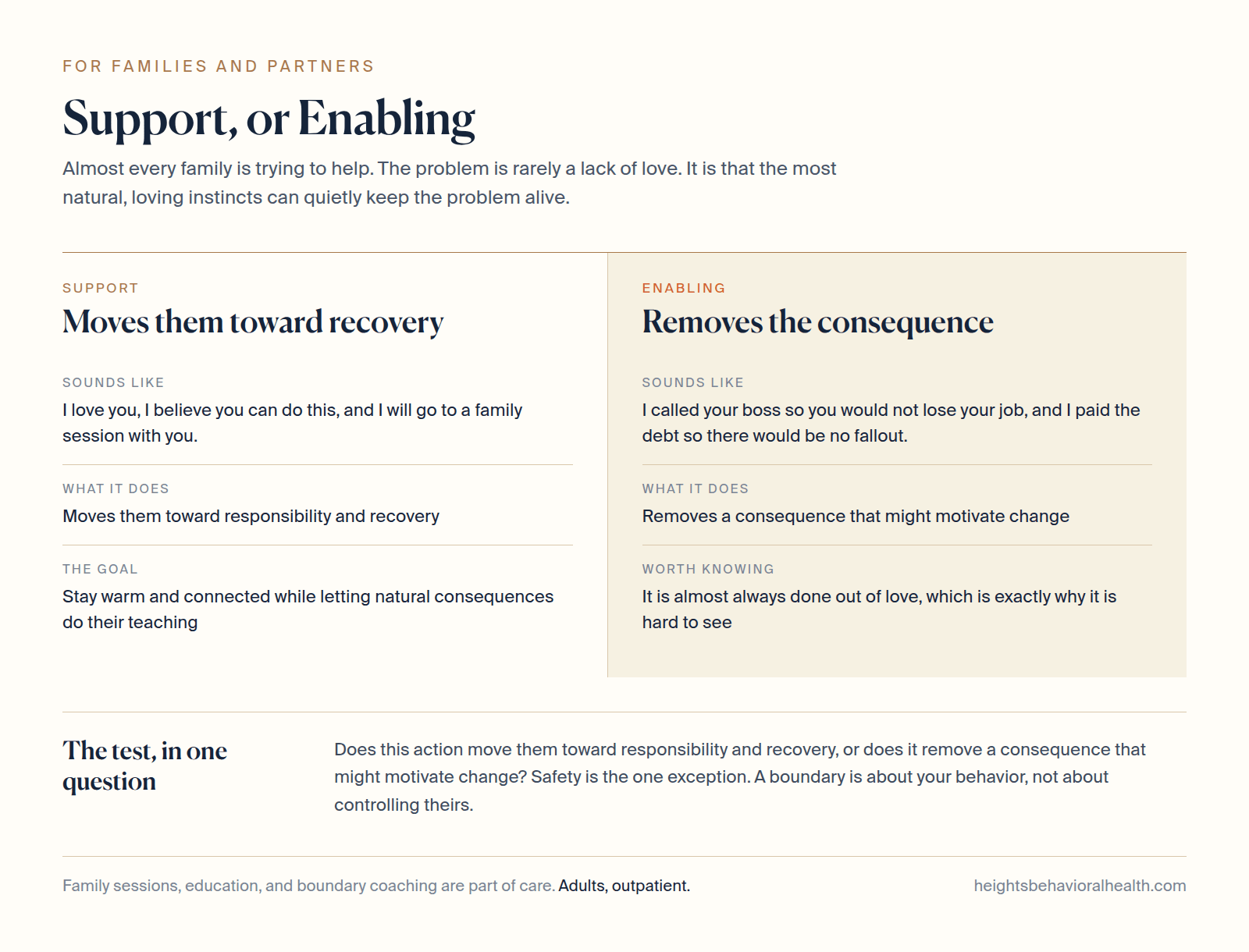
A boundary is something you will do, stated calmly and only if you will actually follow through. An ultimatum is a threat aimed at forcing compliance. Boundaries hold; ultimatums that get walked back teach the person that nothing has changed.
Step 6: Plan for No
A first conversation often ends without agreement. That is not failure. It plants information and makes the second conversation more likely to land. Decide in advance what each person will do differently if the answer is no, and stay in relationship rather than cutting off contact.
What We Do Differently
We favor consent-based, clinician-guided family conversations over the ambush model. The person knows a conversation is happening and why. That approach preserves trust, and trust is the resource treatment runs on. Family work continues after admission through our family programming, because the patterns around the person matter as much as the person. See our family roles article.
If this is an emergency or you are thinking about harming yourself, call 911, or call or text 988 to reach the Suicide and Crisis Lifeline. In Harris County, The Harris Center operates a 24-hour crisis line at 713-970-7000. Heights Behavioral Health is an outpatient program and is not a 24-hour crisis service.
Frequently Asked Questions
Do interventions actually work?
They can, particularly when they are planned with a clinician, treatment is arranged in advance, and the tone stays respectful. Surprise confrontations without a treatment plan are far less reliable and can harm the relationship.
Should the intervention be a surprise?
We generally recommend against ambush-style interventions. A consent-based conversation the person knows is coming produces less defensiveness and preserves the trust recovery depends on.
Do you take insurance?
We are private pay and out of network, and not in network with any plan. Intervention services and the treatment that follows are both quoted before anything starts, so a family is not deciding blind. If your plan has out-of-network benefits, we provide a superbill you can submit.
Who should not be in the room?
Anyone in active conflict with the person, anyone who cannot regulate their own anger, and anyone whose presence would shame rather than persuade.
What if they say no?
Plan for it. Keep the door open, follow through on the boundaries you stated, and stay in contact. Many people say yes on a later conversation because the first one made the problem impossible to ignore.
Can you help us plan one?
Yes. We can talk through whether an intervention is appropriate, what level of care to line up, and how to structure the conversation. Call (877) 549-5102.
Talk to a Clinician Before You Talk to Them
We will help you assess whether an intervention makes sense, arrange care in advance, and plan the conversation.
Sources
- Substance Abuse and Mental Health Services Administration (SAMHSA). Publications and Resources.
- National Institute on Drug Abuse (NIDA). Treatment and Recovery.
- National Institute on Alcohol Abuse and Alcoholism (NIAAA). Treatment for Alcohol Problems.
Written and Reviewed by Licensed Clinicians
Joni Ogle is a Licensed Clinical Social Worker (LCSW) and Certified Sex Addiction Therapist (CSAT) with over 37 years of clinical experience in mental health and addiction recovery, dual diagnosis treatment, behavioral addictions, and family intervention. She is the founder of Heights Behavioral Health and Heights Mentoring in Houston, Texas, where she leads a team of licensed clinicians.
Texas LCSW #37376 · Verify license
Deborah Darnell-Drake, LCSW-S, ACSW, LMFT is the Chief Clinical Officer at Heights Behavioral Health and a clinical reviewer. With more than five decades of experience in mental health and substance use disorder treatment, Deborah specializes in addiction, co-occurring mental health conditions, family dynamics, and behavioral addictions including gambling and technology addiction.
Texas LCSW-S #14508 · LMFT #1125 · Verify license
Start a Confidential Conversation
One confidential message connects you with our admissions team and a clear next step. Prefer to talk now? Call (877) 549-5102.