



Key Takeaways
- Addiction affects the whole family, and loved ones often fall into roles or into codependency, where their own wellbeing becomes tangled up in managing someone else’s addiction.
- Codependency can look like feeling responsible for fixing the other person, letting your own life shrink, struggling with boundaries, covering for them, and losing track of your own needs.
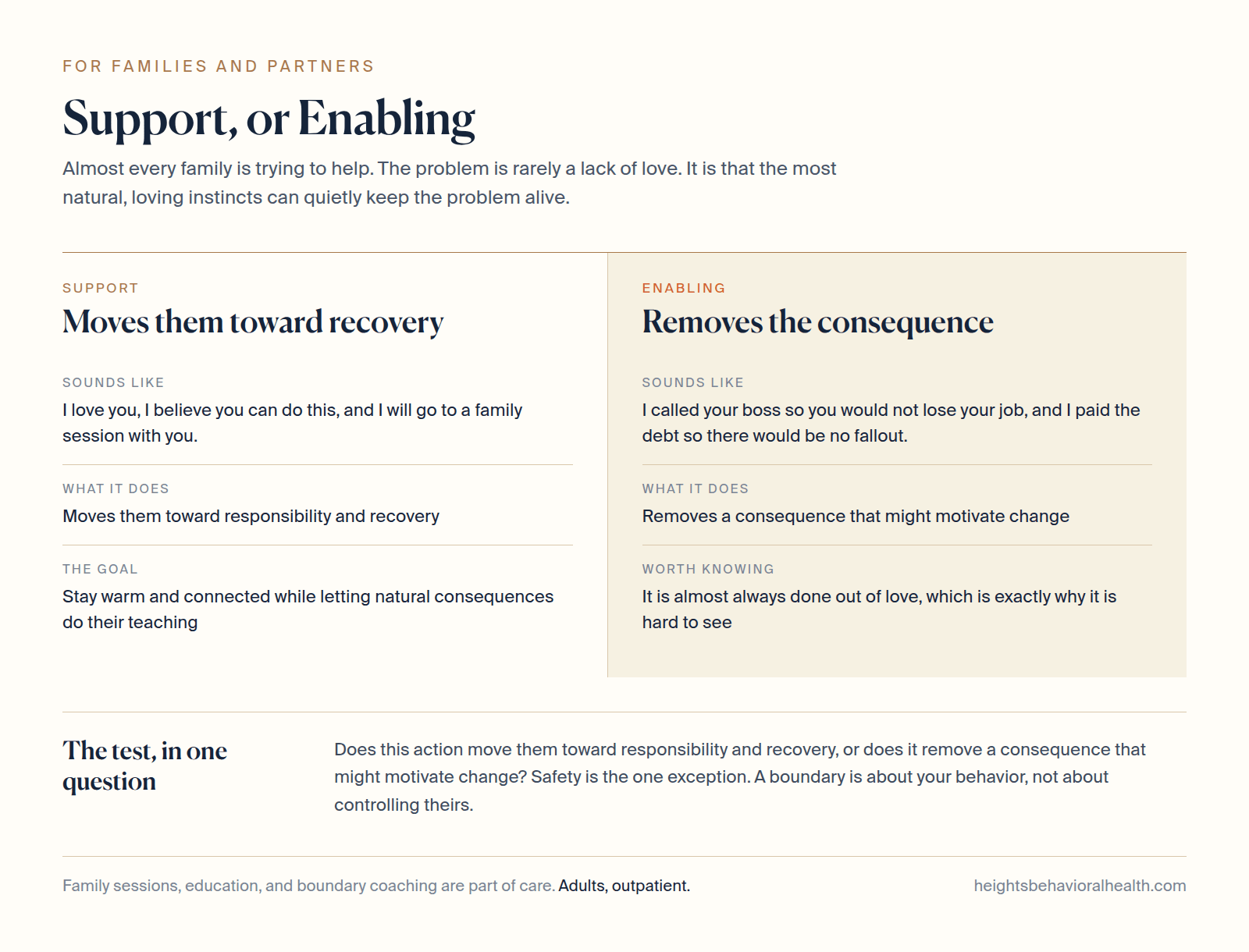
- Helping supports recovery and growth, while enabling shields a person from consequences that might motivate change; the shift is about caring differently, not caring less.
- Common family roles include the enabler, the hero, the scapegoat, the lost child, and the mascot, and naming these patterns helps families step out of them and relate honestly.
- Family healing combines education, boundary work, and support, including a virtual group for loved ones and peer supports such as Al-Anon, whether or not the person is ready for treatment.
Addiction is a family condition, not just an individual one. Over time, loved ones often fall into roles, such as the rescuer, the enabler, or the scapegoat, and into codependency, where their own wellbeing becomes tangled up in managing someone else’s addiction. Families can heal, and that healing strengthens everyone’s recovery. At Heights Behavioral Health in Houston, we include families in care and offer guidance for loved ones alongside our treatment programs.
If you love someone with an addiction, you already know the exhaustion of it: the worry, the walking on eggshells, the way your whole life can start to orbit their crisis. None of that means you did something wrong. It means you are human, and it means you deserve support too.
What Does Codependency Look Like?
- Feeling responsible for managing or fixing the other person’s behavior
- Putting their needs so far ahead of yours that your own life shrinks
- Difficulty setting or keeping boundaries
- Anxiety, guilt, or a sense of failure when you try to step back
- Covering for them, smoothing consequences, or keeping secrets
- Losing track of your own feelings, needs, and identity
What Is the Difference Between Helping and Enabling?
This is the distinction families struggle with most. Helping supports a person’s recovery and growth. Enabling, often done out of love, shields them from the consequences that might motivate change. The line is not always obvious, and learning to tell the difference is one of the most powerful things a family can do. It is rarely about caring less. It is about caring differently.
What Are the Common Family Roles?
In many families affected by addiction, predictable roles form as everyone adapts to the chaos: the enabler who smooths things over, the hero who overachieves to compensate, the scapegoat who absorbs the blame, the lost child who disappears, and the mascot who deflects with humor. Naming these patterns helps families step out of them and relate honestly again.
For Families and Loved Ones
Worn down by loving someone in addiction?
One confidential call with our Houston team can help you find support for them, and for you.
How Do Families Heal?
Family healing combines education, boundary work, and support. We help families understand addiction as a condition, learn healthy boundaries, and rebuild communication and trust. Our program includes a virtual group for family, friends, and loved ones, and we connect families to peer supports such as Al-Anon. This connects closely to our guide on supporting a loved one in treatment.
What If Your Loved One Is Ready for Treatment?
When the person you love is ready, our clinical programs treat the addiction itself, including behavioral addictions and substance use, through our flagship Individualized Intensive Programming. If they are not ready for clinical treatment, our sister practice Heights Mentoring offers non-clinical support.
Heights Behavioral Health is a private-pay, out-of-network provider, and we are clear about pricing before you commit to anything. See how cost and out-of-network benefits work.
If this is an emergency or you are thinking about harming yourself, call 911, or call or text 988 to reach the Suicide and Crisis Lifeline. In Harris County, The Harris Center operates a 24-hour crisis line at 713-970-7000. Heights Behavioral Health is an outpatient program and is not a 24-hour crisis service.
Frequently Asked Questions
What is codependency?
Codependency is a pattern where your own wellbeing becomes tied to managing someone else’s behavior or addiction, often at the expense of your own needs, boundaries, and identity. It is common in families affected by addiction and it can be healed.
How do I know if I am helping or enabling?
Helping supports recovery and growth; enabling shields someone from the consequences that could motivate change. The difference is not about caring less, but caring differently, and a clinician can help you find that line.
Do you take insurance?
We are private pay and out of network, and not contracted with insurance plans. Family and support work is quoted upfront like everything else, so you are not committing blind. Superbills are available for plans with out-of-network benefits.
Should I set boundaries even if it feels harsh?
Healthy boundaries are an act of care, for them and for you. They are not punishment. Learning to set and keep them is one of the most powerful things a family can do.
Can I get help even if my loved one refuses treatment?
Yes. Family support and your own healing do not depend on the other person being ready. Support for loved ones is available regardless of where they are.
Your Wellbeing Matters Too
Families heal, and that healing strengthens everyone’s recovery. One confidential call is the first step.
Sources
Written and Reviewed by Licensed Clinicians
Joni Ogle is a Licensed Clinical Social Worker (LCSW) and Certified Sex Addiction Therapist (CSAT) with over 37 years of clinical experience in mental health and addiction recovery, dual diagnosis treatment, behavioral addictions, and family intervention. She is the founder of Heights Behavioral Health and Heights Mentoring in Houston, Texas, where she leads a team of licensed clinicians.
Texas LCSW #37376 · Verify license
Deborah Darnell-Drake, LCSW-S, ACSW, LMFT is the Chief Clinical Officer at Heights Behavioral Health and a clinical reviewer. With more than five decades of experience in mental health and substance use disorder treatment, Deborah specializes in addiction, co-occurring mental health conditions, family dynamics, and behavioral addictions including gambling and technology addiction.
Texas LCSW-S #14508 · LMFT #1125 · Verify license
Start a Confidential Conversation
One confidential message connects you with our admissions team and a clear next step. Prefer to talk now? Call (877) 549-5102.