




Key Takeaways
- A boundary is a description of what you will do, stated calmly and kept. It controls your own behavior rather than theirs, which is why it does not require your loved one’s agreement to work.
- Examples of real boundaries include not giving money, not lying to an employer or family about where the person is, and leaving a conversation when they are intoxicated, then returning when they are not.
- It is better to set one small boundary you will absolutely hold than five ambitious ones you will not. A boundary you walk back teaches that your limits are negotiable under enough pressure.
- Set calmly, a boundary lands as information rather than punishment. The guilt that comes with holding one is normal and is not evidence that you are doing something wrong.
- If a boundary could put you or your children at risk of violence, plan it with a clinician or a domestic violence advocate. Family members also deserve their own support, and that need is treatable.
Most of what gets called a boundary is a request with a threat attached. “If you drink again, I am done” is not a boundary; it is an ultimatum, and everyone in the room knows whether it will be honored. A boundary is a description of what you will do, stated calmly, and kept. It does not require their agreement, which is precisely why it works.
The Distinction That Makes It Work
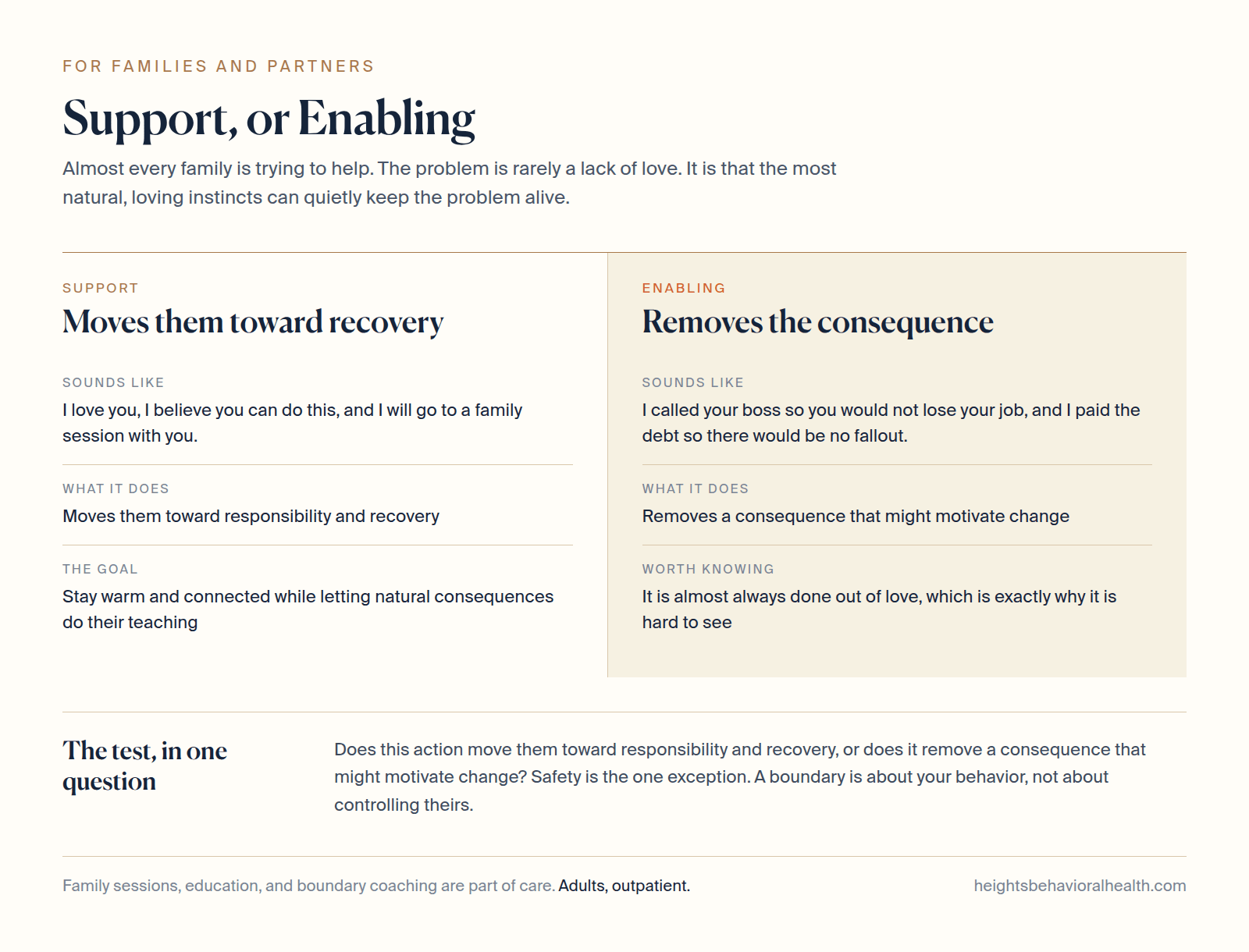
A boundary controls your behavior. A rule attempts to control theirs. “You have to stop using” is a rule you cannot enforce. “I will not lend money” is a boundary you can. The moment you set something that depends on their compliance, you have handed them control of whether you keep your word.
Examples That Are Actually Boundaries
- I will not give you money, and I will not co-sign anything
- I will not lie to your employer or your family about where you are
- I will leave the conversation when you are intoxicated, and come back when you are not
- I will not have substances in my house
- I will not drive you to places where I know you are using
- I will keep going to my own therapy whether or not you go to yours
Do Not Set One You Will Not Keep
This is the part that matters most. A boundary you walk back does not return things to neutral, it teaches that your limits are negotiable and that enough pressure moves them. It is better to set one small boundary you will absolutely hold than five ambitious ones you will not. Start with what you are certain about.
Boundaries Are Not Punishment
Set with anger, a boundary lands as a threat and produces defiance. Set calmly, it lands as information. The tone is not cosmetic; it determines whether the person hears a limit or a fight. You can love someone entirely and still not fund their use.
For Families and Loved Ones
Not sure where your limits should be?
A conversation with a clinician can help you find limits you can actually hold.
The Guilt Is Normal and Not Evidence
Holding a boundary with someone you love feels cruel, especially the first several times, and especially when they tell you it is. That feeling is not a signal that you are doing something wrong. Enabling feels like love and often functions as postponement: it removes the consequences that might otherwise prompt change. Our codependency and family roles article covers why this pattern is so hard to break.
What About Safety
If setting a boundary could put you or your children at risk of violence, that changes the plan and it should be made with support rather than alone. Talk to a clinician or a domestic violence advocate before proceeding. The National Domestic Violence Hotline is 1-800-799-7233.
What Boundaries Do and Do Not Accomplish
They will not make someone ready. Nothing you say or withhold can manufacture that. What they do is stop the situation from consuming you, remove the supports that let use continue without friction, and preserve a relationship that can still exist when readiness arrives. Our guide to talking to a loved one and consent-based intervention article cover the conversations themselves.
Get Your Own Support
Family members routinely spend years managing someone else and never get help of their own. That is its own problem and it is treatable. Our supporting a loved one article covers the support side, and our family programming includes a virtual group for loved ones.
If this is an emergency or you are thinking about harming yourself, call 911, or call or text 988 to reach the Suicide and Crisis Lifeline. In Harris County, The Harris Center operates a 24-hour crisis line at 713-970-7000. Heights Behavioral Health is an outpatient program and is not a 24-hour crisis service.
Frequently Asked Questions
What is the difference between a boundary and an ultimatum?
A boundary describes what you will do and does not depend on their agreement. An ultimatum demands they change and collapses if you do not follow through.
Is setting boundaries the same as giving up on them?
No. A boundary usually preserves the relationship by removing the parts of it that were unsustainable. Cutting off contact is a separate decision.
Do you take insurance?
We are private pay and out of network, and not in network with any plan. If you are calling about someone else, we will still explain pricing clearly so you can think it through before anyone commits. Superbills are available for plans with out-of-network benefits.
What if they get angry?
Anger is common, especially at first, and is not proof you chose wrong. What matters is whether you stated the limit calmly and whether you keep it.
What if I cannot keep the boundary I set?
Then set a smaller one. A boundary that gets walked back teaches that your limits move under pressure, which is worse than never setting it.
Do boundaries make someone get sober?
No. Nothing you do can create readiness. Boundaries protect you, stop enabling the pattern, and keep the relationship intact for when readiness comes.
Find Limits You Can Actually Hold
A confidential conversation about your situation, and support for you rather than only for them.
Sources
Written and Reviewed by Licensed Clinicians
Joni Ogle is a Licensed Clinical Social Worker (LCSW) and Certified Sex Addiction Therapist (CSAT) with over 37 years of clinical experience in mental health and addiction recovery, dual diagnosis treatment, behavioral addictions, and family intervention. She is the founder of Heights Behavioral Health and Heights Mentoring in Houston, Texas, where she leads a team of licensed clinicians.
Texas LCSW #37376 · Verify license
Deborah Darnell-Drake, LCSW-S, ACSW, LMFT is the Chief Clinical Officer at Heights Behavioral Health and a clinical reviewer. With more than five decades of experience in mental health and substance use disorder treatment, Deborah specializes in addiction, co-occurring mental health conditions, family dynamics, and behavioral addictions including gambling and technology addiction.
Texas LCSW-S #14508 · LMFT #1125 · Verify license
Start a Confidential Conversation
One confidential message connects you with our admissions team and a clear next step. Prefer to talk now? Call (877) 549-5102.