




Key Takeaways
- The holidays concentrate many recovery challenges into about six weeks, including alcohol at gatherings, old family dynamics, disrupted routine, financial pressure, and grief. The answer is to plan in November, not in the parking lot.
- A plan that holds includes deciding in advance how long you will stay, driving yourself, having two sentences ready for expected questions, eating beforehand, and scheduling a call with someone right afterward.
- When someone offers a drink, short answers work best, such as no thanks, I am driving, or not tonight. Anyone who pushes past a second refusal has revealed something about themselves, and you may walk away.
- For many people the hardest part is grief, such as an empty chair or a family that no longer speaks. Naming it out loud with someone works better than white-knuckling through the season.
- January is often where the actual risk sits, as structure ends and bills arrive. Keep appointments through the holidays, and if you are not yet in treatment, starting in November offers support during the hardest stretch.
The holidays concentrate everything that makes recovery hard into a six-week stretch: alcohol at every gathering, family dynamics that predate your recovery by decades, disrupted routine, financial pressure, grief that surfaces on schedule, and a cultural expectation that you will feel good about all of it.
This is not a reason to dread it. It is a reason to plan it, in November rather than in the parking lot outside the party.
Company Parties and Client Events
December is dense with work drinking in a way no other month is. Arrive with your own transportation, get a drink in your hand immediately so nobody offers you one, decide your departure time before you walk in, and give yourself permission to leave without explanation. Our returning to work article covers the professional side more fully.
Family, Which Is the Harder One
Family gatherings are not just drinking situations. They are the return of old roles: who you were at fifteen, the sibling comparison, the relative who brings up the worst year of your life at the table. Those patterns are older than your recovery and they will not have updated. Our family roles article explains why they are so durable.
A Plan That Actually Holds
- Decide in advance how long you are staying, and tell one person so it is real
- Drive yourself. Being dependent on someone else’s departure time removes your exit
- Have two sentences ready for the questions you know are coming
- Eat before you go, since hunger and fatigue lower everything
- Schedule a call with someone for immediately after, not just in case of emergency
- Plan the return: what you are doing the evening after, so there is no empty stretch
- Skip what you can genuinely skip. Attendance is not a moral obligation
What to Say When Someone Offers You a Drink
Short works better than honest-and-long. “No thanks, I am good.” “I am driving.” “Not tonight.” Most people accept the first answer and move on. Anyone who pushes past a second refusal has revealed something about themselves rather than about you, and you are permitted to walk away mid-sentence.
Confidential Next Step
Heading into the season without a plan?
It is worth building one in a session rather than improvising in the moment.
Grief Does Not Take December Off
For a lot of people the hardest part is not the alcohol; it is the empty chair, the first year without someone, or the family that no longer speaks. The traditions themselves are the trigger. That is worth naming out loud with someone rather than white-knuckling through it and being surprised by how bad the twenty-sixth feels.
The Stretch After New Year
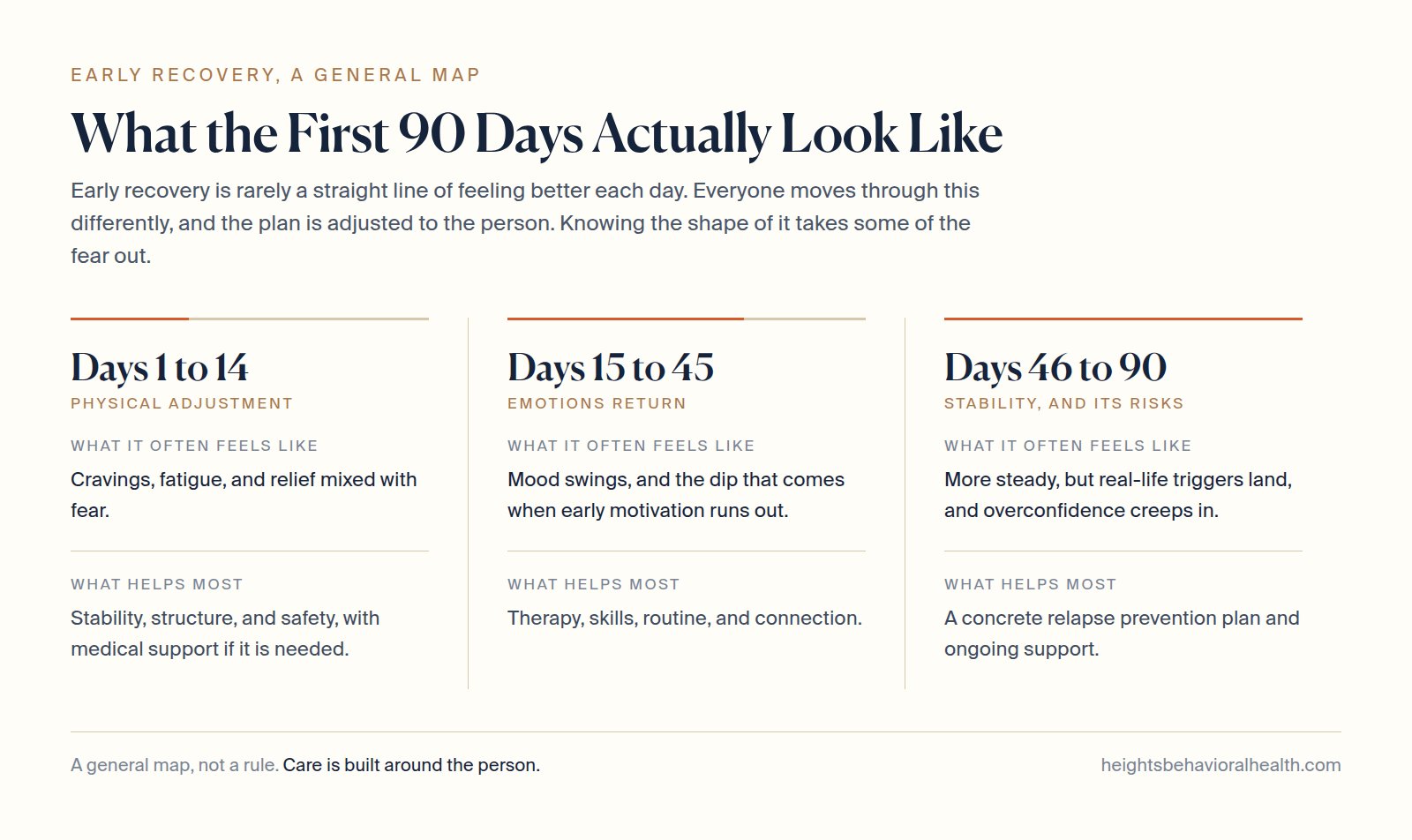
January is where the actual risk often sits. The structure ends, the goodwill ends, the bills arrive, and the daylight is still short. If you have been holding it together through the season, that is exactly when it can come apart. Keep your appointments through the holidays rather than pausing until things settle. See our relapse prevention and seasonal depression articles.
If You Are Not in Treatment Yet
A common plan is to wait until January so the holidays are not disrupted. That logic is understandable and it costs people the six weeks in which they are least equipped to manage on their own. Starting in November is not worse timing; it is support during the hardest part.
If this is an emergency or you are thinking about harming yourself, call 911, or call or text 988 to reach the Suicide and Crisis Lifeline. In Harris County, The Harris Center operates a 24-hour crisis line at 713-970-7000. Heights Behavioral Health is an outpatient program and is not a 24-hour crisis service.
Frequently Asked Questions
How do I handle a party where everyone is drinking?
Drive yourself, get a non-alcoholic drink in hand immediately, decide your departure time before arriving, and give yourself permission to leave without explaining.
What do I say when someone offers me a drink?
Something short. No thanks, I am good, or I am driving. Most people accept the first answer. Anyone pushing past a second refusal has told you about themselves.
Do you take insurance?
We are private pay and out of network, and not in network with any plan. If you are looking at support before or through the holidays, we will explain the cost of that support before it starts. A superbill is available if your plan has out-of-network benefits.
Do I have to attend every family event?
No. Attendance is not a moral obligation. Choosing not to go somewhere that would put your recovery at risk is a reasonable decision, not a failure of family loyalty.
Why is January harder than December?
The structure and social contact end, financial pressure arrives, and daylight is still short. People who hold it together through the season frequently struggle immediately after it.
Should I wait until January to start treatment?
Waiting means going through the hardest six weeks without support. Starting before the holidays is generally the better timing, not the worse one.
Build the Plan Before the Season Starts
A confidential conversation about the specific events you are dreading, and what to do about them.
Sources
Written and Reviewed by Licensed Clinicians
Joni Ogle is a Licensed Clinical Social Worker (LCSW) and Certified Sex Addiction Therapist (CSAT) with over 37 years of clinical experience in mental health and addiction recovery, dual diagnosis treatment, behavioral addictions, and family intervention. She is the founder of Heights Behavioral Health and Heights Mentoring in Houston, Texas, where she leads a team of licensed clinicians.
Texas LCSW #37376 · Verify license
Deborah Darnell-Drake, LCSW-S, ACSW, LMFT is the Chief Clinical Officer at Heights Behavioral Health and a clinical reviewer. With more than five decades of experience in mental health and substance use disorder treatment, Deborah specializes in addiction, co-occurring mental health conditions, family dynamics, and behavioral addictions including gambling and technology addiction.
Texas LCSW-S #14508 · LMFT #1125 · Verify license
Start a Confidential Conversation
One confidential message connects you with our admissions team and a clear next step. Prefer to talk now? Call (877) 549-5102.