


High-functioning addiction describes someone who maintains a successful career and outward stability while privately struggling with a substance or behavioral addiction. The success becomes camouflage, which often delays help until a crisis forces it. At Heights Behavioral Health in Houston, we treat professionals and executives discreetly through flexible outpatient care and our flagship Individualized Intensive Programming.
For accomplished people, addiction rarely looks like the stereotype. The bills are paid, the job is intact, the calendar is full. That is exactly the trap: as long as performance holds, everyone, including the person, can tell themselves nothing is wrong, while the private cost quietly grows.
Why Does Success Hide Addiction?
High achievers are often skilled at control, image management, and compartmentalizing, the same traits that let an addiction hide in plain sight. Several forces keep it hidden:
- Achievement reassures everyone that things are fine
- Fear that asking for help could threaten a career or reputation
- A high tolerance for stress that masks how much is being used to cope
- Resources that smooth over consequences others would face
- A culture where drinking, overwork, or stimulant use is normalized
What Are the Signs Beneath the Surface?
- Needing alcohol, stimulants, or another substance to perform or unwind
- Compartmentalizing, with a hidden private life behind a polished exterior
- Rising tolerance and private rules that keep getting broken
- Anxiety, insomnia, or low mood that the substance temporarily manages
- Relationships quietly eroding even as the career thrives
How Do We Treat High-Functioning Addiction?
Treatment is built to fit a demanding life, not to blow it up. After a confidential assessment, many professionals choose an intensive outpatient program with day or evening structure, supported by individual therapy and groups such as Identity and Growth, Shame Resilience, and skills work in CBT and DBT. Where overwork itself is part of the pattern, we address it directly, as covered in our work addiction guide.
Successful on the outside, struggling on the inside?
One confidential call with our Houston team can help you get support without upending your career.
How Private Is Treatment?
Discretion matters to professionals, and we take it seriously. Care is confidential within the limits of the law, and outpatient treatment lets you get real help while continuing to live and work. Out-of-network, private-pay care also means your treatment is not filed through an employer health plan, which many professionals value for privacy.
What Else Usually Needs Treating?
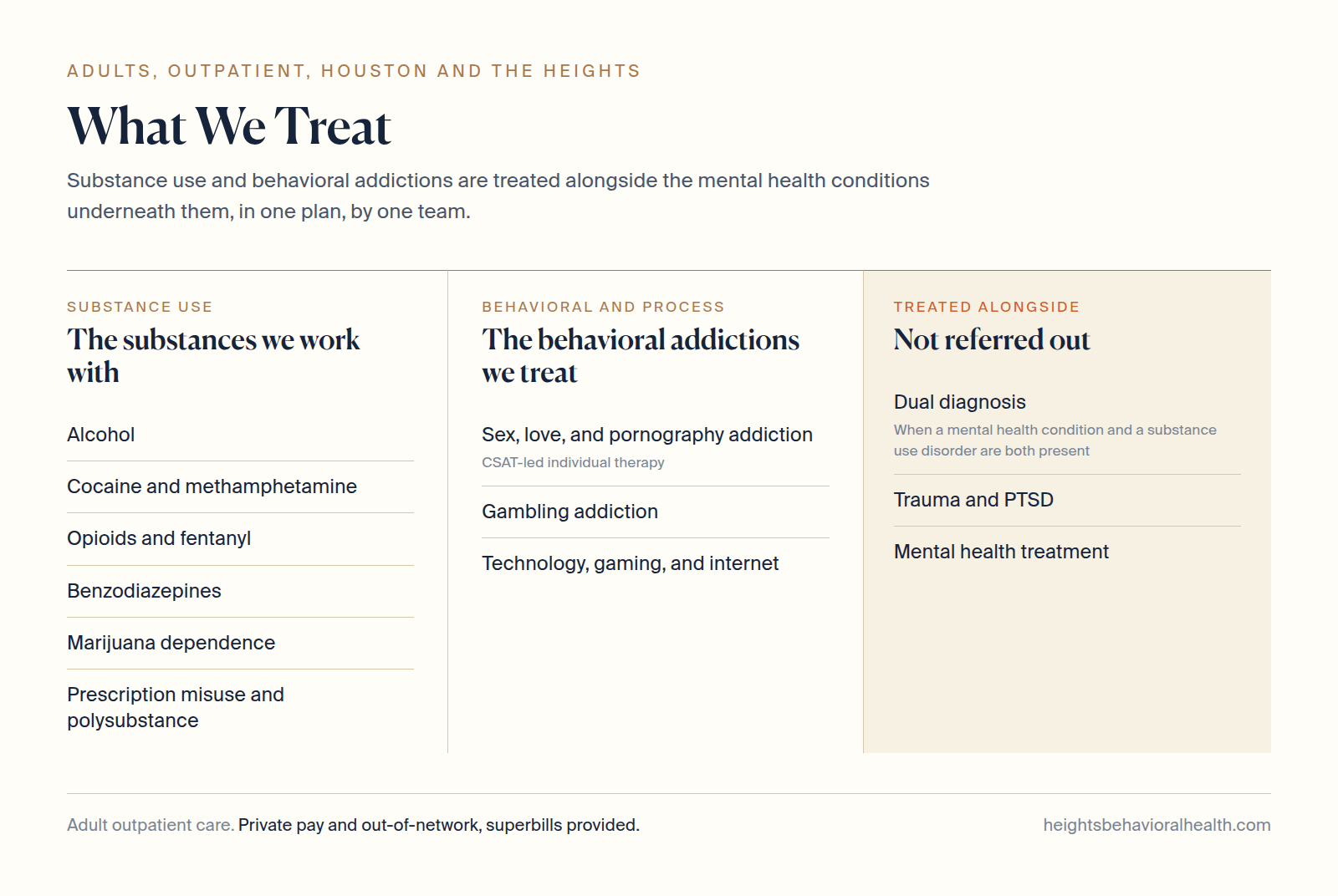
Anxiety, depression, and unresolved trauma are common drivers behind high-functioning addiction. Our dual diagnosis care treats those alongside the addiction, and our flagship Individualized Intensive Programming builds the plan around your life and schedule.
When Has a High-Functioning Pattern Outgrown Outpatient Care?
If there is acute medical or psychiatric risk, a higher level of care comes first, and we will help you find it. For non-clinical support, our sister practice Heights Mentoring may be a fit.
Heights Behavioral Health is a private-pay, out-of-network provider, and we are clear about pricing before you commit to anything. See how cost and out-of-network benefits work.
If this is an emergency or you are thinking about harming yourself, call 911, or call or text 988 to reach the Suicide and Crisis Lifeline. In Harris County, The Harris Center operates a 24-hour crisis line at 713-970-7000. Heights Behavioral Health is an outpatient program and is not a 24-hour crisis service.
Why This Looks Different in Houston
High-functioning addiction takes on the shape of the work around it, and Houston has a particular set of pressures. Energy and petrochemical careers run on long rotations, travel, and client entertaining where drinking is part of the job. The Texas Medical Center runs on punishing hours, high stakes, and, for some roles, easy access to medication. Law and finance reward the person who never appears to need rest. In each of these worlds, functioning at a high level is the very thing that keeps the problem invisible.
It also shapes what treatment has to accommodate. Evening and virtual options exist precisely because a rotation schedule, a call week, or a trial calendar cannot simply be cancelled.
A composite example. This is an illustrative composite, not a real client, and no identifying details belong to any individual. A 44-year-old professional drinks most nights to come down from the day. He has never missed a deadline, so no one has ever raised it. A routine physical flags his liver enzymes. He starts an evening program, keeps working throughout, and treats the anxiety that the drinking had been managing for years.
Frequently Asked Questions
Can you be addicted and still successful at work?
Yes. Many people maintain careers and outward stability while privately struggling, which is what high-functioning addiction means. Functioning does not mean there is no problem, and the private cost usually grows over time.
Will treatment force me to take leave from work?
Not necessarily. Many professionals use intensive outpatient care with day or evening options that fit around work. The aim is to get you help without upending your life.
Do you take insurance?
We are private pay and out of network, so we are not contracted with insurance plans. For many professionals the privacy matters as much as the flexibility, since care is not filed through an in-network claim. Pricing is agreed before you start, and superbills are available for out-of-network benefits.
Is treatment confidential?
Yes, within the limits of the law. Private-pay, out-of-network care also means treatment is not filed through an employer health plan, which many professionals value for privacy.
What if overwork is part of my problem?
That is common, and we treat it directly. High-functioning addiction and work addiction often overlap, and both can be addressed together.
Help That Fits Your Life
You can get real support without sacrificing your career or your privacy. One confidential call is the first step.
Sources
Start a Confidential Conversation
One confidential message connects you with our admissions team and a clear next step. Prefer to talk now? Call (877) 549-5102.