




Key Takeaways
- PTSD usually follows a discrete event, while Complex PTSD follows prolonged, repeated trauma, often beginning in childhood and often involving someone the person could not get away from.
- Both share intrusive memories, avoidance, a persistent sense of threat, and hyperarousal. Complex PTSD adds difficulty regulating emotion, a deeply negative sense of self, chronic relationship difficulty, and dissociation.
- The WHO ICD-11 recognizes Complex PTSD as a distinct diagnosis, but the DSM-5 does not list it separately, so it is often misdiagnosed as borderline personality disorder, treatment-resistant depression, or generalized anxiety.
- Substance use is common because substances quiet a nervous system stuck in threat. Treating substance use without the trauma tends to fail, and processing trauma without stabilizing substance use tends to overwhelm.
- Treatment for complex trauma begins with a longer phase of safety, stabilization, and emotion regulation skills before any processing. Rushing that step is the most common way trauma treatment goes wrong.
PTSD is usually understood as the aftermath of a discrete event: a crash, an assault, a deployment. Complex PTSD describes what happens after prolonged, repeated trauma, often beginning in childhood and often involving someone the person could not get away from. The symptoms overlap, but the shape of the injury is different, and so is the treatment.
The distinction is not academic. People with complex trauma are frequently treated for years for depression, anxiety, or a personality disorder without anyone naming what actually happened.
What They Share
Both involve the core PTSD cluster: intrusive memories or flashbacks, avoidance of reminders, a persistent sense of threat, and hyperarousal such as startle response, disrupted sleep, and difficulty concentrating.
What Complex PTSD Adds
| PTSD | Complex PTSD | |
|---|---|---|
| Intrusive memories, avoidance, hyperarousal | Core feature | Core feature |
| Regulating emotion | Not a defining feature | Persistent difficulty, including intense reactions that take a long time to settle |
| Sense of self | Not a defining feature | Deeply negative: worthlessness, shame, feeling permanently damaged |
| Relationships | Not a defining feature | Chronic difficulty, including trouble with closeness and trust |
| Dissociation | Not a defining feature | Losing time, or feeling detached from your own body |
| How it is experienced | Something that happened to you | A sense that this is simply who you are |
| Diagnostic status | Listed in both the DSM-5 and the ICD-11 | Recognized as a distinct diagnosis by the WHO ICD-11, not listed separately in the DSM-5 |
| Where treatment starts | Processing can often begin relatively early | A longer first phase of safety, stabilization, and emotion regulation skills before any processing |
The WHO ICD-11 recognizes Complex PTSD as a distinct diagnosis. The DSM-5 does not list it separately, which is part of why it is missed so often in the United States.
Why It Gets Misdiagnosed
The emotional intensity and relationship difficulties of complex trauma can look like borderline personality disorder; the flatness and self-loathing can look like treatment-resistant depression; the vigilance can look like generalized anxiety. Each of those diagnoses leads somewhere different. Treatment that does not account for the trauma history often stalls, which the person then experiences as further evidence that they are the problem.
Trauma-Informed Care
Been in treatment before and it did not hold?
A trauma-informed assessment can tell you whether something was being missed.
Why Substance Use Is So Common Here
Alcohol, benzodiazepines, cannabis, and stimulants all do something useful for a nervous system stuck in threat: they quiet it, or they make it possible to function. That is not weakness, it is effective short-term regulation with a long-term cost. Treating the substance use without the trauma tends to fail, and processing trauma without stabilizing the substance use tends to overwhelm. Our trauma and addiction and dual diagnosis articles cover the sequencing.
How Treatment Differs
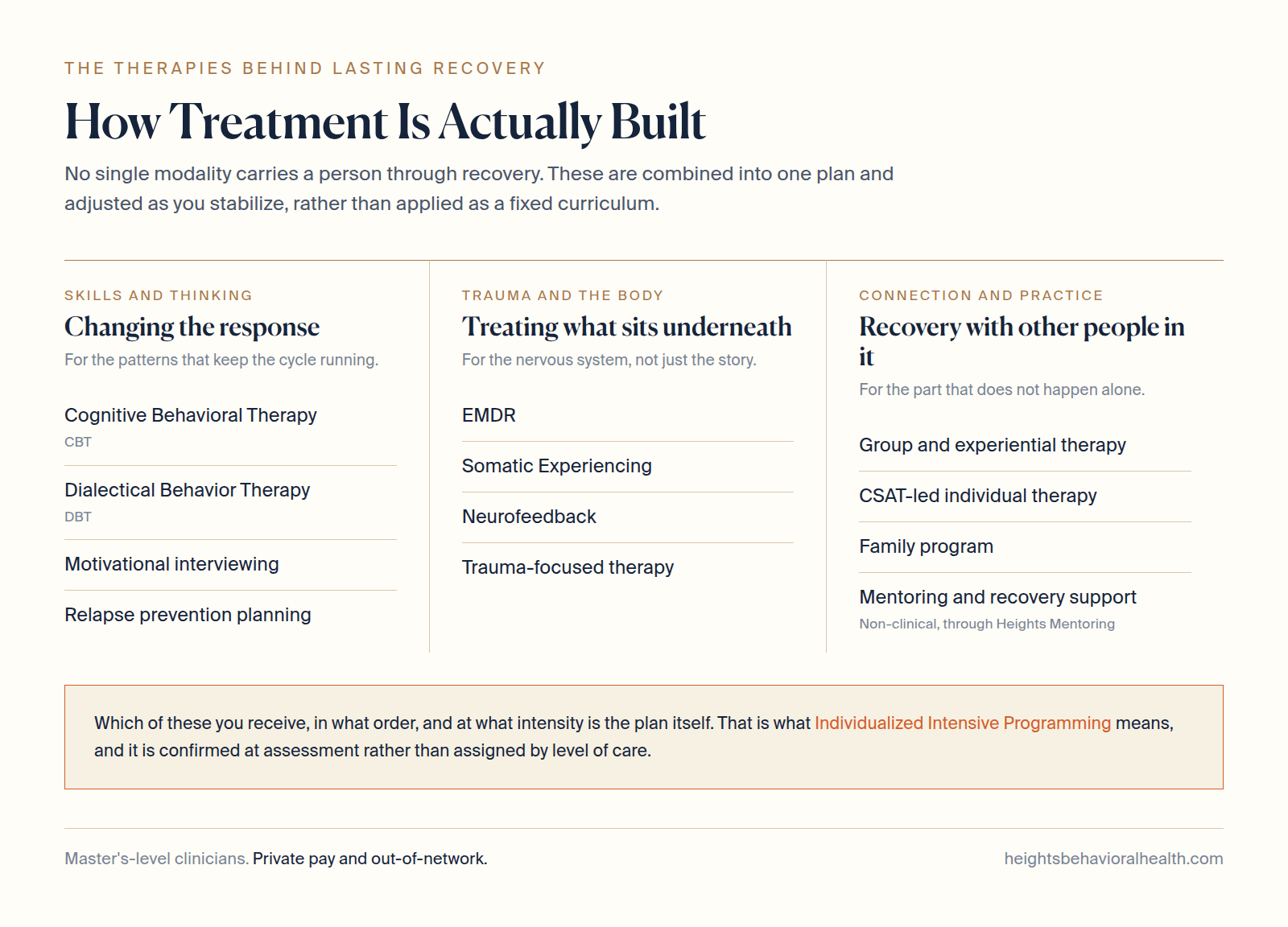
With single-incident PTSD, trauma processing can often begin relatively early. With complex trauma, the first phase is longer and focuses on safety, stabilization, and skills for regulating emotion before any processing starts. Rushing that step is the most common way trauma treatment goes wrong. Our clinicians are trained in EMDR, CPT, and Somatic Experiencing, with neurofeedback available as a supportive tool, and no one is required to narrate details before they are ready. See our trauma therapy article and our PTSD treatment overview.
If this is an emergency or you are thinking about harming yourself, call 911, or call or text 988 to reach the Suicide and Crisis Lifeline. In Harris County, The Harris Center operates a 24-hour crisis line at 713-970-7000. Heights Behavioral Health is an outpatient program and is not a 24-hour crisis service.
Wondering what evidence-based treatment actually involves? Our session-by-session walkthrough of cognitive processing therapy shows the full arc.
Frequently Asked Questions
Is complex PTSD an official diagnosis?
It is recognized in the WHO ICD-11 as a distinct condition. The DSM-5 used in the United States does not list it separately, though the symptom pattern is well described in the clinical literature.
Can you have PTSD and complex PTSD?
The distinction is about the pattern of trauma and the resulting symptoms rather than two separate illnesses. Many people have both a discrete traumatic event and a history of prolonged trauma, and treatment accounts for both.
Do you take insurance?
We are private pay and out of network, and not contracted with insurance plans. Complex trauma work takes a longer first phase, so we explain what that course of care costs before you commit rather than session by session. Superbills are available if your plan has out-of-network benefits.
Is complex PTSD the same as borderline personality disorder?
No, though they can look similar and can co-occur. Complex PTSD is organized around a trauma history and typically responds to phased trauma treatment. Getting the distinction right changes the treatment plan substantially.
Do I have to talk about what happened?
No. The first phase of trauma treatment is safety and stabilization, and no one is required to narrate details before they are ready. Some approaches, including EMDR and somatic work, require far less verbal recounting than people expect.
Can complex PTSD be treated in outpatient care?
Often yes, particularly with stable housing and no active withdrawal risk. Our outpatient levels of care are designed for it, and we will tell you if a higher level of care is the safer starting point.
Trauma Treatment That Does Not Rush You
A confidential assessment with clinicians trained in EMDR, CPT, and somatic approaches.
Sources
Written and Reviewed by Licensed Clinicians
Joni Ogle is a Licensed Clinical Social Worker (LCSW) and Certified Sex Addiction Therapist (CSAT) with over 37 years of clinical experience in mental health and addiction recovery, dual diagnosis treatment, behavioral addictions, and family intervention. She is the founder of Heights Behavioral Health and Heights Mentoring in Houston, Texas, where she leads a team of licensed clinicians.
Texas LCSW #37376 · Verify license
Deborah Darnell-Drake, LCSW-S, ACSW, LMFT is the Chief Clinical Officer at Heights Behavioral Health and a clinical reviewer. With more than five decades of experience in mental health and substance use disorder treatment, Deborah specializes in addiction, co-occurring mental health conditions, family dynamics, and behavioral addictions including gambling and technology addiction.
Texas LCSW-S #14508 · LMFT #1125 · Verify license
Start a Confidential Conversation
One confidential message connects you with our admissions team and a clear next step. Prefer to talk now? Call (877) 549-5102.