




Key Takeaways
- Growing up with a parent who drank or used teaches adaptive skills, like reading a room and keeping your needs small, that kept a child safe but often continue running adult relationships.
- Common later patterns include hypervigilance, difficulty knowing what you want, over-responsibility for others’ moods, conflict avoidance, discomfort accepting care, and attraction to relationships that feel familiar rather than safe.
- Some adult children develop their own substance use while others avoid alcohol entirely, yet both can carry the same relational patterns. Many arrive in treatment for anxiety, depression, or a relationship crisis.
- A childhood organized around a parent’s use is prolonged, repeated stress associated with complex trauma, which changes the pacing of treatment. Effective work combines trauma processing, such as EMDR, CPT, or Somatic Experiencing, with relational skills.
- Your own recovery is not contingent on your parent’s recovery. You are allowed to work on yourself whether or not they ever stop drinking, and waiting for them can delay your own care.
Growing up around a parent who drank or used teaches a set of skills. You learn to read a room before you enter it, to keep your needs small, to manage other people so the house stays calm. Those skills were adaptive. They kept a child safe. The difficulty is that they do not switch off in adulthood, and the same vigilance that protected you at nine can quietly run your marriage at thirty-nine.
This is not about blaming parents. It is about naming what a nervous system learned, and what can be unlearned.
Patterns That Show Up Later
- Hypervigilance: scanning faces and tone for signs that something is about to go wrong
- Difficulty identifying what you want, because attention was always aimed outward
- Guessing at what normal is, and assuming everyone else received a manual you missed
- Over-responsibility, including feeling accountable for other people’s moods
- Conflict avoidance, or the opposite, reacting explosively when avoidance finally fails
- Difficulty accepting care, and discomfort when someone is simply kind to you
- Attraction to relationships that feel familiar rather than safe
Why Some Adult Children Drink and Others Never Touch It
Both outcomes are common, and both are responses to the same history. Some people develop their own substance use, sometimes decades later. Others take a hard line against alcohol and still carry every relational pattern intact. The absence of drinking does not mean the absence of injury, which is why so many adult children arrive in treatment for anxiety, depression, or a relationship crisis rather than for substance use.
For Families and Loved Ones
Recognize yourself in this?
A confidential assessment can tell you what is worth working on and where to start.
The Trauma Underneath
Growing up in a home organized around a parent’s use is a prolonged, repeated stress that a child cannot escape, which is the profile associated with complex trauma rather than single-incident PTSD. That framing matters clinically because it changes the pacing of treatment. See our complex PTSD article.
What Treatment Actually Works On
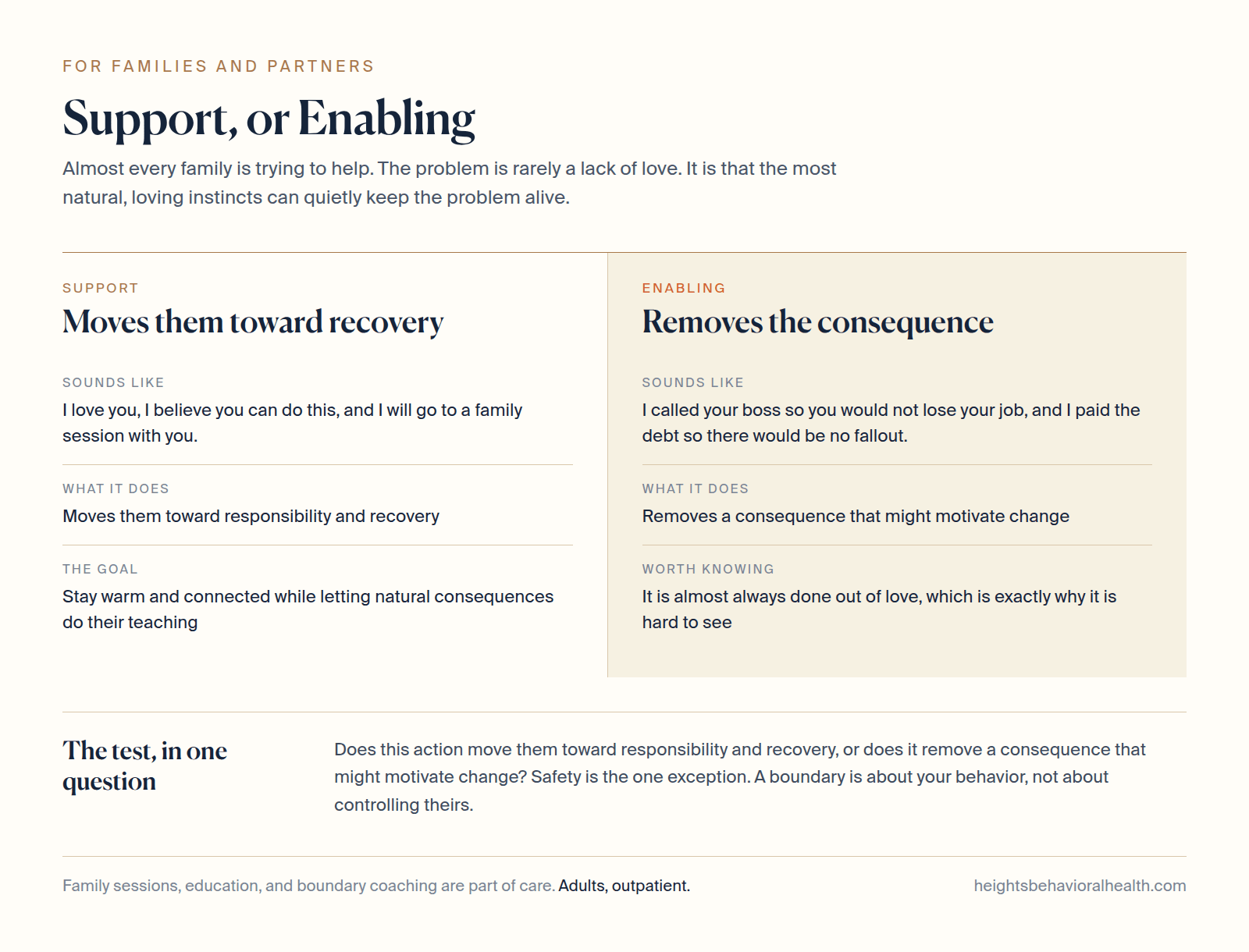
Insight alone rarely changes these patterns, because they are held in the body as much as in belief. Effective work combines trauma processing when the person is ready, using EMDR, CPT, or Somatic Experiencing, with concrete relational skills: naming a need, tolerating someone else’s displeasure, distinguishing your feelings from theirs. Our codependency and family roles article covers the relational side, and our group programming includes healthy relationships and shame resilience work where these patterns become visible in real time.
If Your Parent Is Still Drinking
You are allowed to work on yourself whether or not they ever stop. Recovery for you is not contingent on their recovery, and waiting for it is one of the more painful ways adult children delay their own care. If you do want to have a conversation with them, our guide to talking to a loved one is a reasonable starting point.
If this is an emergency or you are thinking about harming yourself, call 911, or call or text 988 to reach the Suicide and Crisis Lifeline. In Harris County, The Harris Center operates a 24-hour crisis line at 713-970-7000. Heights Behavioral Health is an outpatient program and is not a 24-hour crisis service.
Frequently Asked Questions
Is adult child of an alcoholic a diagnosis?
No. It is a descriptive term for a shared set of patterns, not a clinical diagnosis. What is diagnosable is what often accompanies it: anxiety, depression, complex trauma symptoms, or a substance use disorder.
Do I need to have a substance problem to get help?
No. Many adult children never develop one and still carry significant relational and trauma-related difficulties. We treat mental health conditions as well as substance use.
Do you take insurance?
We are private pay and out of network, so we are not contracted with insurance plans. Adult children of alcoholics often spent years managing everyone else’s crises, so we are direct about ours: pricing is explained and agreed before anything starts. If your plan has out-of-network benefits, we provide a superbill you can submit.
Am I destined to become an alcoholic?
No. Family history raises risk, it does not determine outcome. Knowing your risk, and addressing the underlying trauma, meaningfully changes the odds.
Should I confront my parent?
That is your decision, and it is not required for your own healing. If you choose to, planning the conversation with a clinician first tends to produce a better outcome than an unplanned confrontation.
Is this treated in outpatient care?
Yes. This work fits well in outpatient therapy and group programming, and we will tell you if a higher level of care is a better starting point.
Unlearn What the House Taught You
A confidential assessment with clinicians trained in trauma and family systems work.
Sources
- Substance Abuse and Mental Health Services Administration (SAMHSA). Children Living with Parents Who Have a Substance Use Disorder.
- Centers for Disease Control and Prevention (CDC). Adverse Childhood Experiences (ACEs).
- National Institute on Alcohol Abuse and Alcoholism (NIAAA). Alcohol Use Disorder.
Written and Reviewed by Licensed Clinicians
Joni Ogle is a Licensed Clinical Social Worker (LCSW) and Certified Sex Addiction Therapist (CSAT) with over 37 years of clinical experience in mental health and addiction recovery, dual diagnosis treatment, behavioral addictions, and family intervention. She is the founder of Heights Behavioral Health and Heights Mentoring in Houston, Texas, where she leads a team of licensed clinicians.
Texas LCSW #37376 · Verify license
Deborah Darnell-Drake, LCSW-S, ACSW, LMFT is the Chief Clinical Officer at Heights Behavioral Health and a clinical reviewer. With more than five decades of experience in mental health and substance use disorder treatment, Deborah specializes in addiction, co-occurring mental health conditions, family dynamics, and behavioral addictions including gambling and technology addiction.
Texas LCSW-S #14508 · LMFT #1125 · Verify license
Start a Confidential Conversation
One confidential message connects you with our admissions team and a clear next step. Prefer to talk now? Call (877) 549-5102.