




Key Takeaways
- Eating disorders and substance use co-occur far more often than treatment usually reflects. When only one is addressed and the other is never named, the untreated condition tends to expand into the space cleared.
- The two interact in specific ways, such as stimulants used for appetite suppression, alcohol used to numb shame after a binge, and restriction that intensifies the effect of any substance on an underfed body.
- Sequential treatment usually fails because both conditions are often doing the same emotional job. Coordinated care that names both from the start produces better results than treating one and then the other.
- Eating disorders carry the highest mortality of any psychiatric condition, and body size does not indicate severity. Someone who is medically unstable needs medical or specialized eating disorder care before any outpatient behavioral program.
- For someone medically stable whose eating disorder is managed or in remission and whose substance use is pressing, an Individualized Intensive Program or IOP can be a reasonable fit, with trauma work where needed.
Eating disorders and substance use disorders co-occur far more often than either is treated as if they do. Stimulants suppress appetite. Alcohol is used to manage the distress after a binge, or to make eating socially possible, or to blunt the self-loathing that follows either. When a person is treated for one and the other is never named, the untreated condition tends to expand into the space that was cleared.
This article is about how they interact and how to think about level of care. It is not a substitute for an evaluation.
How the Two Interact
- Stimulants, including prescribed ones, used for appetite suppression rather than focus
- Alcohol used to numb the shame after a binge, or to lower inhibition before eating
- Restriction that intensifies the effect of any substance on an underfed body
- Compensatory behaviors and substance use both functioning as ways to discharge unbearable feeling
- Cannabis used to force appetite, which can escalate into its own dependence
Why Sequential Treatment Usually Fails
The standard experience is being told to address one first. In practice, both are usually doing the same emotional job, so removing one leaves the job open. Coordinated care that names both from the start produces better results than a queue, which is the same principle behind our dual diagnosis approach and the reason cross-addiction is so common in early recovery.
Medical Safety Comes First, and It Is Not Negotiable
Eating disorders carry the highest mortality of any psychiatric condition, and the danger is often invisible from the outside. Body size does not indicate severity. Electrolyte disturbance, cardiac complications, and refeeding risk require medical assessment, and someone who is medically unstable needs medical or specialized eating disorder care before any outpatient behavioral program, including ours.
Integrated Dual Diagnosis Care
Not sure which problem to treat first?
One confidential call. If specialized eating disorder care needs to come first, we will tell you and help you find it.
Being Honest About Our Scope
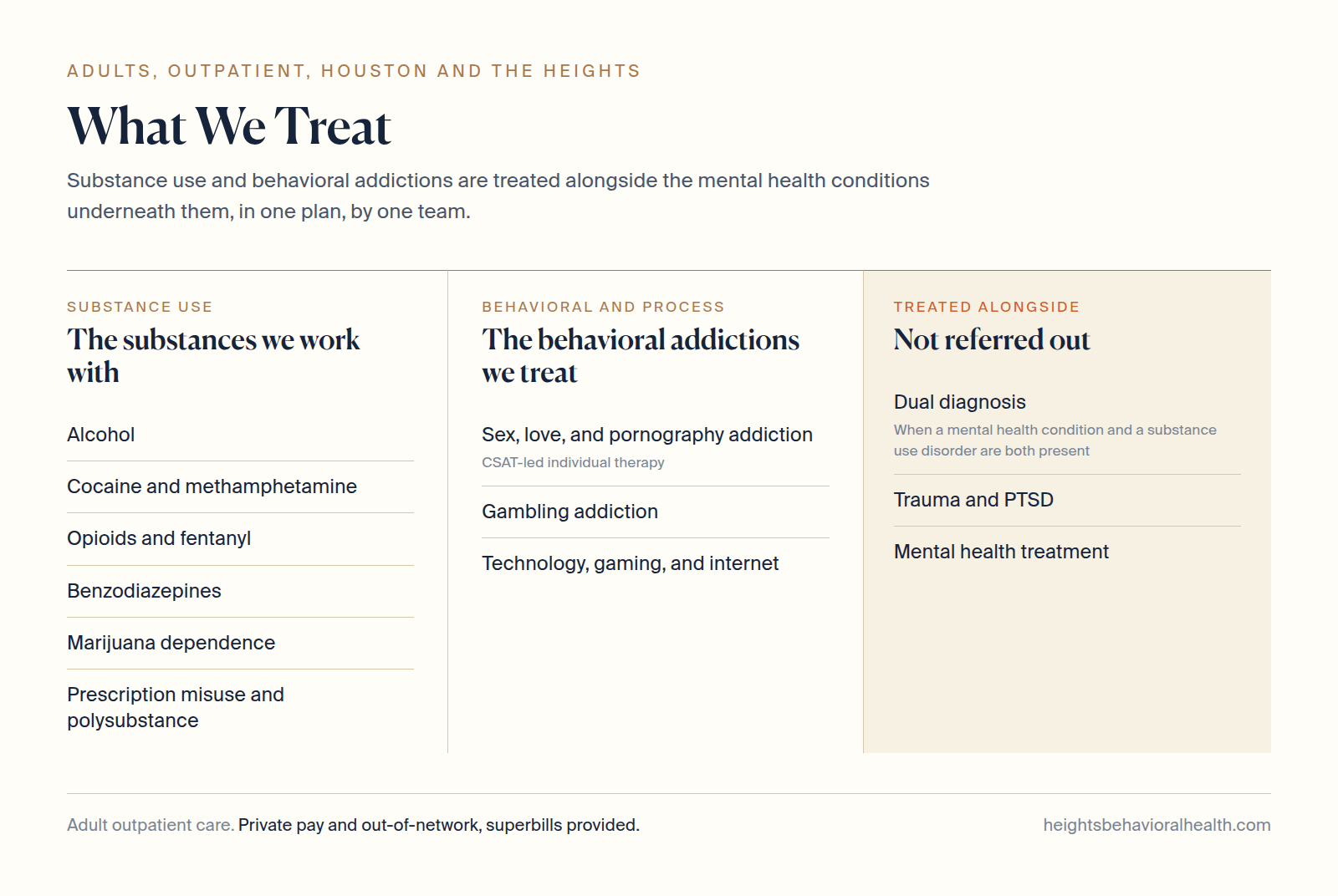
We are an adult outpatient behavioral health program. We treat substance use, mood and anxiety disorders, trauma, and process addictions, and our clinicians work with the emotional patterns that drive disordered eating: shame, control, perfectionism, and body-based distress. We are not a specialized eating disorder treatment program, and we do not provide medical monitoring, refeeding, or supervised meal support. When those are needed, the right move is a program built for them, sometimes alongside us and sometimes before us.
Where We Do Help
For someone who is medically stable, whose eating disorder is being managed or is in remission, and whose substance use is the pressing problem, our Individualized Intensive Program and IOP are a reasonable fit, with individual work in EMDR, CPT, or Somatic Experiencing where trauma is part of the picture. See our overview of process and behavioral addictions for the related but distinct pattern.
If this is an emergency or you are thinking about harming yourself, call 911, or call or text 988 to reach the Suicide and Crisis Lifeline. In Harris County, The Harris Center operates a 24-hour crisis line at 713-970-7000. Heights Behavioral Health is an outpatient program and is not a 24-hour crisis service.
Frequently Asked Questions
How common is it to have both?
Co-occurrence is well documented and substantially higher than chance in both directions. Many people in substance use treatment have unrecognized disordered eating, and the reverse is also true.
Which should I treat first?
That is a medical question before it is a preference. If there is medical instability, eating disorder care comes first. If both are stable enough for outpatient care, treating them together generally works better than in sequence.
Do you take insurance?
We are private pay and out of network, so we are not contracted with insurance plans. When two conditions are treated together, you still get one plan and one price, explained before you commit. Superbills are available if your plan has out-of-network benefits.
Can you tell if someone has an eating disorder by looking at them?
No. Body size does not indicate whether someone has an eating disorder or how severe it is. Serious medical risk is frequently present in people who look unremarkable.
Do you treat eating disorders?
We are not a specialized eating disorder program and do not provide medical monitoring, refeeding, or meal support. We treat co-occurring substance use, mood, trauma, and the emotional drivers, and coordinate with eating disorder specialists.
Where can I get eating disorder support?
The National Alliance for Eating Disorders operates a clinician-staffed helpline at 1-866-662-1235. If there is a medical emergency, call 911.
Get an Honest Read on What You Need
One confidential call. We will tell you if another program is the right starting point.
Sources
Written and Reviewed by Licensed Clinicians
Joni Ogle is a Licensed Clinical Social Worker (LCSW) and Certified Sex Addiction Therapist (CSAT) with over 37 years of clinical experience in mental health and addiction recovery, dual diagnosis treatment, behavioral addictions, and family intervention. She is the founder of Heights Behavioral Health and Heights Mentoring in Houston, Texas, where she leads a team of licensed clinicians.
Texas LCSW #37376 · Verify license
Deborah Darnell-Drake, LCSW-S, ACSW, LMFT is the Chief Clinical Officer at Heights Behavioral Health and a clinical reviewer. With more than five decades of experience in mental health and substance use disorder treatment, Deborah specializes in addiction, co-occurring mental health conditions, family dynamics, and behavioral addictions including gambling and technology addiction.
Texas LCSW-S #14508 · LMFT #1125 · Verify license
Start a Confidential Conversation
One confidential message connects you with our admissions team and a clear next step. Prefer to talk now? Call (877) 549-5102.