




Key Takeaways
- The first therapy session is mostly assessment, a conversation about what brought you in, your history, and what you want to be different. You are also assessing the clinician, which is expected.
- A typical session of around fifty minutes includes a check-in, focused work on a skill or pattern, sometimes a grounding exercise, and a few minutes on what to carry into the week.
- You never have to discuss your childhood unless it is relevant, describe trauma in detail, cry, or agree with your therapist. Saying something did not land is useful clinical information.
- What you say stays with your treatment team, with narrow legal exceptions for imminent risk of harm and suspected abuse. Substance use treatment carries additional federal protections under 42 CFR Part 2.
- Fit between client and clinician predicts outcome more than almost anything else. Three or four sessions is usually enough to tell whether the fit is workable, so say so if it is not.
People delay therapy partly because they have no idea what it involves. The cultural image is a couch, a silent figure taking notes, and an expectation that you will produce something profound about your mother. The reality is more structured, more collaborative, and considerably less mysterious.
The First Session Is Mostly Assessment
It is a conversation, not a test. Your clinician will ask what brought you in, what has been happening and for how long, what you have tried, your history with substances and mental health, medical background, and what you want to be different. Toward the end you will agree on what you are working on. You are also assessing them, which is legitimate and expected.
What a Typical Session Looks Like
- A brief check-in on the week and anything that came up since last time
- Following whatever is most alive, or returning to the thread from last session
- Actual work: a skill, a pattern examined, a difficult conversation prepared or processed
- Sometimes something experiential, like a grounding or somatic exercise
- A few minutes at the end on what to carry into the week
Sessions are typically around fifty minutes. Not every one produces a breakthrough. Progress is usually cumulative and only visible looking backward.
What You Are Never Required to Do
You do not have to talk about your childhood unless it is relevant to what you came for. You do not have to describe traumatic events in detail; several evidence-based approaches, including EMDR and Somatic Experiencing, deliberately require far less verbal recounting than people expect. You do not have to cry, and you do not have to agree with your therapist. Saying “that did not land for me” is useful clinical information, not rudeness.
What Modality Actually Means
You may hear CBT, DBT, EMDR, CPT, ACT, or Somatic Experiencing. In practice, most clinicians integrate several based on what you need. CBT works on thoughts and behavior patterns, DBT on tolerating intense emotion, EMDR and CPT on trauma, somatic approaches on what the nervous system holds. Our DBT and EMDR and somatic therapy articles go deeper.
Confidential Next Step
Wondering whether it would help?
A confidential assessment will tell you what we would actually work on.
Confidentiality, and Its Limits
What you say stays between you and your treatment team, with narrow legal exceptions: imminent risk of harm to yourself or someone else, and suspected abuse of a child or vulnerable adult. If you are in treatment for substance use, additional federal protections under 42 CFR Part 2 apply, which are stricter than HIPAA. Your therapist will explain all of it at the start.
How It Fits With Group
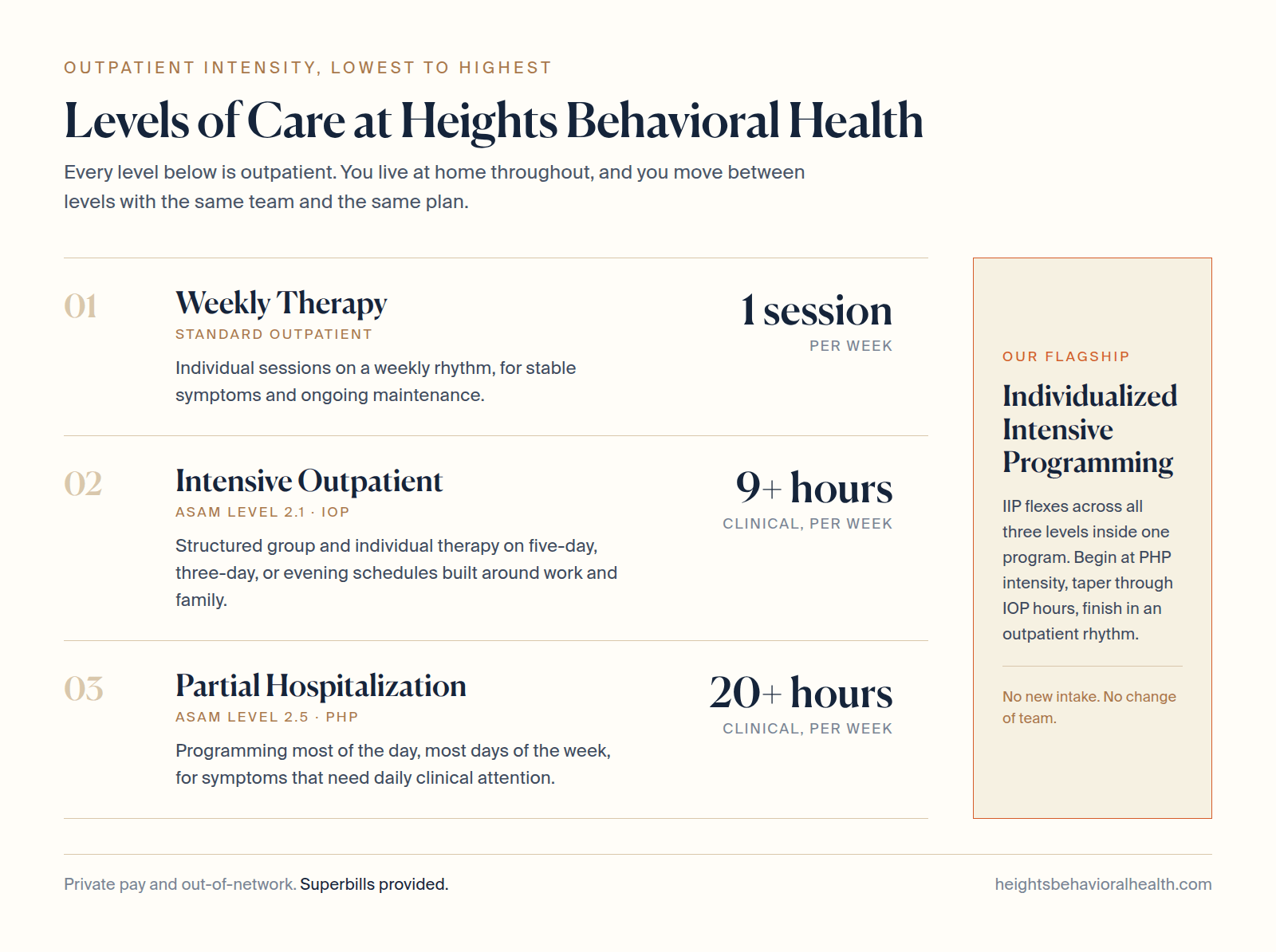
In our programs individual therapy runs alongside group work, and they do different jobs. Individual is where the specific material goes, group is where patterns show up in real time with other people. Neither substitutes for the other. See our group therapy article and Individualized Intensive Program.
If It Is Not Working
Say so. Fit between client and clinician predicts outcome more than almost anything else, and a good therapist would rather adjust or refer than have you quietly stop attending. Three or four sessions is usually enough to tell whether the fit is workable.
If this is an emergency or you are thinking about harming yourself, call 911, or call or text 988 to reach the Suicide and Crisis Lifeline. In Harris County, The Harris Center operates a 24-hour crisis line at 713-970-7000. Heights Behavioral Health is an outpatient program and is not a 24-hour crisis service.
For an example of how structured a course of individual therapy can be, see our session-by-session walkthrough of cognitive processing therapy.
Frequently Asked Questions
How long is an individual therapy session?
Typically around fifty minutes, with frequency depending on your level of care and clinical need.
Do I have to talk about my childhood?
No. Childhood comes up when it is relevant to what you came for, and not otherwise. Nobody will require it in the first session.
Do you take insurance?
We are private pay and out of network, and not contracted with insurance plans. You will know what a session and a course of care cost before the first one. Some clients use out-of-network benefits to offset part of it, and we provide the superbill.
What if I do not know what to say?
That is common and it is your therapist’s job, not yours, to help. Sessions are guided rather than left to you to fill.
Is what I say confidential?
Yes, with narrow legal exceptions for imminent risk of harm and suspected abuse of a child or vulnerable adult. Substance use records carry additional federal protections stricter than HIPAA.
What if I do not like my therapist?
Say so. Fit is one of the strongest predictors of outcome, and adjusting the approach or changing clinicians is a normal request rather than an insult.
See What You Would Actually Work On
A confidential assessment, with a straight answer about whether we are the right fit.
Sources
Written and Reviewed by Licensed Clinicians
Joni Ogle is a Licensed Clinical Social Worker (LCSW) and Certified Sex Addiction Therapist (CSAT) with over 37 years of clinical experience in mental health and addiction recovery, dual diagnosis treatment, behavioral addictions, and family intervention. She is the founder of Heights Behavioral Health and Heights Mentoring in Houston, Texas, where she leads a team of licensed clinicians.
Texas LCSW #37376 · Verify license
Deborah Darnell-Drake, LCSW-S, ACSW, LMFT is the Chief Clinical Officer at Heights Behavioral Health and a clinical reviewer. With more than five decades of experience in mental health and substance use disorder treatment, Deborah specializes in addiction, co-occurring mental health conditions, family dynamics, and behavioral addictions including gambling and technology addiction.
Texas LCSW-S #14508 · LMFT #1125 · Verify license
Start a Confidential Conversation
One confidential message connects you with our admissions team and a clear next step. Prefer to talk now? Call (877) 549-5102.